Home
Class 11
PHYSICS
A ball is dropped vertically from a heig...

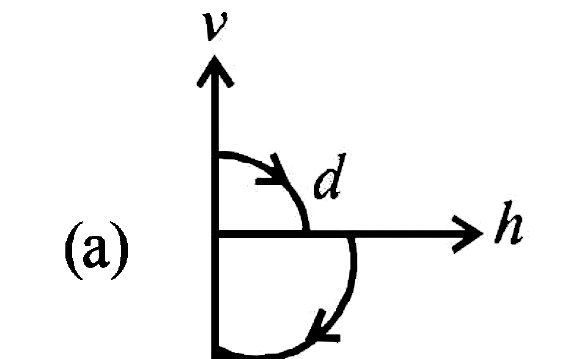
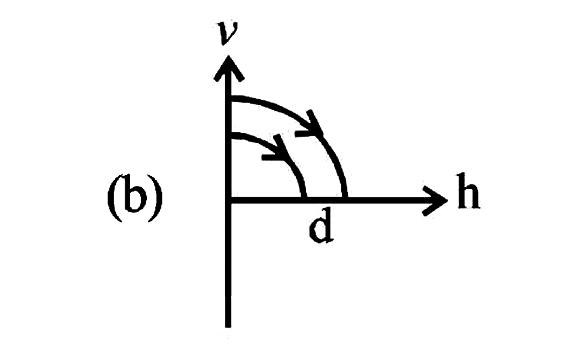
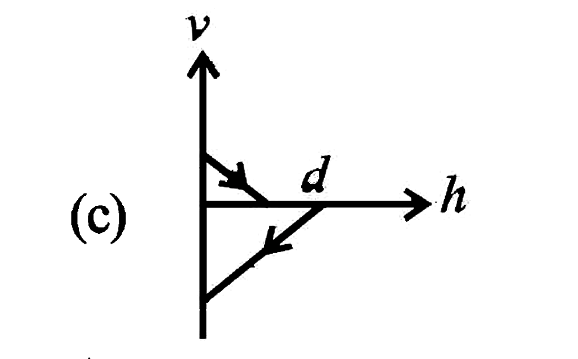
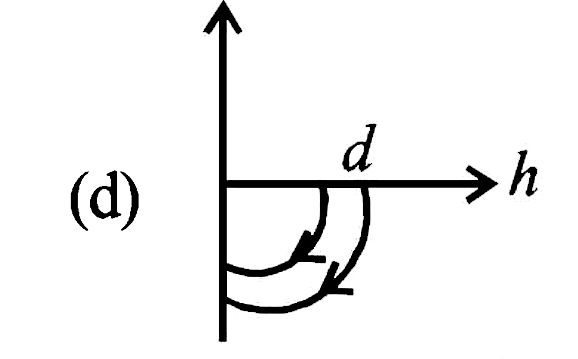
A ball is dropped vertically from `a` height `d` above the ground . It hits the ground and bounces up vertically to a height ` (d)//(2). Neglecting subsequent motion and air resistance , its velocity `v` varies with the height `h` above the ground as

A

B

C

D

Text Solution

AI Generated Solution

The correct Answer is:

To solve the problem of how the velocity \( v \) of a ball varies with the height \( h \) above the ground after being dropped from a height \( d \) and bouncing back to a height of \( \frac{d}{2} \), we can follow these steps: ### Step 1: Analyze the motion of the ball when dropped When the ball is dropped from height \( d \), it starts from rest, so its initial velocity \( u = 0 \). As it falls, it accelerates due to gravity, \( g \). Using the equation of motion: \[ v^2 = u^2 + 2gh \] where \( h \) is the height fallen (which will be \( d \) when it hits the ground), we can find the velocity just before it hits the ground. Substituting \( u = 0 \) and \( h = d \): \[ v^2 = 0 + 2gd \implies v = \sqrt{2gd} \] ### Step 2: Analyze the motion of the ball after bouncing After hitting the ground, the ball bounces back to a height of \( \frac{d}{2} \). At the maximum height of the bounce, the final velocity \( v = 0 \) and the initial velocity \( u \) can be found using the same equation of motion. Using the equation: \[ v^2 = u^2 + 2gh \] where \( h = \frac{d}{2} \), we set \( v = 0 \): \[ 0 = u^2 - 2g\left(\frac{d}{2}\right) \implies u^2 = gd \implies u = \sqrt{gd} \] ### Step 3: Establish the relationship between velocity and height Now we have two key points: 1. Just before hitting the ground (at height \( h = 0 \)), the velocity is \( v = \sqrt{2gd} \). 2. At the maximum height after bouncing (at height \( h = \frac{d}{2} \)), the velocity is \( v = 0 \). ### Step 4: Determine the graph of velocity vs. height - As the ball falls from height \( d \) to height \( 0 \), the velocity increases from \( 0 \) to \( \sqrt{2gd} \). - As the ball bounces back from height \( 0 \) to height \( \frac{d}{2} \), the velocity decreases from \( \sqrt{2gd} \) to \( 0 \). ### Step 5: Graphical representation The graph of velocity \( v \) versus height \( h \) will show: - A curve starting from \( (d, 0) \) and moving to \( (0, \sqrt{2gd}) \) as the ball falls. - Then it will curve back from \( (0, \sqrt{2gd}) \) to \( (\frac{d}{2}, 0) \) as the ball bounces back. ### Conclusion The velocity \( v \) varies with height \( h \) in a parabolic manner, reflecting the changes in kinetic and potential energy during the fall and bounce.

To solve the problem of how the velocity \( v \) of a ball varies with the height \( h \) above the ground after being dropped from a height \( d \) and bouncing back to a height of \( \frac{d}{2} \), we can follow these steps: ### Step 1: Analyze the motion of the ball when dropped When the ball is dropped from height \( d \), it starts from rest, so its initial velocity \( u = 0 \). As it falls, it accelerates due to gravity, \( g \). Using the equation of motion: \[ v^2 = u^2 + 2gh ...
Promotional Banner

Topper's Solved these Questions

  • MOMENTUM & IMPULSE

    SUNIL BATRA (41 YEARS IITJEE PHYSICS)|Exercise JEE Main And Advanced|30 Videos
  • ROTATIONAL MOTION

    SUNIL BATRA (41 YEARS IITJEE PHYSICS)|Exercise MCQs with one correct answer|1 Videos

Similar Questions

Explore conceptually related problems

A ball is dropped vertically from a height d above the ground. It hits the ground and bounces up vertically to a height d/2. Neglecting the subsequent motion and the air resistance, how its velocity v varies with the height h above the ground?

A ball is dropped vertically from a height d above the ground. It hits the ground and bounes up vertically to a height d//2 . Neglecting subsequent motion and air resistance, its speed v varies with the height h above the ground as

A ball is dropped from a height h above ground. Neglect the air resistance, its velocity (v) varies with its height (y) above the ground as :-

A ball is dropped from a height h above ground,Neglect the air resistance,its velocity (v) varies with its height y above the ground as

A ball is dropped from a height H above the ground. It hits the ground and bounces up vertically to a height (H)/(2) where it is caught. Taking origin at the point from where the ball was dropped, plot the variation of its displacement vs velocity. Take vertically downward direction as positive.

A ball is thrown upwards with a speed u from a height h above the ground.The time taken by the ball to hit the ground is

A ball is dropped from a height 64m above the ground and every time it hits the ground it rises to a height equal to half of the previous height.The height attained after it hits the ground for the 16h time is

A body is thrown vertically upward from a point A 125 m above the ground. It goes up to a maximum height of 250 m above the ground and passes through A on its downward journey. The velocity of the body when it is at a height of 70 m above the ground is (g=10 m//s^(2))

SUNIL BATRA (41 YEARS IITJEE PHYSICS)-MOTION-JEE Main And Advanced
  1. A boat which has a speed of 5 km per hour in still water crosses a riv...

    Text Solution

    |

  2. In 1.0 s, a particle goes from point A to point B , moving in a semici...

    Text Solution

    |

  3. A ball is dropped vertically from a height d above the ground . It hit...

    Text Solution

    |

  4. A particle starts sliding down a frictionless inclined plane. If S(n...

    Text Solution

    |

  5. A body starts from rest at time t = 0 , the acceleration time graph ...

    Text Solution

    |

  6. The velocity - displacement graph of a particle moving along a straigh...

    Text Solution

    |

  7. Two identical discs of same radius R are rotating about their axes in ...

    Text Solution

    |

  8. Consider a disc rotating in the horizontal plane with a constant angul...

    Text Solution

    |

  9. A particle is moving eastwards with a velocity of 5 m//s. In 10 s the...

    Text Solution

    |

  10. A particle of mass m moves on the x- axis as follows : it starts fro...

    Text Solution

    |

  11. The coordinate of a particle moving in a plane are given by x(t) = ...

    Text Solution

    |

  12. A car accelerates from rest at a constant rate alpha for some time, af...

    Text Solution

    |

  13. The displacement x of particle moving in one dimension, under the acti...

    Text Solution

    |

  14. Answer the following giving reasons in brief : Is the time variati...

    Text Solution

    |

  15. Particles P and Q of mass 20g and 40g respectively are simu ltaneously...

    Text Solution

    |

  16. Two towers AB and CD are situated at a distance d apart, as shown in ...

    Text Solution

    |

  17. Two guns situated at the top of a hill of height 10 m fire one shot ea...

    Text Solution

    |

  18. A large , heavy box is sliding without friction down a smooth plane o...

    Text Solution

    |

  19. An object A is kept fixed at the point x= 3 m and y = 1.25 m on a pl...

    Text Solution

    |

  20. On a frictionless horizontal surface , assumed to be the x-y plane ,...

    Text Solution

    |
