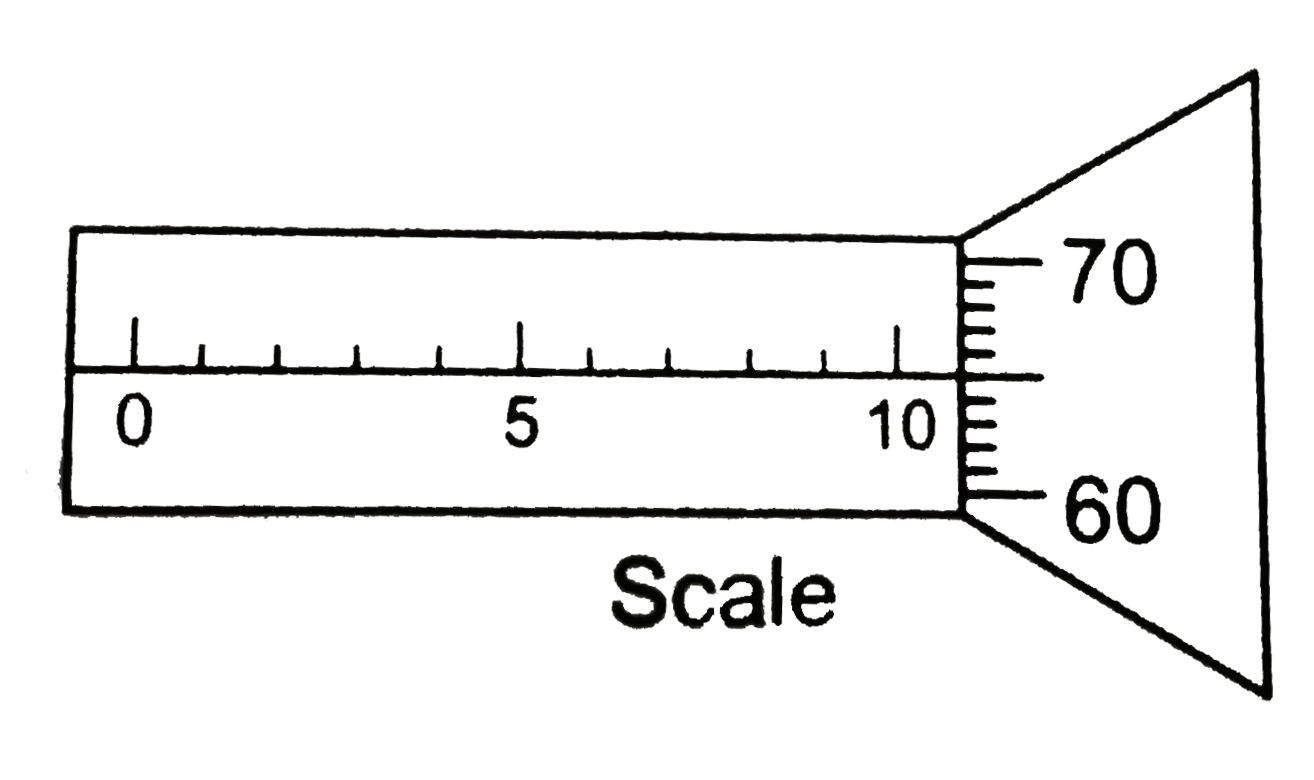
Read the screw gauge shown below in the figure. Given that circular scale has ` 100` divisions and in one complete rotation the screw advances by `1 mm`. .
Text Solution
Verified by Experts
The correct Answer is:
A
` LC = ("pitch")/("Number of divisions on circular scale")` `= (1mm)/(100)=0.01mm` Linear scale reading =`10("pitch")=10 mm` circular scale reading = `10("pitch")=10 mm` =`0.65mm` `:.` Total reading =`(10 + 0.65) mm=10.65mm`.
Topper's Solved these Questions
EXPERIMENTS
DC PANDEY|Exercise Exercise 3.3|8 Videos
EXPERIMENTS
DC PANDEY|Exercise Exercise 3.4|2 Videos
EXPERIMENTS
DC PANDEY|Exercise Exercise 3.1|2 Videos
ELECTROSTATICS
DC PANDEY|Exercise Integer|17 Videos
FLUID MECHANICS
DC PANDEY|Exercise Medical entranes gallery|49 Videos
Similar Questions
Explore conceptually related problems
In a screw guage the graduation in the circular scale consists of 100 equal divisions and 10 complete rotation of athe cap is equivalent to 5mm on the main scale . While measuring diameter of a wire with screw gauge a particular observation gives initial circular cap reading as 57 and after completing 3 complete rotation the final circular cap reading as 63 . it is observed that while proceeding from initial reading to final reading the cap reading increases. calculate the diameter of the wire from the above data.
In a screw gauge, the main scale has divisions in millimetre and circular scale has 50 divisions. The least count of screw gauge is
The given diagram represents a screw gauge. The circular scale is divided into 50 divisions and the linear scale is divided into millimeters. If the screw advances by 1 mm when the circular scale makes 2 complete revolutions, find the least count of the instrument and the reading of the instrument in the figure. .
The figure shown below is a screwgauge. When the circular scale division matches the main scale at 43, the 6.5 mm mark on the main scale is just visible. The main scale has (1)/(2)mm marks. In complete rotation, the screw advances by (1)/(2) mm and circular scale has 50 divisions. The reading of the screwgauge is
 .
.

