Home
Class 11
CHEMISTRY
Consider the following unbalanced redox ...

Consider the following unbalanced redox reaction:
`H_(2)O+AX+BYrarrHA+OY+X_(2)B`
The oxidation number of `X` is `-2` and niether `X` nor water is involved in the redox process.
The elements(s) undergoing oxidation is`//`are

A

`A`

B

`B`

C

`Y`

D

`B` or `Y` or both

Text Solution

Verified by Experts

The correct Answer is:
D

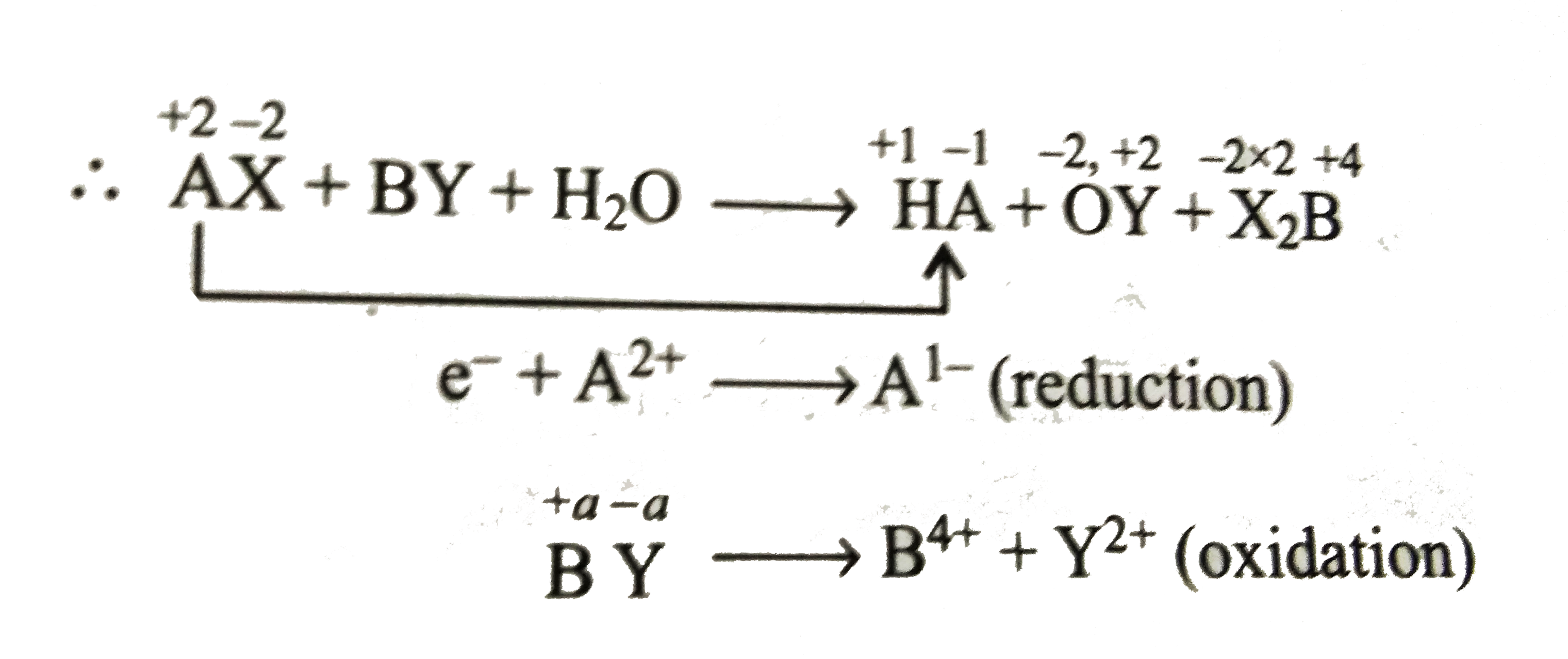
Oxidation state of `X= -2 implies overset(+2)Aoverset(-2)X`
Oxidation state of `O= -2impliesoverset(-2+2)(OY)`
Oxidation state of `X= -2implies overset(-2xx2+4)(X_(2)B`

`e^(-)+A^(2+)rarrA^(1-)` (reduction)
`overset(+a-a)(BY)rarrB^(4+)+Y^(2+)`(oxidation)
Therefore, `B or Y` or both might have been oxidised.
Promotional Banner

Topper's Solved these Questions

  • REDOX REACTIONS

    CENGAGE CHEMISTRY|Exercise Exercises (Multiple Correct)|32 Videos
  • REDOX REACTIONS

    CENGAGE CHEMISTRY|Exercise Exercises (Single Correct)|91 Videos
  • REDOX REACTIONS

    CENGAGE CHEMISTRY|Exercise Exercise|29 Videos
  • PURIFICATION OF ORGANIC COMPOUNDS AND QUALITATIVE AND QUANTITATIVE ANALYSIS

    CENGAGE CHEMISTRY|Exercise Assertion Reasoning Type|5 Videos
  • S-BLOCK GROUP 1 - ALKALI METALS

    CENGAGE CHEMISTRY|Exercise Archives Subjective|8 Videos

Similar Questions

Explore conceptually related problems

Consider the following unbalanced redox reaction: H_(2)O+AX+BYrarrHA+OY+X_(2)B The oxidation number of X is -2 and niether X nor water is involved in the redox process. The positive oxidation states of B and Y in BY are respectively,

Consider the following unbalanced redox reaction: H_(2)O+AX+BYrarrHA+OY+X_(2)B The oxidation number of X is -2 and niether X nor water is involved in the redox process. If the above reaction is balanced with smallest whole number coefficients, the sum of the stoichiometric coefficients of all the compound is

Consider the following redox reaction : H_(2)O + AX + BY rarr HA + YO + BX_(2) (unbalanced) It is also known that oxidation number of X is -2 and neither X nor water is involved in the redox process. (In compound BY, B is cation and consider its oxidation number lt 4 ). Answer the following question based on the information given. If the given reaction is balanced with smallest whole number coefficients, then:

Consider the following redox reaction : H_(2)O + AX + BY rarr HA + YO + BX_(2) (unbalanced) It is also known that oxidation number of X is -2 and neither X nor water is involved in the redox process. (In compound BY, B is cation and consider its oxidation number lt 4 ). Answer the following question based on the information given. Select the correct option(s) :

Find the oxidation number of S in H_2S_(x+2)O_6

Classify the following redox reactions. N_(2)+O_(2) rarr 2NO NaH+H_(2)O rarr NaOH+H_(2)

Justify that the reaction : H_(2)O(s) + F_(2) rarr HF + HOF is a redox reaction

Knowledge Check

  • Consider the following unbalanced redox reaction: H_(2)O+AX+BYrarrHA+OY+X_(2)B The oxidation number of X is -2 and niether X nor water is involved in the redox process. The positive oxidation states of B and Y in BY are respectively,

    A
    `+1, -1`
    B
    `+2,-2`
    C
    `+3,-3`
    D
    All of these
  • Consider the following unbalanced redox reaction: H_(2)O+AX+BYrarrHA+OY+X_(2)B The oxidation number of X is -2 and niether X nor water is involved in the redox process. If the above reaction is balanced with smallest whole number coefficients, the sum of the stoichiometric coefficients of all the compound is

    A
    `9`
    B
    `8`
    C
    `7`
    D
    `6`
  • Consider the following redox reaction : H_(2)O + AX + BY rarr HA + YO + BX_(2) (unbalanced) It is also known that oxidation number of X is -2 and neither X nor water is involved in the redox process. (In compound BY, B is cation and consider its oxidation number lt 4 ). Answer the following question based on the information given. If the given reaction is balanced with smallest whole number coefficients, then:

    A
    Sum of stoichmetric coefficient of all the components is `8`.
    B
    Sum of stoichmetric coefficient of all the components is `9`.
    C
    Stoichiometric coefficient of `AX ` is `6`.
    D
    Stoichiometric coefficient of `HX ` is `2`.
  • CENGAGE CHEMISTRY-REDOX REACTIONS-Exercises (Linked Comprehension)
    1. Consider the following unbalanced redox reaction: H(2)O+AX+BYrarrHA+...

      Text Solution

      |

    2. Consider the following unbalanced redox reaction: H(2)O+AX+BYrarrHA+...

      Text Solution

      |

    3. Consider the following unbalanced redox reaction: H(2)O+AX+BYrarrHA+...

      Text Solution

      |

    4. Oxidation reaction involves loss of electrons, and reduction reaction ...

      Text Solution

      |

    5. Oxidation reaction involves loss of electrons, and reduction reaction ...

      Text Solution

      |

    6. Oxidation reaction involves loss of electrons, and reduction reaction ...

      Text Solution

      |

    7. Oxidation reaction involves loss of electrons, and reduction reaction ...

      Text Solution

      |

    8. Oxidation reaction involves loss of electrons, and reduction reaction ...

      Text Solution

      |

    9. The valancy of carbons is generally 4, but its oxidation state may be ...

      Text Solution

      |

    10. The valancy of carbons is generally 4, but its oxidation state may be ...

      Text Solution

      |

    11. The valancy of carbons is generally 4, but its oxidation state may be ...

      Text Solution

      |

    12. The valancy of carbons is generally 4, but its oxidation state may be ...

      Text Solution

      |

    13. The valancy of carbons is generally 4, but its oxidation state may be ...

      Text Solution

      |

    14. Redox equations are balanced either by ion-electron method or by oxida...

      Text Solution

      |

    15. Redox equations are balanced either by ion-electron method or by oxida...

      Text Solution

      |

    16. Redox equations are balanced either by ion-electron method or by oxida...

      Text Solution

      |

    17. Redox equations are balanced either by ion-electron method or by oxida...

      Text Solution

      |

    18. Cartain materials such as turpentine oil, unsaturated organic compound...

      Text Solution

      |

    19. Cartain materials such as turpentine oil, unsaturated organic compound...

      Text Solution

      |

    20. Cartain materials such as turpentine oil, unsaturated organic compound...

      Text Solution

      |

