Home
Class 12
CHEMISTRY
Plots showing the variation of the rate ...

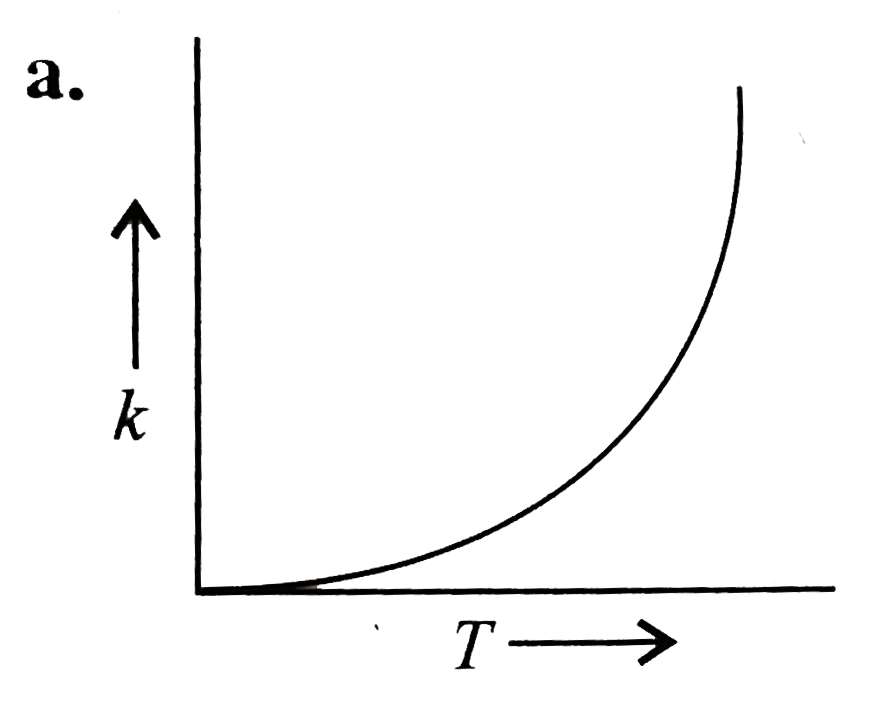
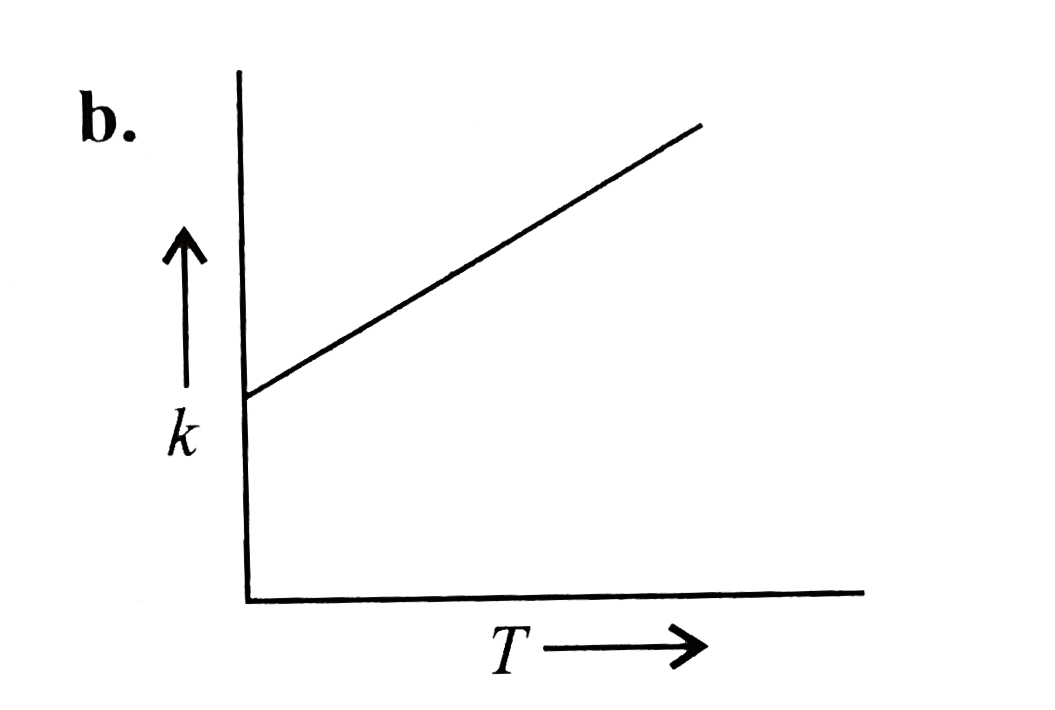
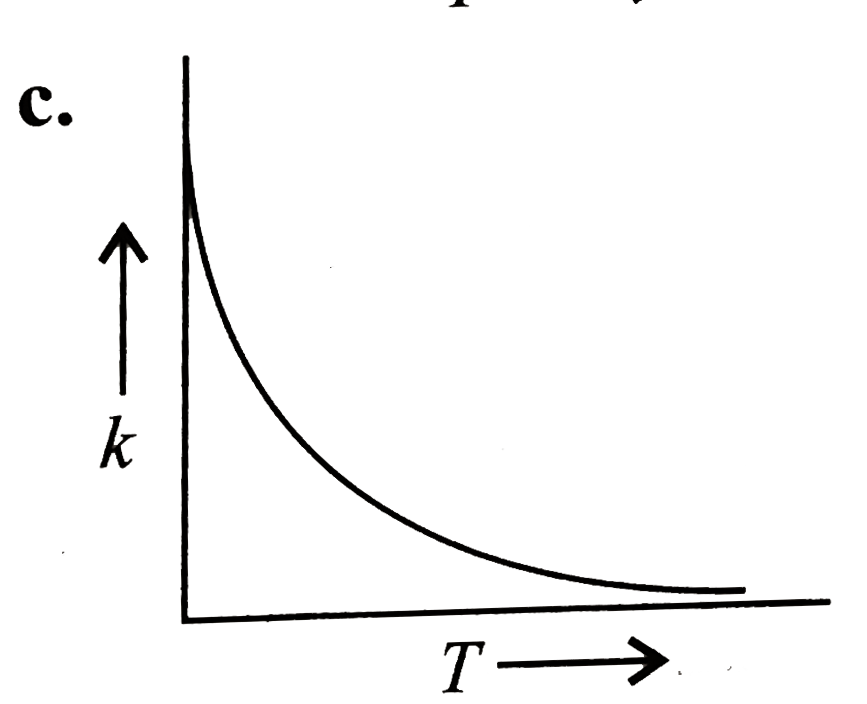
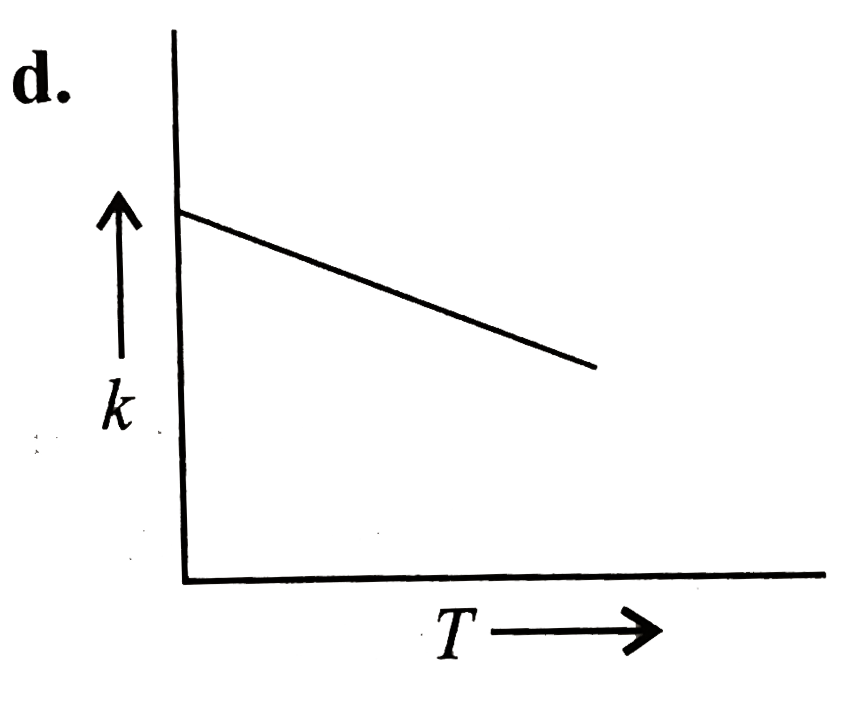
Plots showing the variation of the rate constant `(k)` with temperature `(T)` are given below. The plot that follows the Arrhenius equation is

A

B

C

D

Text Solution

AI Generated Solution

The correct Answer is:

To determine which plot shows the variation of the rate constant \( k \) with temperature \( T \) that follows the Arrhenius equation, we can analyze the relationship described by the equation and how it translates into a graphical representation. ### Step-by-Step Solution: 1. **Understanding the Arrhenius Equation**: The Arrhenius equation is given by: \[ k = A e^{-\frac{E_a}{RT}} \] where: - \( k \) is the rate constant, - \( A \) is the pre-exponential factor, - \( E_a \) is the activation energy, - \( R \) is the universal gas constant, - \( T \) is the temperature in Kelvin. 2. **Taking the Natural Logarithm**: To analyze the equation, we can take the natural logarithm of both sides: \[ \ln k = \ln A - \frac{E_a}{RT} \] This shows that \( \ln k \) is a linear function of \( \frac{1}{T} \). 3. **Identifying the Relationship**: From the equation, we see that as the temperature \( T \) increases, the term \( \frac{E_a}{RT} \) decreases, leading to an increase in \( k \). Therefore, \( k \) increases exponentially with increasing \( T \). 4. **Graphical Representation**: - If we plot \( k \) versus \( T \), we expect to see an exponential increase in \( k \) as \( T \) increases. - This means the graph should show a steep upward curve, indicating that \( k \) increases rapidly with temperature. 5. **Analyzing Given Plots**: - Look for a plot that shows \( k \) increasing sharply as \( T \) increases. - The correct plot will not be linear or show a gradual increase; instead, it will exhibit an exponential rise. 6. **Conclusion**: After analyzing the provided plots, the one that shows an exponential increase in \( k \) with increasing \( T \) is the plot that follows the Arrhenius equation. ### Final Answer: The plot that follows the Arrhenius equation is **option A**.

To determine which plot shows the variation of the rate constant \( k \) with temperature \( T \) that follows the Arrhenius equation, we can analyze the relationship described by the equation and how it translates into a graphical representation. ### Step-by-Step Solution: 1. **Understanding the Arrhenius Equation**: The Arrhenius equation is given by: \[ k = A e^{-\frac{E_a}{RT}} ...
Promotional Banner

Topper's Solved these Questions

  • CHEMICAL KINETICS

    CENGAGE CHEMISTRY|Exercise Archives Integer|2 Videos
  • CHEMICAL KINETICS

    CENGAGE CHEMISTRY|Exercise Archives Fill In The Blanks|4 Videos
  • CHEMICAL KINETICS

    CENGAGE CHEMISTRY|Exercise Archives Multiple Correct|5 Videos
  • CARBOXYLIC ACIDS AND THEIR DERIVATIVES

    CENGAGE CHEMISTRY|Exercise Exercises Archives (Analytical And Descriptive)|34 Videos
  • COORDINATION COMPOUNDS

    CENGAGE CHEMISTRY|Exercise Archives Subjective|18 Videos

Similar Questions

Explore conceptually related problems

Which of the following graph is incorrect for variation of rate constant (K) with temperature for a reaction obeying Arrhenius equation ?

Accroding to Arrhenius equation, the rate constnat (k) is related to temperature (T)as

The variation of rate constant with temperature can be explained by Arrhenius equation. However , the can be explained by Activation energy is found to be temperature dependent/In such cases (d "in" K)/(dT)=(E_(a))/(RT^(2)) should be used to predict variation of rate constant with tempreature. On the basic of this information , answer the question that follow : If Arrhenius constant and E_(a) (activation energy0 are assumed to be constant then which of the following graph will be correct

Which one of the following given graphs represents the variation of rate constant (k) with temperature (t) for an endothermic reaction ?

Which one of the following given graphs represents the variation of rate constant (k) with temperature (f) for an endothermic reaction ?

The variation of rate constant with temperature is given by the integrated from of the Arrhenius equation, log_10k = (-Ea)/(2.303 RT) + constant where k = rate cosntant and Ea is the experimental activation energy. If for a certain reaction, log_10k = (-3163.0)/T + 11.899 , calculate Ea.

The variation of rate constant with temperature can be explained by Arrhenius equation. However , the can be explained by Activation energy is found to be temperature dependent/In such cases (d"in"K)/(dT)=(E_(a))/(RT^(2)) should be used to predict variation of rate constant with tempreature. On the basic of this information , answer the question that follow : If for a reaction in K=20-(20)/(T)+3 in T then E_(a) at 300 K will be

CENGAGE CHEMISTRY-CHEMICAL KINETICS-Archives Single Correct
  1. The rate constant of a reaction depends on

    Text Solution

    |

  2. A catalyst is a substance which

    Text Solution

    |

  3. The specific rate constant of a first order reaction depends on the

    Text Solution

    |

  4. The rate constant for the reaction 2N(2)O(5) rarr 4NO(2)+O(2) is 3...

    Text Solution

    |

  5. For an endothermic reaction, where Delta H represents the enthalpy of ...

    Text Solution

    |

  6. The rate constant, the activation energy, and the Arrhenius parameter ...

    Text Solution

    |

  7. If I is the intenisty of an absorbed light and c is the concentration ...

    Text Solution

    |

  8. Conisder the chemical reaction N(2)(g) + 3H(2)(g) rarr 2NH(3)(g) T...

    Text Solution

    |

  9. In a first order reaction, the concentration of the reactant decreases...

    Text Solution

    |

  10. A follows first order reaction. (A) rarr Product The concentration...

    Text Solution

    |

  11. Which of the following statements for the order of reaction is not cor...

    Text Solution

    |

  12. Conisder a reaction aG+bH rarr Products. When concentration of both th...

    Text Solution

    |

  13. Under the same reaction conditions, the intial concentration of 1.386 ...

    Text Solution

    |

  14. For a first order reaction A rarr P, the temperature (T) dependent rat...

    Text Solution

    |

  15. Plots showing the variation of the rate constant (k) with temperature ...

    Text Solution

    |

  16. The rate of a reaction doubles when its temperature changes form 300 K...

    Text Solution

    |

  17. In the reaction, P+Q rarr R+S the time taken for 75% reaction of P i...

    Text Solution

    |

  18. For the non-stoichiometric reaction 2A+BrarrC+D The following kineti...

    Text Solution

    |

  19. For the elementary reaction MrarrN, the rate of disappearance of M inc...

    Text Solution

    |
