Home
Class 11
PHYSICS
You are given a rod of length L. The lin...

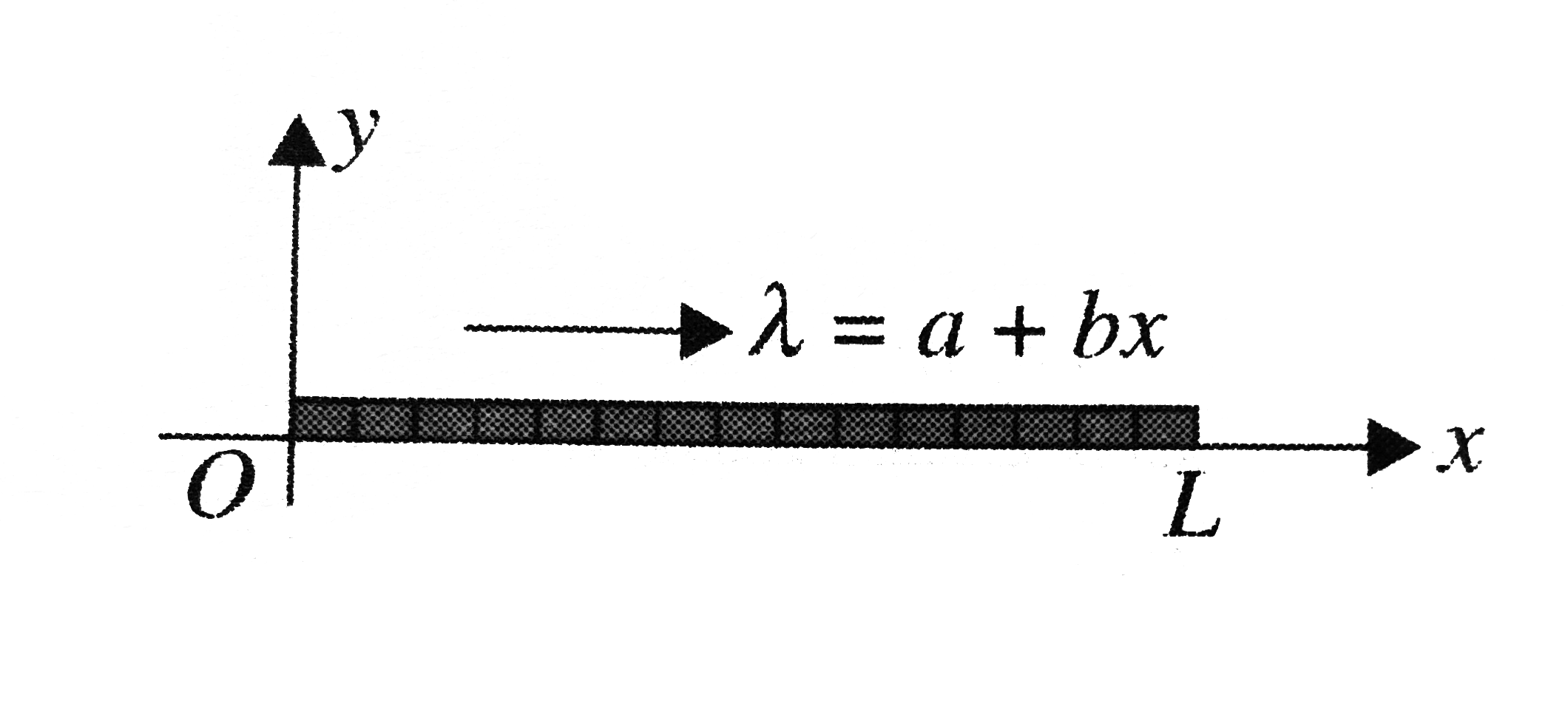
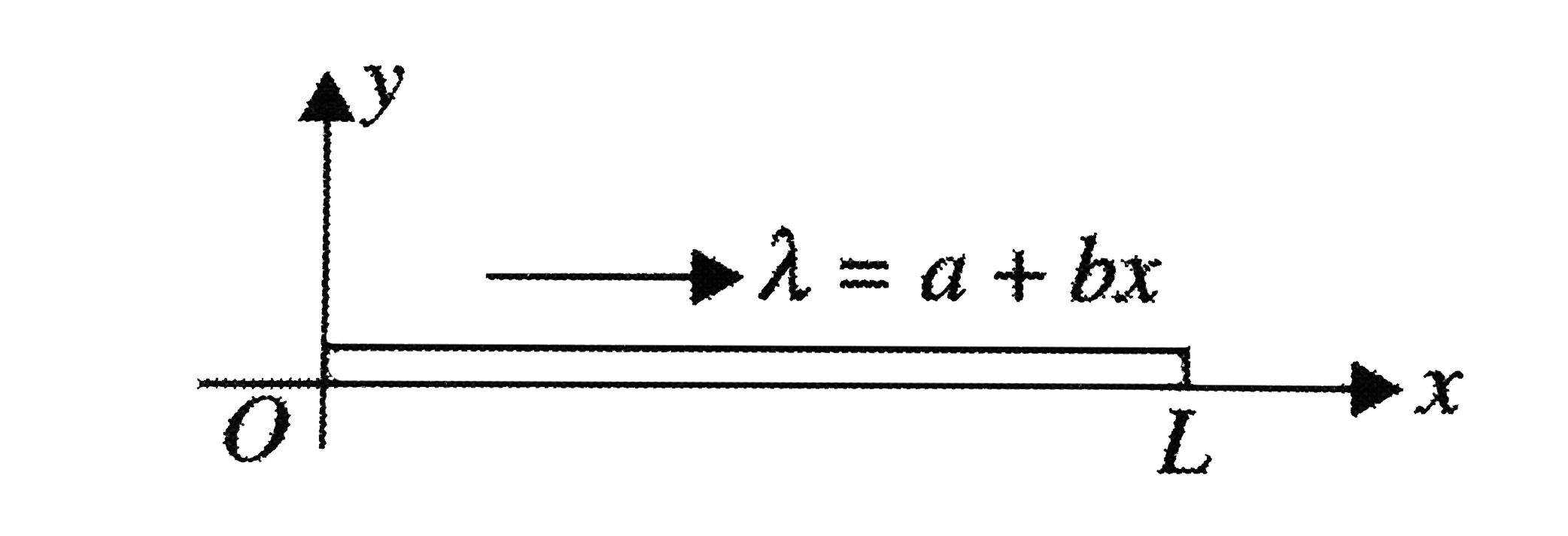
You are given a rod of length L. The linear mass density is `lambda` such that `lambda=a+bx`. Here a and b are constants and the mass of the rod increases as x decreases. Find the mass of the rod

Text Solution

Verified by Experts
We are not calculated the mass of the rod simply multiplying linear mass density `lambda` will the length of the rod as `lambda` is not constant.

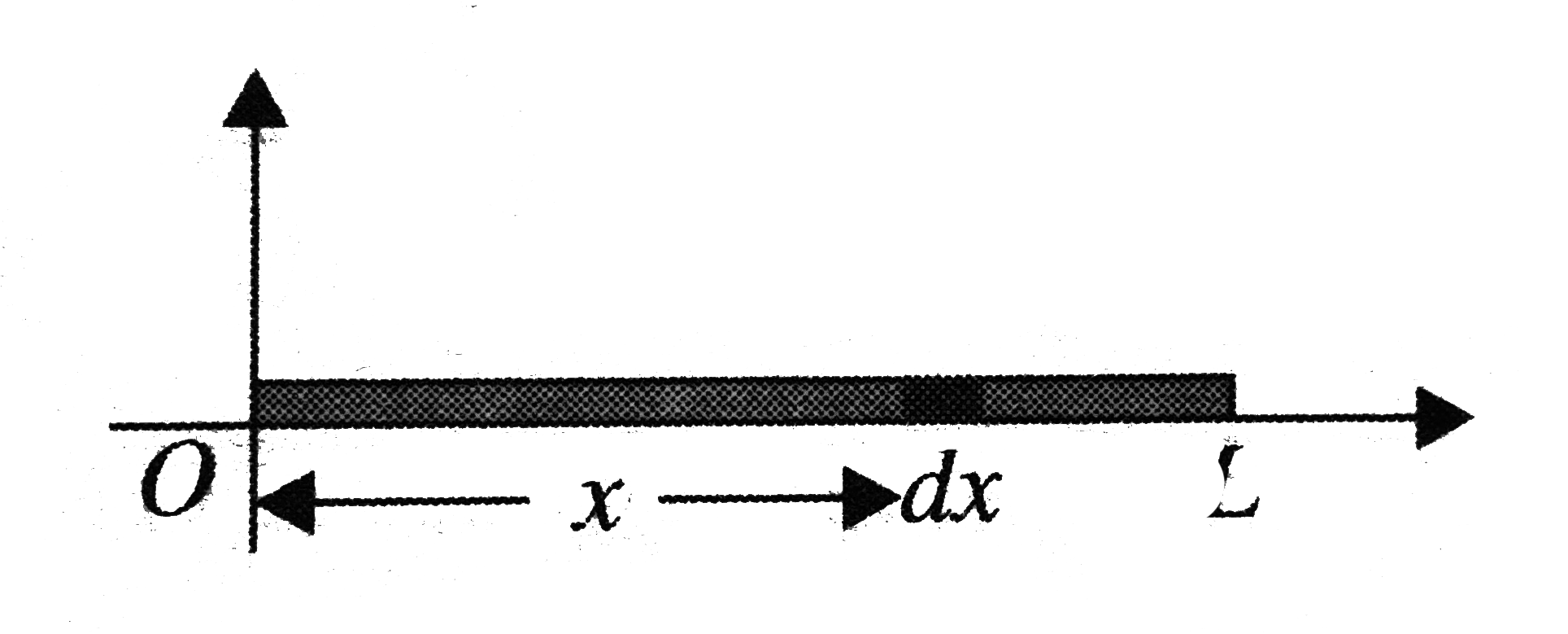
Hence, we have to divide entire rod length into a number of elements and add the mass of the elements.
`M=dm_1+dm_2+dm_3+...`
This step can be written in terms of integration.
`M=intdm`
If we take an element `dx` on the rod at a distance `x` from the left end of the rod.

Mass of this element `dm=lambda.dx`
`dm=(a+bx)dx`
Hence, total mass,
`M=intdm=underset0oversetLint(a+bx)dx`
`=underset0oversetLintadx+underset0oversetLintbxdx`
`=aunderset0oversetLintdx+bunderset0oversetLintxdx`
`=a[x]_0^L+b[x^2/2]_0^L=aL+(bL^2)/(2)`
Promotional Banner

Topper's Solved these Questions

  • BASIC MATHEMATICS

    CENGAGE PHYSICS|Exercise Exercise 2.1|2 Videos
  • BASIC MATHEMATICS

    CENGAGE PHYSICS|Exercise Exercise 2.2|3 Videos
  • BASIC MATHEMATICS

    CENGAGE PHYSICS|Exercise Exercise 2.6|20 Videos
  • ARCHIVES 2 VOLUME 6

    CENGAGE PHYSICS|Exercise Integer|4 Videos
  • CALORIMETRY

    CENGAGE PHYSICS|Exercise Solved Example|13 Videos

Similar Questions

Explore conceptually related problems

A rod of length L is placed along the x-axis between x=0 and x=L. The linear mass density is lambda such that lambda=a+bx . Find the mass of the rod.

Find the MI of a rod about an axis through its centre of mass and perpendicular to the length whose linear density varies as lamda = ax where a is a constant and x is the position of an element of the rod relative to it's left end. The length of the rod l .

Find coordinates of mass center of a non-uniform rod of length L whose linear mass density lambda varies as lambda=a+bx, where x is the distance from the lighter end.

A rod of length L is placed along the x-axis between x=0 and x=L . The linear mass density (mass/length) rho of the rod varies with the distance x from the origin as rho=a+bx . Here, a and b are constants. Find the position of centre of mass of this rod.

The linear mass density lambda of a rod AB is given by lambda =aplha+betaxkg/m taking O as origin. Find the location of the centre of mass from the end A?

The linear density of a non - uniform rod of length 2m is given by lamda(x)=a(1+bx^(2)) where a and b are constants and 0lt=xlt=2 . The centre of mass of the rod will be at. X=

If the linear density of a rod of length L varies as lambda = A+Bx , find the position of its centre of mass .

A non-uniform thin rod of length L is palced along X-axis so that one of its ends is at the origin. The linear mass density of rod is lambda = lambda_(0)x . The centre of mass of rod divides the length of the rod in the ratio: