Home
Class 11
PHYSICS
Study the following graph: The part...

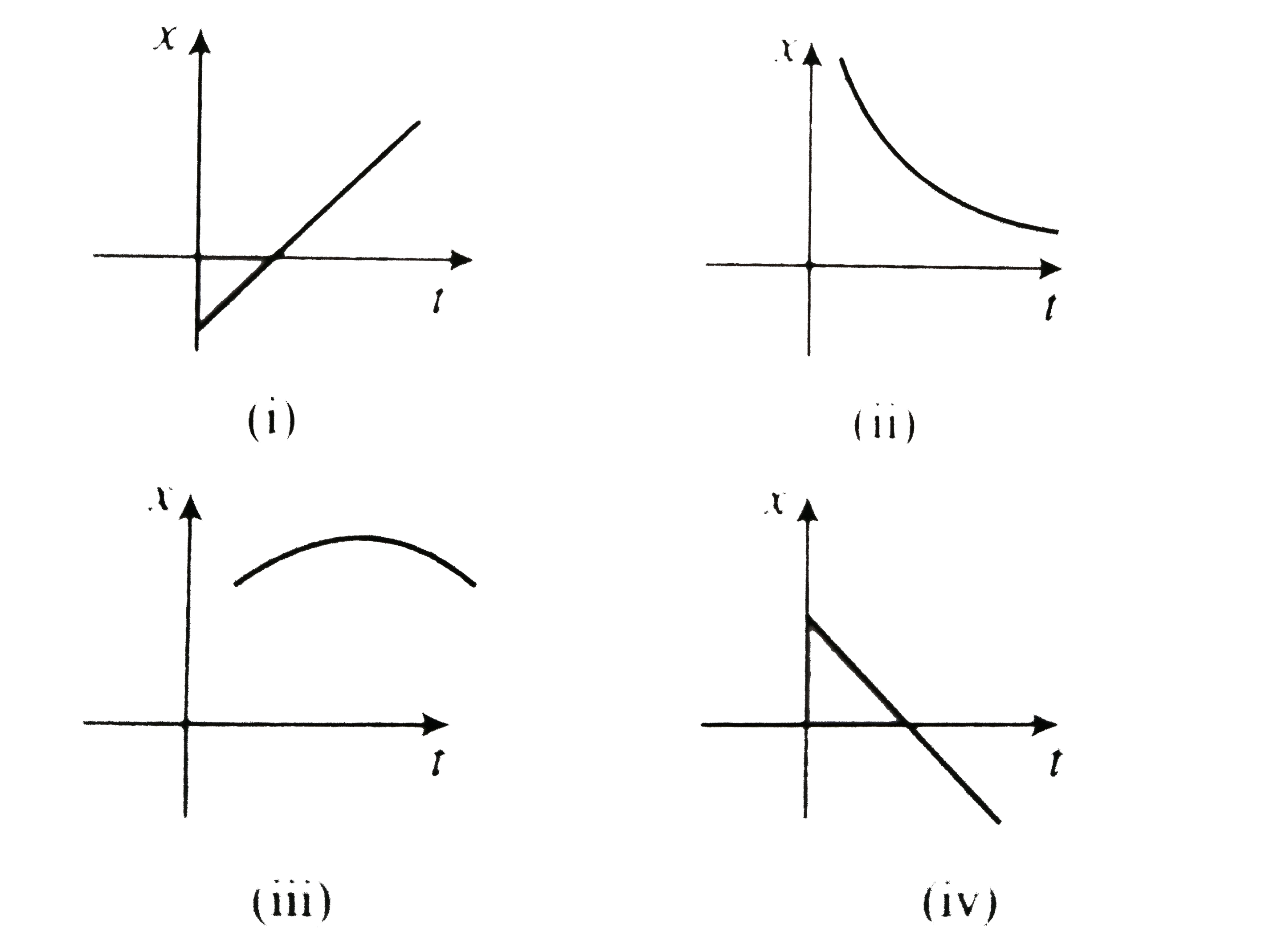
Study the following graph:

The particle has negative acceleration.

A

In graph (i)

B

In graph (ii)

C

In graph (iii)

D

In graph (iv)

Text Solution

Verified by Experts

The correct Answer is:

c

c. for the graph (iii) the partciles`s velocity first dereases and then increases in negative direction. It means neative acceleration is involved in this motion.
Promotional Banner

Topper's Solved these Questions

  • KINEMATICS-1

    CENGAGE PHYSICS|Exercise Integer|9 Videos
  • KINEMATICS-1

    CENGAGE PHYSICS|Exercise Assertion-reasoning|5 Videos
  • GRAVITATION

    CENGAGE PHYSICS|Exercise INTEGER_TYPE|1 Videos
  • KINEMATICS-2

    CENGAGE PHYSICS|Exercise Exercise Integer|9 Videos

Similar Questions

Explore conceptually related problems

Study the following graph: The particle is moving with constant speed .

Assertion : In the s-t graph as shown in figure, velocity of particle is negative and acceleration is positive. Reason : Slope of s-t graph is negative and increasing in magnitude.

The position time graph for a particle moving along X axis has been shown in the fig. At which of the indicated points the particle has (i) negative velocity but acceleration in positive X direction. (ii) positive velocity but acceleration in negative X direction. (iii) received a sharp blow (a large force for negligible interval of time)?

Which of the following x-t graphs shows an object moving with negative acceleration ?

Study the following graph . On the basis of above graph, coordinates of U and Z are

Study the following graph and mark the incorrect statement following it .

Which of the following x - t graphs shows an object moving with negative acceleration?

Position - time graph for motion with negative acceleration is

Consiedr the following x-t garaph to be parabolic. Draw the velocity-time graph and acceleration-time graph analyze the motion of the particle regarding its velocity and acceleration. .

CENGAGE PHYSICS-KINEMATICS-1-Linked Comprehension
  1. A body is allowed to fall from a height of 10 m. If the time taken for...

    Text Solution

    |

  2. A body is allowed to fall from a height of 10 m. If the time taken for...

    Text Solution

    |

  3. A body is dropped from a balloon moving up with a velocity of 4 m s^(-...

    Text Solution

    |

  4. A body is dropped from a balloon meving up wigh a velocity of 4 m s^(-...

    Text Solution

    |

  5. A bus starts moving with acceleration 2 ms^-2. A cyclist 96 m behind t...

    Text Solution

    |

  6. A bus starts moving with acceleration 2 ms^(-2). A cyclist 96 m behind...

    Text Solution

    |

  7. A car is moving towards south with a speed of 20 m s^(-1). A motorcycs...

    Text Solution

    |

  8. A car is moving towards south with a speed of 20 m s^(-1). A motorcycs...

    Text Solution

    |

  9. Two particles A and B are initially 40 m apart, A is behind B. Particl...

    Text Solution

    |

  10. Two particles A and B are initially 40 mapart, A is behind B. Particl...

    Text Solution

    |

  11. The velocity-time graph of a particle in straight line motion is veloc...

    Text Solution

    |

  12. The velocity-time graph of a particle in straight line motion is veloi...

    Text Solution

    |

  13. The velocity-time graph of a particle in straight line motion is veloi...

    Text Solution

    |

  14. The velocity-time graph of a particle moving along a straight line is ...

    Text Solution

    |

  15. The velocity-time graph of a particle moving along a straight line is ...

    Text Solution

    |

  16. The velocity-time graph of a particle moving along a straight line is ...

    Text Solution

    |

  17. Sundy the four graphs given below. Answer the follwing questions on th...

    Text Solution

    |

  18. Sundy the four graphs given below. Answer the follwing questions on th...

    Text Solution

    |

  19. Study the following graph: The particle is moving with constant ...

    Text Solution

    |

  20. Study the following graph: The particle has negative acceleration...

    Text Solution

    |
