Home
Class 11
PHYSICS
Two identical blocks A and B, each of ma...

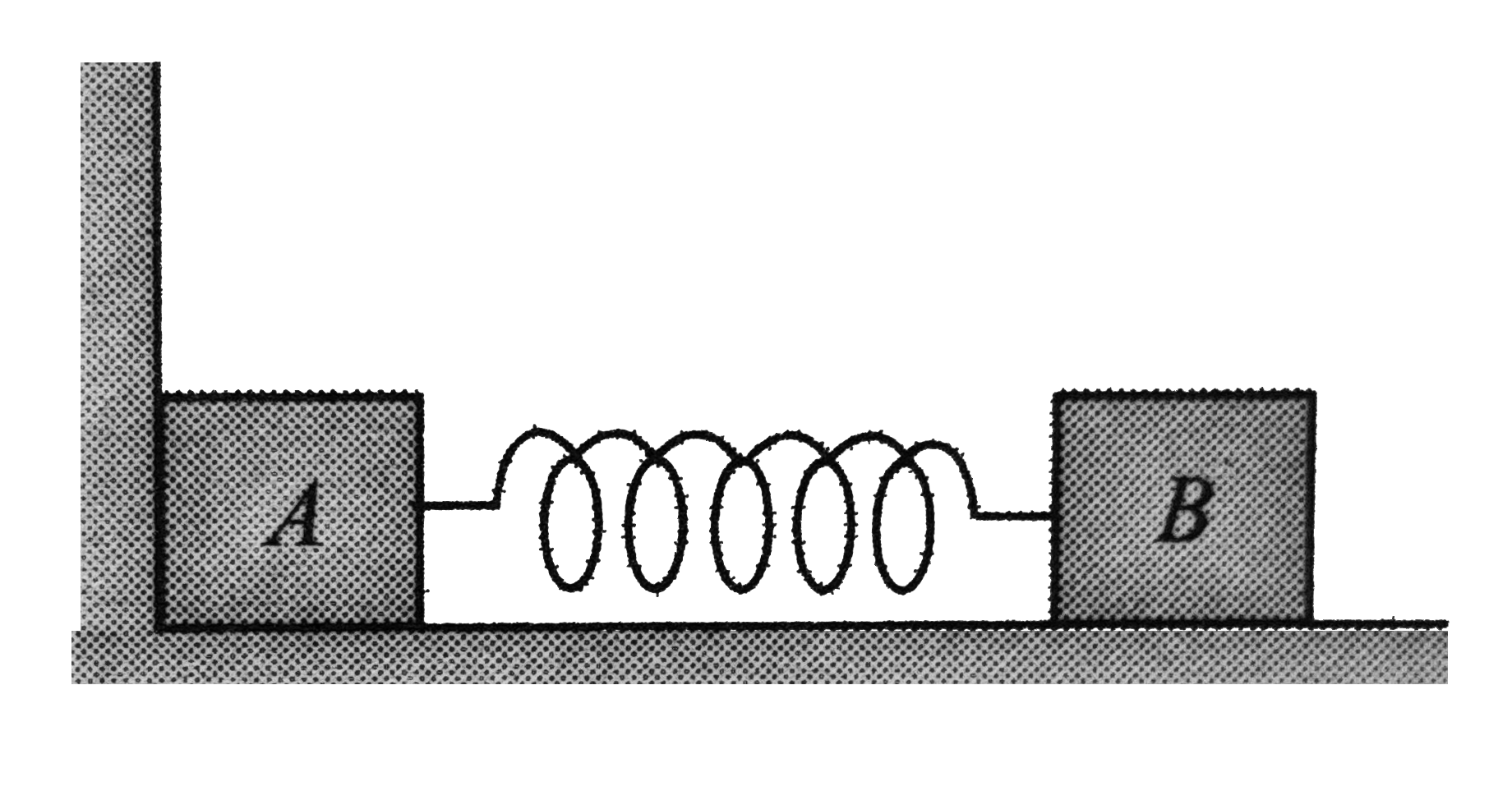
Two identical blocks A and B, each of mass `m=2kg` are connected to the ends of an ideal spring having force constant `K=1000Nm^-1`. System of these blocks and spring is placed on a rough floor. Coefficient of friction between blocks and floor is `m=0.5`. Block B is passed towards left so that spring gets compressed.

Calculate initial minimum compression `x_0` of spring such that block A leaves contact with the wall when system is released.

Text Solution

Verified by Experts

Since, spring is initially compressed, therefore, on releasing the system, block B experiences a resultant force ( to the right) and system, block B experiences a resultant force (to the right) and starts moving to the right.
Block A leaves contact with the wall when rightward force on it applied by spring becomes just equal to the force of friction between this block and floor. Let at that instant, elongation of spring (from its natural length) be `x^'`, then tension in spring is `T=Kx^'=1000x^'` newton. Considering free body diagram of A at that instant.
`V_1=mg=20N`
`1000.x^'=mu.V_1=0.5xx20`
`x^'=0.01m`
Since spring was initially compressed by `x_0` and it has an elongation of `x^'`, therefore, displacement of block B (upto this instant)`=x_0=x^'`.
According to the law of conservation of energy,
Decrease in energy stored in the spring = Work done by block B against friction
`[1/2Kx_0^2-1/2K(x^')^2]=mumg(x_0+x^')`
Substituting `x^'=0.01m`, `K=1000Nm^-1`, `mu=0.5`, `n=2kg` and `x_0=0.03cm`.
If initial compression of spring is `x=2 x_0=6cm`, initial energy stored in spring is
`U_0=1/2K(2x_0)^2=1.80J`
When block A loses contanct with the wall, at that instant, elongation of spring (from natural length) is `x^'=1cm`.
At that instant energy stored in the spring is ,
`U=1/2K(x^')^2=0.05J`
Decrease in energy stored in the spring is,
`(U_0-U)=1.75J`
This energy is used in two ways.
To over come frictional loss during motion of block. But displacement of block B is `(2x_0+x^')=7cm`. Hence, energy lost against friction is
`mumg=(2x_0+x^')=0.7J`
Promotional Banner

Topper's Solved these Questions

  • WORK, POWER & ENERGY

    CENGAGE PHYSICS|Exercise Exercise 8.1|25 Videos
  • WORK, POWER & ENERGY

    CENGAGE PHYSICS|Exercise Exercise 8.2|25 Videos
  • WORK, POWER & ENERGY

    CENGAGE PHYSICS|Exercise Archives (integer)|4 Videos
  • VECTORS

    CENGAGE PHYSICS|Exercise Exercise Multiple Correct|5 Videos

Similar Questions

Explore conceptually related problems

A block of mass 50 kg is projected horizontal on a rough horizontal floor. The coefficient of friction between the block and the floor is 0.1. The block strikes a light spring of stiffness k = 100 N//m with a velocity 2 m//s , the maximum compression of the spring is

Two blocks of mass 10 kg and 2 kg are connected by an ideal spring of spring constant 1000 N/m and the system is placed on a horizontal surface as shown. The coefficient of friction between 10 kg block and surface is 0.5 but friction is assumed to be absent between 2 kg and surface. Initially blocks are at rest and spring is unstretched then 2 kg block is displaced by 1 cm to elongate the spring then released. Then the graph representing magnitude of frictional force on 10 kg block and time t is : (Time t is measured from that instant when 2 kg block is released to move)

A block of mass m is attached to one end of a mass less spring of spring constant k. the other end of spring is fixed to a wall the block can move on a horizontal rough surface. The coefficient of friction between the block and the surface is mu then the compession of the spring for which maximum extension of the spring becomes half of maximum compression is .

Two identical blocks, each of mass m, are connected through a massless spring of force constant k and arranged as shown in fig the spring is compressed by an amount y by applying an external force and released (a) What is the velocity of upper block when the spring is relaxed (b) What should be the initial compression of the spring so that the lower block is just raised above the floor ?

A block of mass m attached with a an ideal spring of force constant k is placed on a rough inclined plane having inclination theta with the horizontal and coefficient of friction mu=1//2 tan theta , Initially the block is held stationary with the spring in its relaxed state, find the maximum extension in the spring if the block is released.

A block of mass 1 kg moves towards a spring of force constant 10 N//m . The spring is massless and unstretched. The coeffcient of friction between block and surface is 0.30 . After compressing the spring, block does not return back : (g = 10 m//s) .

A block of mass m is moving with a speed v on a horizontal rought surface and collides with a horizontal monted spring of spring constant k as shown in the figure .The coefficient of friction between the block and the floor is mu The maximum cobnpression of the spring is

A block of mass m initially at rest is dropped from a height h on to a spring of force constant k . the maximum compression in the spring is x then
