Home
Class 11
PHYSICS
A particle of mass m slides along a curv...

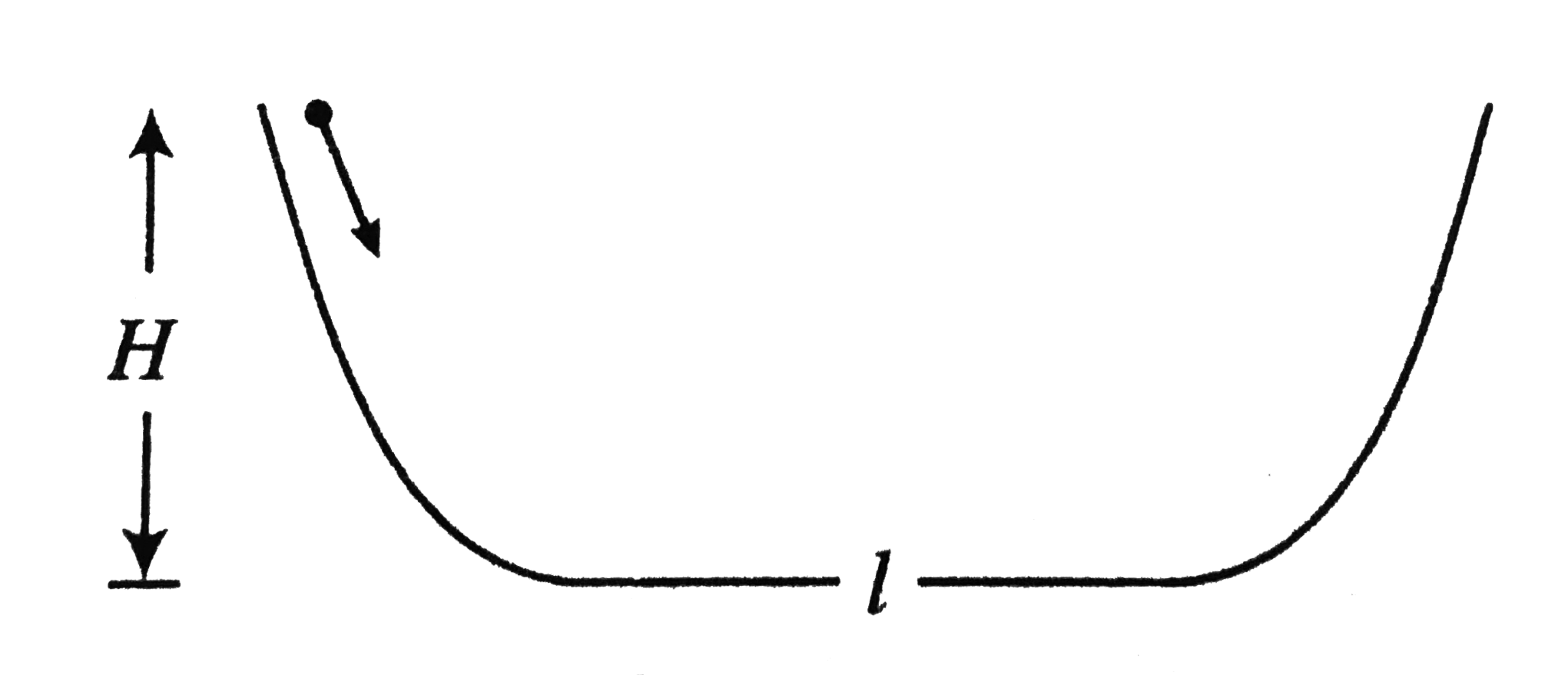
A particle of mass `m` slides along a curved-flat-curved track. The curved portions of the track are smooth. If the particle is released at the top of one of the curved portions, the particle comes to rest at flat portion of length l and of `mu=mu_(ki n etic)` after covering a distance of

A

(a) `(l)/(3mu)`

B

(b) `(H)/(2mu_(ki n etic)`

C

(c) `l/6`

D

(d) `(H)/(mu_(ki n etic))`

Text Solution

Verified by Experts

The correct Answer is:

D

Here PE=Work done
`mgH=mu_(ki n etic)mgS` or `S=(H)/(mu_(ki n etic))`
The particle covers the length l or not or covers it repeatedly is determined by the above relation.
Promotional Banner

Topper's Solved these Questions

  • WORK, POWER & ENERGY

    CENGAGE PHYSICS|Exercise Multiple Correct|25 Videos
  • WORK, POWER & ENERGY

    CENGAGE PHYSICS|Exercise Linked Comprehension|55 Videos
  • WORK, POWER & ENERGY

    CENGAGE PHYSICS|Exercise Subjective|23 Videos
  • VECTORS

    CENGAGE PHYSICS|Exercise Exercise Multiple Correct|5 Videos

Similar Questions

Explore conceptually related problems

The curved portions are smooth and horizontal surface is rough. The block is released from P . At what distance from A it will stop?

A point particle of mass m, moves long the uniformly rough track PQR as shown in figure. The coefficient of friction, between the particle and the rough track equals mu . The particle is released, from rest from the point P and it comes to rest at a point R. The energies, lost by the ball, over the parts, PQ and QR, of the track, are equal to each other, and no energy is lost when particle changes direction from PQ to QR. The value of the coefficient of friction mu and the distance x (=QR) , are, respectively close to:

Two charged particle of equal mass are constrained to move along X and Y direction. The X – Y plane is horizontal and the tracks are smooth. The particles are released from rest when they were at positions shown in the figure. At the instant distance of q becomes 2r from the origin, find the location of charge Q.

A rod AB of mass M and length L is lying on a horizontal frictionless surface. A particle of mass m travelling along the surface hits the end A of the rod with a velocity v_(0) in a direction perpendicular to AB. The collision in elastic. After the collision the particle comes to rest (a). Find the ratio m//M (b). A point P on the rod is at rest immediately after collision find the distance AP. (c). Fid the linear speed of the point P a time piL//3v_(0) after the collision.

A particle slides along a track with elevated ends and a flat central part as shown in figure. The flat part has a length l=3m . The curved portions of the track are frictionless. For the flat part, the coefficient of kinetic friction is mu_k=0.2 . The particle is released at point A which is at height h=1.5m above the flat part of the track. Where does the particle finally come to rest?

A small block slides along a track with elevated ends and a flat central part as shown in figure. The flat portion BC has a length l=3.0 m , The curved portions of the track are frictionless. For the flat part, the coefficient of kinetic friction is mu_(k) = 0.20 , the particle is releast at point A which is at height h = 15 m above the flat part of the track. Where does the block finally comes to rest?

If a particle of mass m start from along curved circular path shown in figure with constant tangential acceleration a, then net force at B on the particle has the magnitude :

A particle of mass m and speed u collides elastically with the end of a uniform rod of mass M and length L as shown. If the particle comes to rest after collision, find m/M

A particle of mass 5kg is free to slide on a smooth ring of radius r=20cm fixed in a vertical plane. The particle is attached to one end of a spring whose other end is fixed to the top point O of the ring. Initially, the particle is at rest at a point A of the ring such that /_OCA=60^@ , C being the centre of the ring. The natural length of the spring is also equal to r=20cm . After the particle is released and slides down the ring, the contact force between the particle and the ring becomes zero when it reaches the lowest position B. Determine the force constant (i n xx 10^2Nm^-1) of the spring.

A particle of mass m is pulled along an arbitrary curved surface without acceleration as shown in figure. Coefficient of friction between surface and particle is mu . Then codes:

CENGAGE PHYSICS-WORK, POWER & ENERGY-Single Correct
  1. Let r be the distance of a particle from a fixed point to which it is ...

    Text Solution

    |

  2. A mass m starting from A reaches B of a frictionless track. On reachin...

    Text Solution

    |

  3. A particle of mass m slides along a curved-flat-curved track. The curv...

    Text Solution

    |

  4. A block of mass m has initial velocity u having direction towards +x a...

    Text Solution

    |

  5. A moving railway compartment has a spring of constant k fixed to its f...

    Text Solution

    |

  6. A rope ladder of length L is attached to a balloon of mass M. As the m...

    Text Solution

    |

  7. A block of mass m is lying at rest at point P of a wedge having a smoo...

    Text Solution

    |

  8. Figure shows a smooth vertical circular track AB of radius R. A block ...

    Text Solution

    |

  9. A bead of mass m is released from rest at A to move along the fixed sm...

    Text Solution

    |

  10. A simple pendulum consisting of a mass M attached to a string of lengt...

    Text Solution

    |

  11. Two bodies of masses m and 4m are attached to a light string as shown ...

    Text Solution

    |

  12. A 500-kg car, moving with a velocity of 36kmh^-1 on a straight road un...

    Text Solution

    |

  13. Two spring P and Q having stiffness constants k1 and k2(ltk1), respect...

    Text Solution

    |

  14. In the above question, if equal forces are applied on two springs, the...

    Text Solution

    |

  15. Water is drawn from a well in a 5kg drum of capacity 55L by two ropes ...

    Text Solution

    |

  16. A bead of mass 1/2 kg starts from rest from A to move in a vertical pl...

    Text Solution

    |

  17. A block of mass m is connected to a spring of spring constant k as sho...

    Text Solution

    |

  18. Figure shows a plot of the potential energy as a function of x for a p...

    Text Solution

    |

  19. A 20-kg block attached to a spring of spring constant 5Nm^-1 is releas...

    Text Solution

    |

  20. Two identical blocks, each having mass M, are placed as shown in figur...

    Text Solution

    |
