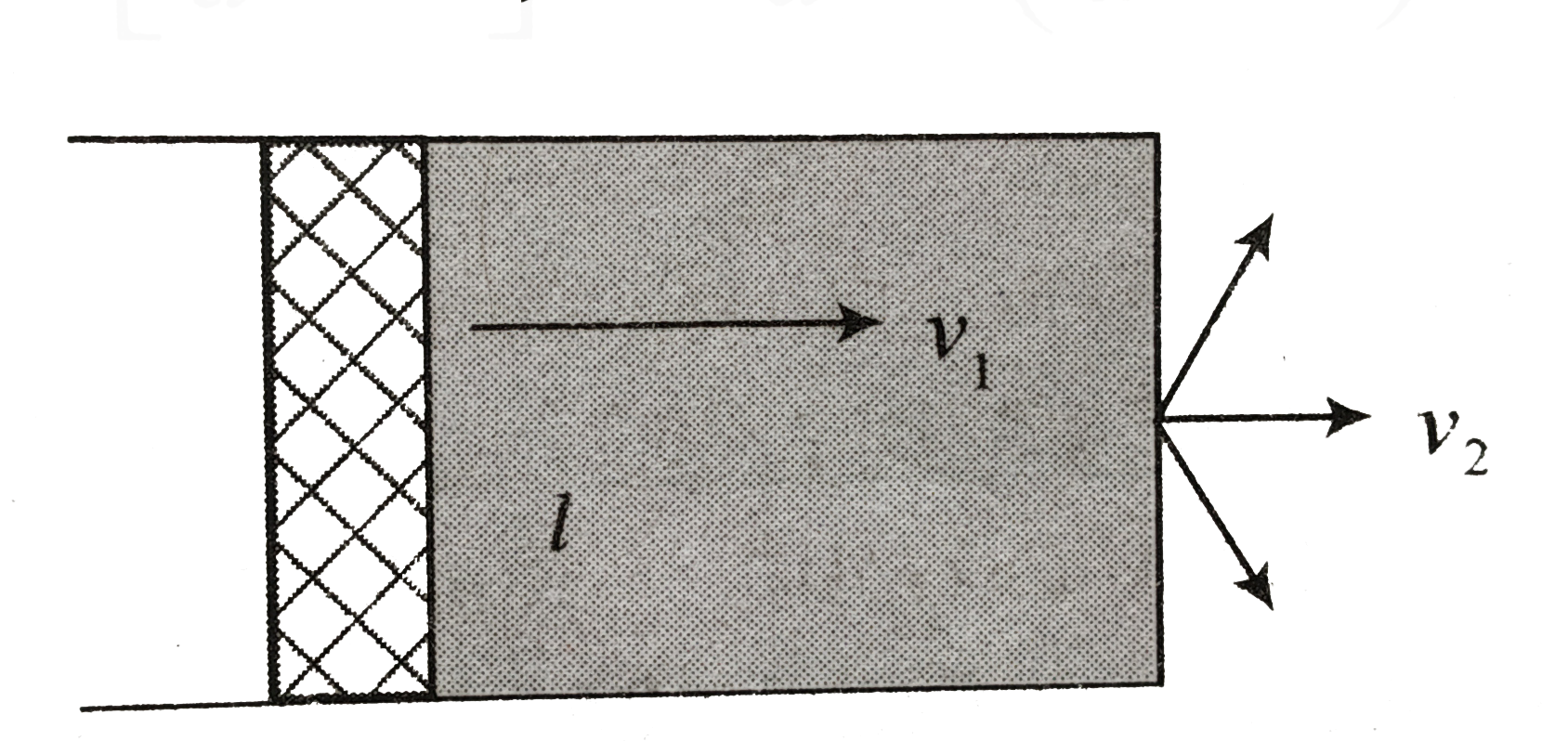
A horizontal cylinder of length `l` contains water. On the left a constant force `F` is applied on the piston and on the right there is a small hole of area a. What is the velocity of the piston? Hence, calculate the work done in emptying the vessel in time `t`. brgt given area of cylinder is A
Text Solution
Verified by Experts
Let `A` be the area of the piston and `v_(1)` be its velocity. Then `(F/A+P_(0))+1/2rhov_(1)^(2)=P_(0)+1/2rhov_(2)^(2), Av_(1)=av_(2)` `impliesF/A=1/2rhov_(1)^()2[(A^(2))/(a^(2))-1]=(rhov_(1)^(2)A^(2))/(a^(2))((A^(2))/(a^(2))-1)` Net work done is `Fxx` distance `=Fl=(2v_(1)^(2)A^(2)t)/(2a^(2))`
Topper's Solved these Questions
FLUID MECHANICS
CENGAGE PHYSICS|Exercise Solved Examples|7 Videos
FLUID MECHANICS
CENGAGE PHYSICS|Exercise Exercise 4.1|11 Videos
DIMENSIONS & MEASUREMENT
CENGAGE PHYSICS|Exercise Integer|2 Videos
GRAVITATION
CENGAGE PHYSICS|Exercise INTEGER_TYPE|1 Videos
Similar Questions
Explore conceptually related problems
A uniform rod of mass m and length l is on the smooth horizontal surface. When a constant force F is applied at one end of the rod for a small time t as shown in the figure. Find the angular velocity of the rod about its centre of mass.
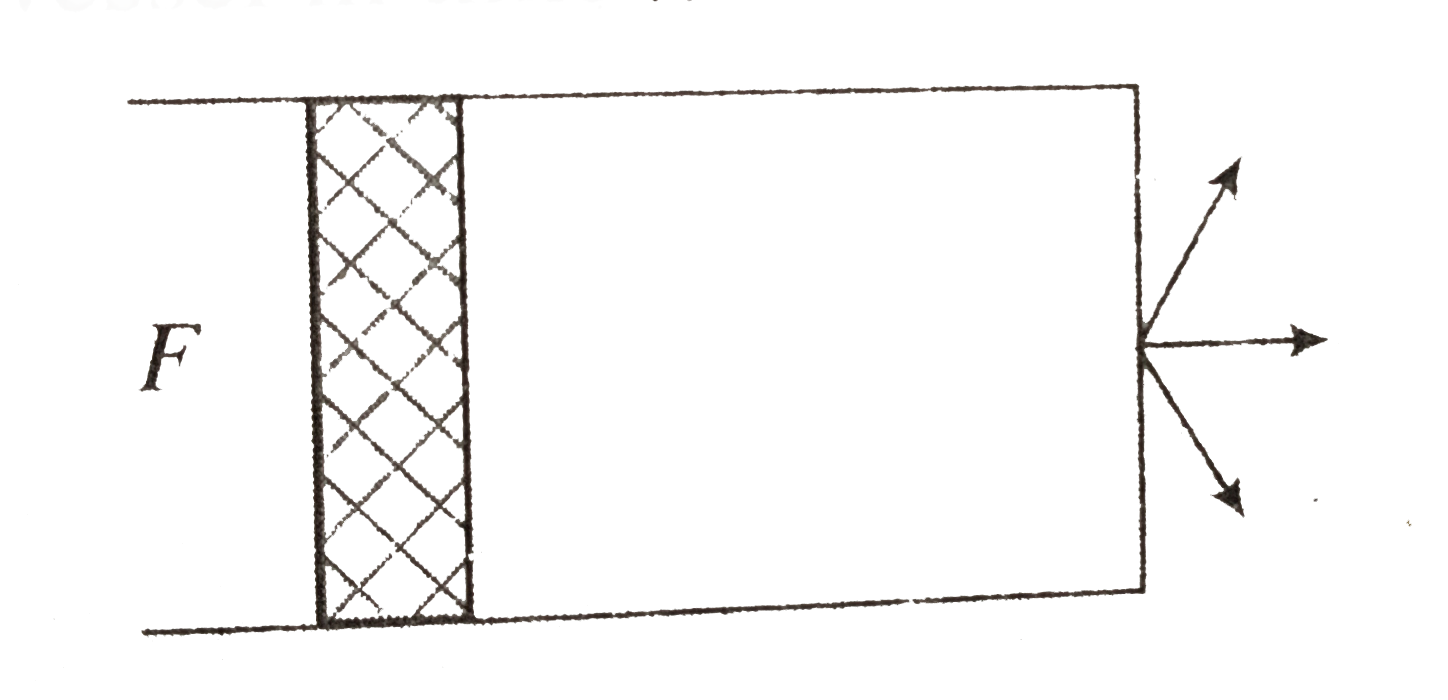
What work should be done in order to squeeze all water from a horizontally located cylinder (figure) during the time t by means of a constant force acting on the piston? The volume of water in the cylinder is equal to V, the cross-sectional area of the orifice to s, with s being considerably less than the piston area. The friction and viscosity are negligibly small.
What work should be done in order to sqeeze all water from a horizontally located cylinder (figure) during the time t by means of a constant force acting on the poston? The volume of water in the cylinder is equal to V, the cross-sectional area of the orifice is s, with s being considerablu less than the piston area. The friction and viscosity are negligibly small. Density of water is rho
A gas is contained in a cyclinder and expands according to the relation rhoV^(13) =constant. The initial pressure and initial volume of the gas are 30atm. And 30L respectively. If the final pressure is 15atm, then calculate the work done on the face of piston by the pressure force of the gas.
A horizontal cylindrical vessel with a small orifice of area s is first filled with a liquid of density rho and then forced out through it by applying a constant force on the piston closing the cylinder. The time taken is t. The time taken is t. Calculate the work done.
A 5L cylinder contained 10 moles of oxygen gas at 27^(@)C . Due to sudden leakage through the hole, all the gas escaped into the atmosphere and the cylinder got empty. If the atmospheric pressure is 1.0atm , calculate the work done by the gas.
A cylinder of area 300 cm^(2) and length 10 cm made of material of specific gravity 0.8 is floated in water with its axis vertical. It is then pushed downward, so as to be just immersed. Calculate the work done by the agent who pushes the cylinder into the water.
An horizontal insulated cylindrical vessel of length 2l is separated by a thin insulating piston into two equal parts as shown. Each part contains n moles of an ideal monoatomic gas at temperature T. The piston is connected to end faces of cylinder with help of two springs each of spring constank k. Initially both springs are in relaxed state. The temperature of left part of cylinder is kept constant by some external means while heat is supplied to right part with help of filament. Answer following questions. If energy Q is supplied to right part so that the piston moves to left by l/4 then change in internal energy of right part of cylinder is
 given area of cylinder is A