Home
Class 12
CHEMISTRY
What are micelles ? Discuss the mechanis...

What are micelles ? Discuss the mechanism of micelle formation and cleaning action of soap.

Text Solution

Verified by Experts
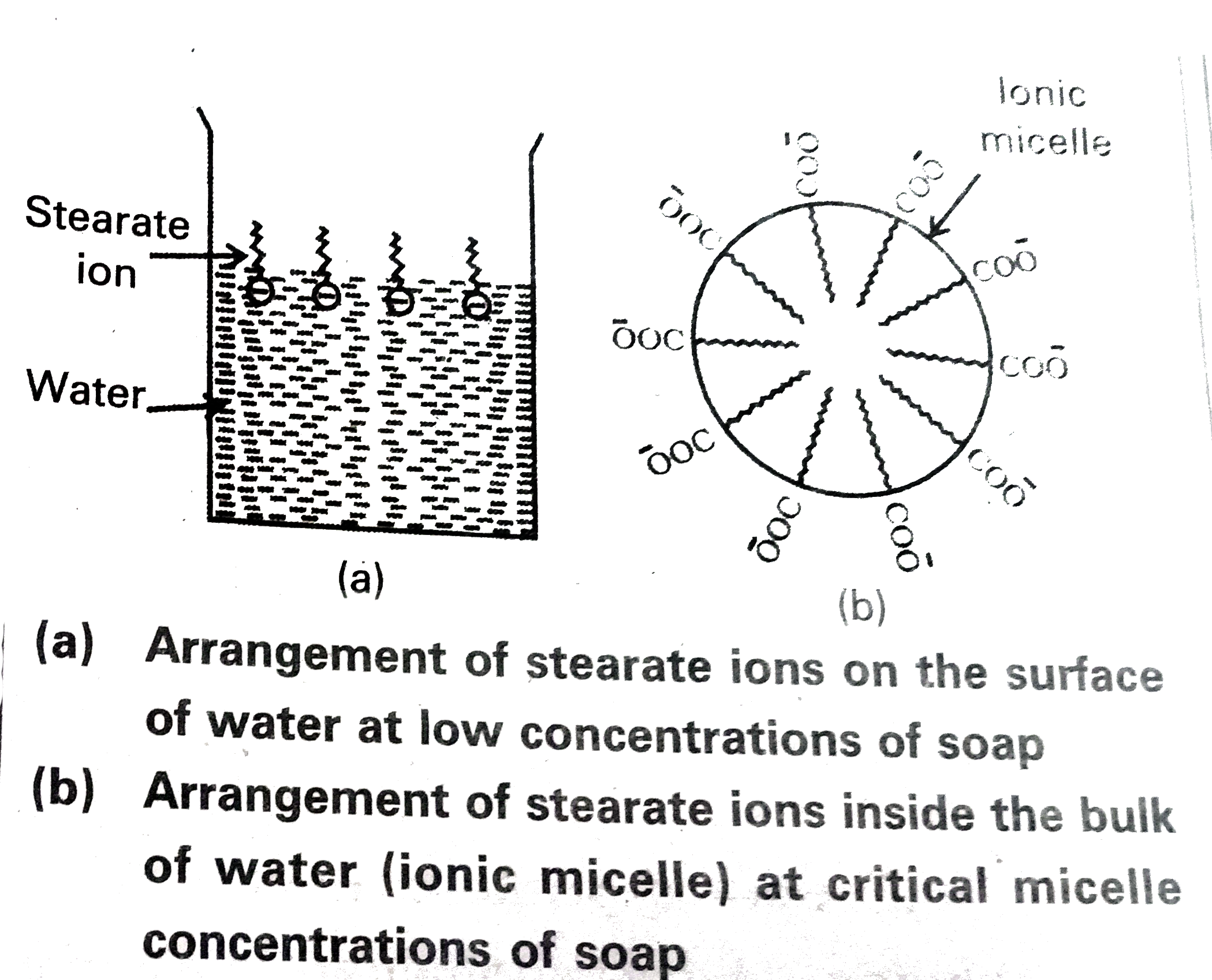
Micelles : Some substances which at low concentrations behave as normal strong electrolytes, but at high concentrations exhibit colloidal behaviour due to formation of aggregates. The aggregated particles thus formed are called micelles.
Eg : Stearate ions `(C_(17) H_(35)COO^(-))` associate together in high concentration, in a solution of soap in water and forms a micelle.
Mechanism of micelle formation : Let us take the example of soap solution. Soap is sodium or potassium salt of a higher fatty acid and may be represented as `RCOO^(-) Na^(+)` (E.g. , sodium strearate `CH_(3) (CH_(2))_(6) COO^(-)Na^(+)` , which is a major component of many bar soaps). When dissolved in water, it dissociates into `RCOO^(-)` and `Na^(+)` ions. The `RCOO^(-)` ions, however, Consist of two parts — a long hydrocarbon chain R (also called non-polar 'tail') which is hydrophobic (water repelling), and a polar group `COO^(-)` (also called polar-ionic 'head'), which is hydrophilic (water loving).
The `RCOO^(-)` ions are, therefore, present on the surface with their `COO^(-)` groups in water and the hydrocarbon chains (R) staying away from it and remain at the surface. But at critical micelle concentration, the `COO^(-)` irons are pulled into the bulk of the solution and are aggregated to form a spherical shape with their hydro- carbon chains pointing towards the centre of the sphere with `COO^(-)` part remaining outward on the surface of the sphere . The aggregate thus formed is known as 'ionic micelle'. These micelles may contain as many as 100 simple molecules .
Similarly, in case of detergents , E.g., sodium laurylsulphate. `CH_(3) (CH_(2)_(11) SO_(3)^(-)Na^(+)` , the polar group is `-SO_(3)^(-)` along with the long hydrocarbon chain. Hence, the mechansim of micelle formation here also is same as that of soaps.
Soap is sodium stearate, `C_(17)H_(35) COONa` , in water soap gives the ions stearate anion and sodium ion.
`C_(17)H_(35) COONa to underset("Stearate ion")(C_(17)H_(15) COO^(-) + Na^(+)`


Cleaning action of soap : Soap anions form a micelle . The grease or dirt of the cloth are absorbed into the interior of the micelle. The tails of the anion are pegged into micelle and these micelle are washed away with the soap solution.
Soap, thus functions are an emulsifying agent for the water dirst emulsion. The emulsified grease or dirt is then washed away with soap solution.
Promotional Banner

Topper's Solved these Questions

  • SURFACE CHEMISTRY

    VIKRAM PUBLICATION ( ANDHRA PUBLICATION)|Exercise INTEXT QUESTIONS|8 Videos
  • SURFACE CHEMISTRY

    VIKRAM PUBLICATION ( ANDHRA PUBLICATION)|Exercise SHORT ANSWER QUESTIONS|50 Videos
  • SOLUTIONS

    VIKRAM PUBLICATION ( ANDHRA PUBLICATION)|Exercise INTEXT QUESTIONS|10 Videos
  • TELANGANA MARCH-2019

    VIKRAM PUBLICATION ( ANDHRA PUBLICATION)|Exercise SECTION C|6 Videos

Similar Questions

Explore conceptually related problems

Discuss the mechanism of acetylation of aniline

Explain the cleansing action of soaps.

Discuss S_(N)1 mechanism

Discuss S_(N)2 mechanism

Mechanism of urine formation involves

A micelle formed during the cleansing action by soap is

A micelle formed during the cleansing action by soap is

What are micelles ? Give one example.

What is a micelle? Give an example of micelle formation .