Home
Class 12
PHYSICS
A flat, square surface with sides of len...

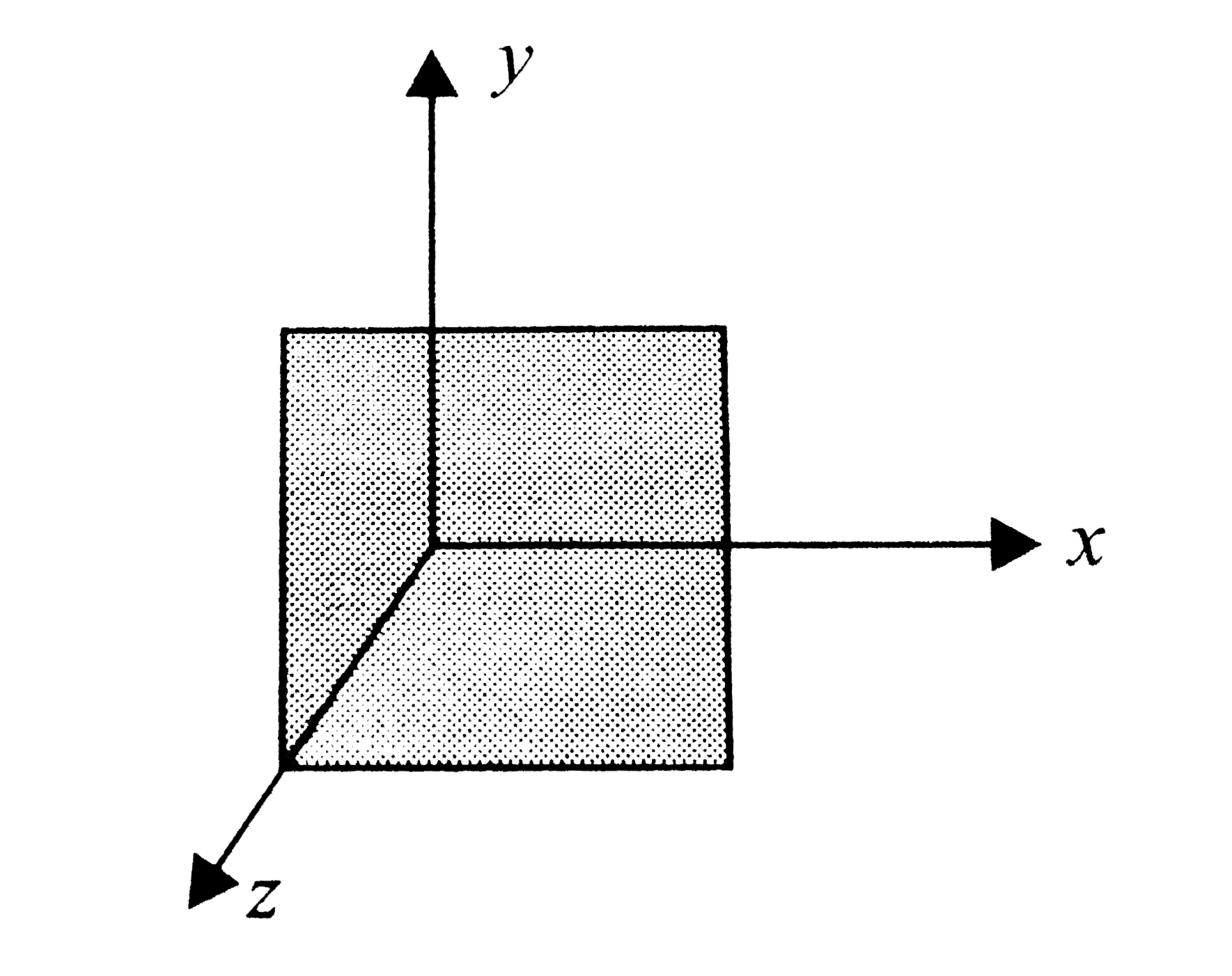
A flat, square surface with sides of length L is described by the equations
`x = L, 0le y leL,0lezleL`
The electric flux through the square due to a positive point charge q located at the origin `(x = 0 , y = 0, z = 0)` is

A

`q/(4epsilon_0)`

B

`q/(6epsilon_0)`

C

`q/(24epsilon_0)`

D

`q/(48epsilon_0)`

Text Solution

Verified by Experts

The correct Answer is:
C

c. Imagine a charge q at the center of a cube of edge length 2L
Then `phi = q//epsilon_0`. Here, the square is `1//24` of the surface area of the imaginary cube, so it intercepts `1//24` of the flux. That is ,
`Phi = q/(24epsilon_0)`
Promotional Banner

Topper's Solved these Questions

  • ELECTRIC FLUX AND GAUSS LAW

    CENGAGE PHYSICS|Exercise Multiple Correct|8 Videos
  • ELECTRIC FLUX AND GAUSS LAW

    CENGAGE PHYSICS|Exercise Comprehension|36 Videos
  • ELECTRIC FLUX AND GAUSS LAW

    CENGAGE PHYSICS|Exercise Subjective|12 Videos
  • ELECTRIC CURRENT AND CIRCUIT

    CENGAGE PHYSICS|Exercise Interger|8 Videos
  • ELECTRIC POTENTIAL

    CENGAGE PHYSICS|Exercise DPP 3.5|14 Videos

Similar Questions

Explore conceptually related problems

A point charge q is placed at a distance a//2 directly above the centre of a square of side a . The electric flux through the square is

Describe the locus of the point (x, y) satisfying the equation x-y=0

a point charge q is placed at the centre of a cylinder of length L and radius R the electric flux through the curved surface of the cylinder is

In figure + charge is located at one of the edge of the cube. Then electric flux through cube due to + charge is + a a 0- +Q

Asserions: Two points charges +Q and -Q are fixed at point A(+a,0,0) and point B(-a,0,0) respectively.Then the magnitude of electric flux due to electric field of either point charge through infinite y-zplane (that is x=0 plane) is less than magnitude of net electric flux due to electric field of both charges through that plane ( x=0 plane) Reason :the magnitude of the net electric flux through a surface due to a system of point charges is equal to sum of magnitude of electric flux through that surface due to each of the point charge of the system.

A uniformly charged square plate having side L carries a uniform surface charge density sigma . The plate lies in the y - z plane with its centre at the origin. A point charge q lies on the x-axis. The flux of the electric field of q through the plate is phi0 , while the foce on the point charge q due to the plate is F_(0) , along the x-axis. Then,

Two charges of magnirude -2Q and +Q are located at points (a,0) and (4a,0) respectively . What is the electric flux due to charges through a sphere of radius '3a' with its center at the origin.

Two charges of magnitudes +4Q and -Q and located at points (a, 0) and (-3a, 0) respectively. What is the electric flux due to these charges through a sphere of radius '2a' with its centre at the orgin ?

CENGAGE PHYSICS-ELECTRIC FLUX AND GAUSS LAW-Single Correct
  1. In a region of space, the electric field is given by vecE = 8hati + 4h...

    Text Solution

    |

  2. A spherical shell of radius R = 1.5 cm has a charge q = 20muC uniforml...

    Text Solution

    |

  3. A flat, square surface with sides of length L is described by the equa...

    Text Solution

    |

  4. The electric field vecE1 at one face of a parallelopiped is uniform ov...

    Text Solution

    |

  5. A dielectric in the form of a sphere is introduced into a homogeneous ...

    Text Solution

    |

  6. The electric field on two sides of a large charged plate is shown in f...

    Text Solution

    |

  7. A sphere of radius R carries charge such that its volume charge densit...

    Text Solution

    |

  8. An uncharged conducting large plate is placed as shown. Now an electri...

    Text Solution

    |

  9. An uncharge aluminium block has a cavity within it. The block is place...

    Text Solution

    |

  10. Figure shows a uniformly charged hemisphere of radius R. It has a volu...

    Text Solution

    |

  11. Consider an infinite line charge having uniform linear charge density ...

    Text Solution

    |

  12. One-fourth of a sphere of radius R is removed as shown in figure. An e...

    Text Solution

    |

  13. A nonconducting sphere of radius R is filled with uniform volume charg...

    Text Solution

    |

  14. A large charged metal sheet is placed in a uniform electric field, per...

    Text Solution

    |

  15. A positively charge sphere of radius r0 carries a volume charge densit...

    Text Solution

    |

  16. Four very large metal plates are given charges as shown in figure. The...

    Text Solution

    |

  17. A conic surface is placed in a uniform electric field E as shown in fi...

    Text Solution

    |

  18. Flux passing through the shaded surface of a sphere when a point charg...

    Text Solution

    |

  19. An infinitely long line charge having a uniform charge per unit length...

    Text Solution

    |

  20. Two infinite sheets having charge densities sigma1 and sigma2 are plac...

    Text Solution

    |

