Home
Class 12
PHYSICS
Two source are placed on x-axis at a sep...

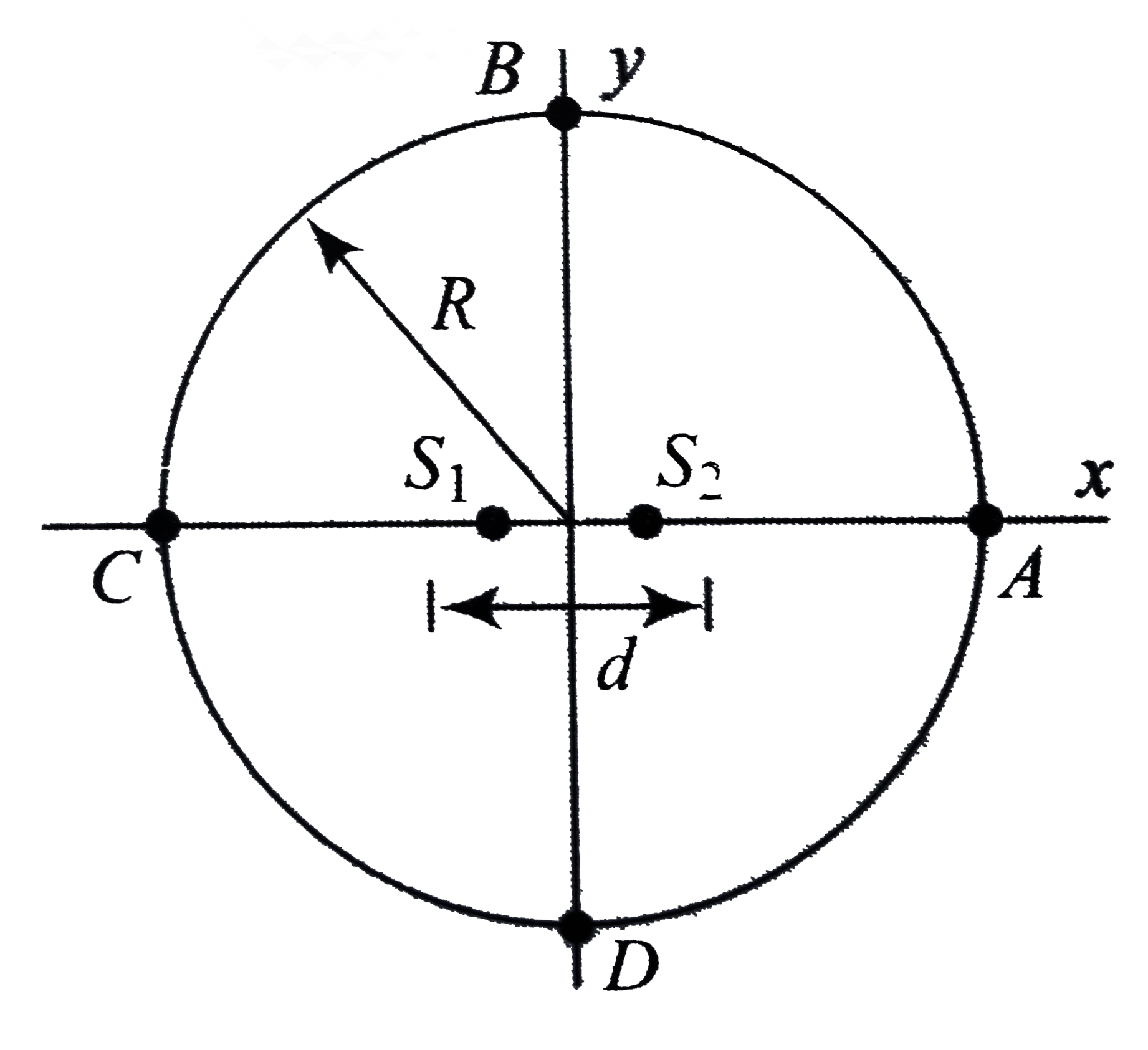
Two source are placed on x-axis at a separation `d = 3lambda`. An observer starts moving from A on a circular track of radius R `(R gt gt d)`. How many bright points and dark points will he observer?
Find the angular positions of maxima and minima.
.

Text Solution

Verified by Experts

The observer will have maximum path difference at position A and C equal to `3 lambda`
Minimum path difference equals to zero at position B and D.
In each quarter circle, he will have path difference between 0 and `3 lambda`
path difference corresponding to maxima in our given range is 0, `lambda, 2 lambda, 3 lambda`.
Path difference corresponding to minima inour given range is `lambda//2, 3 lambda//2, 5 lambda//2`.
Hence total number of bright point in the complete circular path is `4 xx 2 + 4 = 12`.
Total number of dark points on circular path is `4 xx 3 = 12`.
Hence, the observer will find 12 bright points and 12 dark points in the circular track.
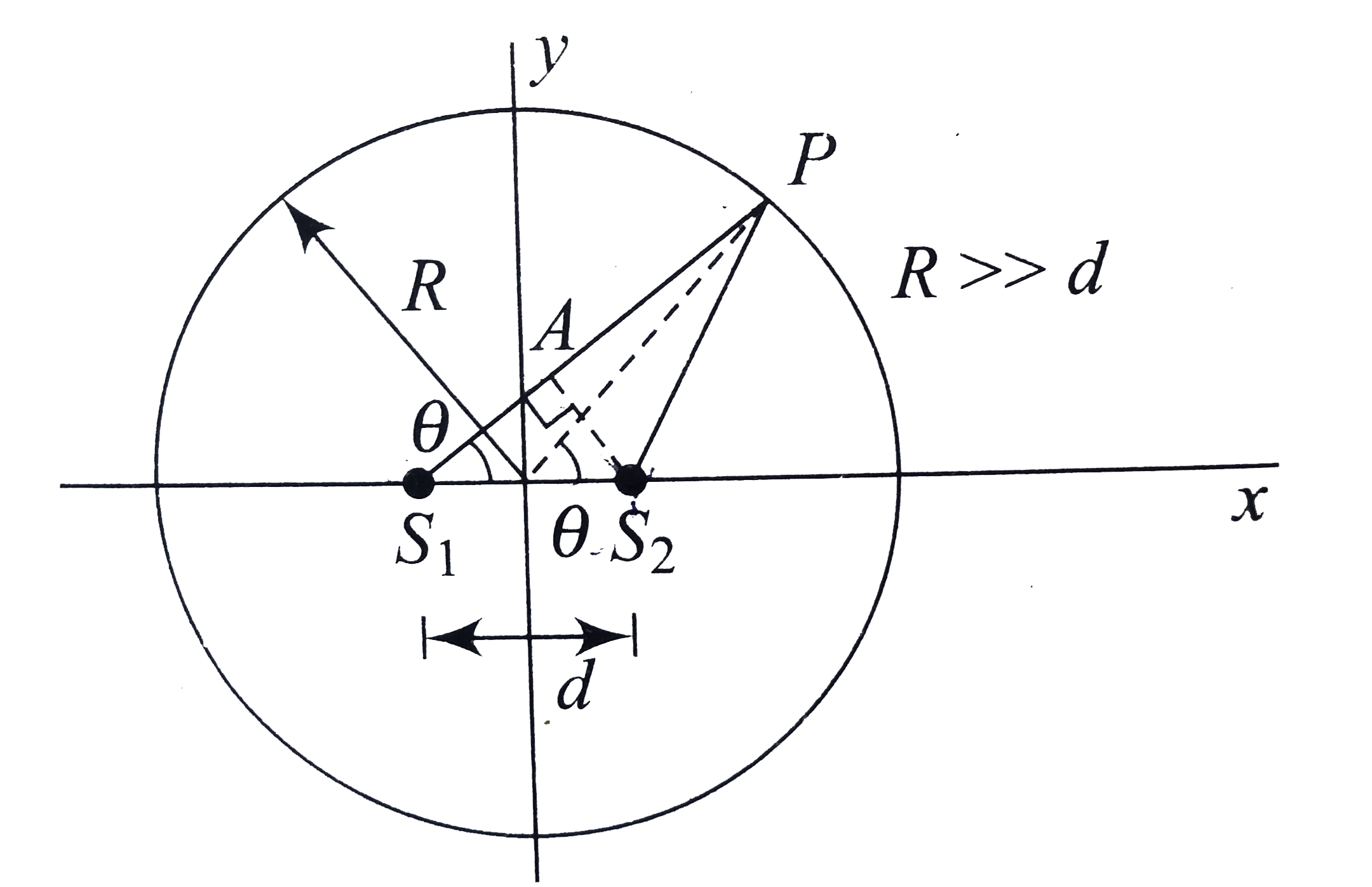
Finding angular positions of maxima and minima:
Path difference at point P.
`S_(1)P -S_(2)P = Delta x`
` S_(1) A = Delta x`
`d cos theta = Delta x`
Hence, `cos theta = (lambda D)/(4d)`
`implies theta = cos^(-1) ((Delta x)/(d))`
For Maxima, `Delta x = n lambda`
For minima,`Delta x = (2n - 1)(lambda)/(2)`
.
Promotional Banner

Topper's Solved these Questions

  • WAVE OPTICS

    CENGAGE PHYSICS|Exercise Solved Examples|10 Videos
  • WAVE OPTICS

    CENGAGE PHYSICS|Exercise Exercise 2.1|12 Videos
  • THERMODYNAMICS

    CENGAGE PHYSICS|Exercise QUESTION BANK|34 Videos
  • WAVES

    CENGAGE PHYSICS|Exercise QUESTION BANK|38 Videos

Similar Questions

Explore conceptually related problems

Two sources of sound are placed along the diameter of a circle of radius R(R gt gt 41) . How many minima will be heard as one moves along the perimeter of circle.

Two monochromatic (wavelength =a//5 ) and coherent sources of electromagnetic waves are placed on the x-axis at the point (2a,0) and (-a,0) . A detector moves in a circle of radius R(gt gt 2a) whose centre is at te origin. The number of maximas detected during one circular revolution by the deterctor are -

Two coherent sources separated by distance d are radiating in phase having wavelength lambda . A detector moves in a big circle around the two sources in the plane of the two sources. The angular position of n=4 interference maxima is given as

Two point sources are placed on a straight line separated by a distance d = 3 lambda . Both the sources are placed at a distance L from a wall which is perpendicular to the straight line. Both the sources are sending waves of equal intensity. Find: a. Locus of the points on the wall having equal intensity. b. Maximum and minimun path difference observed on the wall.

Figure shows two coherent sources S_(1) and S_(2) which emit sound of wavelength lambda in phase. The separation between the sources is 3lambda. A circular wire of large radius is placed in such a way that S_(1)S_(2) lies in its plane and the middle point of S_(1)S_(2) is at the centre of the wire. Find the angular positions theta, on the wire for which constructive interference takes place.

In Fig. 3.12 a particle moves along a circular parth of radius r. It starts from point A and moves anticlockwise. Find the distance travelled by the particle as it : moves A to D

Sound from a point isotropic source spreads equally in all directions in homogeneous medium. Therefore its intensity decreases with square of distance from the source. When distance between observer and the source changes, apart from changes in intensity, the observer listens sound of pitch higher or lower than actual pitch depending upon the fact that the distance between the observer and source is decreasing or increasing respectively. An observer O is at a distance 2R from centre of a circle of radius R. A point isotropic sound source S moves on the circle with uniform angular velocity omega = pi//3 " rad"//s . Initially observer, source and centre of the circle are in same line. Starting from initial moment, the source moves through an angular displacement 180^(@) . Intensity of the sound as observed by the observer decreases by a factor of –

In Fig. 3.12 a particle moves along a circular parth of radius r. It starts from point A and moves anticlockwise. Find the distance travelled by the particle as it : moves from A to C

In Fig. 3.12 a particle moves along a circular parth of radius r. It starts from point A and moves anticlockwise. Find the distance travelled by the particle as it : moves from A to B

CENGAGE PHYSICS-WAVE OPTICS-QUESTION BANK
  1. Two source are placed on x-axis at a separation d = 3lambda. An observ...

    Text Solution

    |

  2. In a single slit diftion, slit width is 0.6mm and distance of first mi...

    Text Solution

    |

  3. The ratio of resolving powers of an optical microscope for two wavelen...

    Text Solution

    |

  4. A beam of light of lambda=600 nm from a.distant sourcé falls on a sing...

    Text Solution

    |

  5. In Young's double slit experiment, the slits are 2 mm apart and are il...

    Text Solution

    |

  6. In a Young's double slit experiment the spacing between the slits is 0...

    Text Solution

    |

  7. A slit of size 0.15m is placed at 2.1m from a screen. On illuminated i...

    Text Solution

    |

  8. In the Young's double-slit experiment, the intensity of light at a poi...

    Text Solution

    |

  9. In YDSE distance between slits and screen is 1.5 m. When light of wave...

    Text Solution

    |

  10. Two Polaroids P(1) and P(2) are placed with their axis perpendicular t...

    Text Solution

    |

  11. In an YDSE, the fringes are formed at a distance of 1 m from double sl...

    Text Solution

    |

  12. In Young's double slit experiment the separation d between the slits i...

    Text Solution

    |

  13. A single slit is of width 0.5mm. Distance of screen from slit is 1 m. ...

    Text Solution

    |

  14. In YDSE distance between slits is 0.2 mm, distance between slit & scre...

    Text Solution

    |

  15. In an interference pattern the (n+4)^(th) blue bright fringe and n^(th...

    Text Solution

    |

  16. In double slit experiment, the angular width of the fringes is 0.20^(c...

    Text Solution

    |

  17. A light has amplitude A and angle between analyser and polariser is 60...

    Text Solution

    |

  18. A unpolarised light is passing through three polaroids as shown. If fi...

    Text Solution

    |

  19. In YDSE, if sources are incoherent, the intensity on screen is 13 I(0^...

    Text Solution

    |

  20. An unpolarized light passes through three polarizing sheets whose pola...

    Text Solution

    |

  21. In a Young's double slit experiment, 60 fringes were seen in the field...

    Text Solution

    |