Home
Class 12
PHYSICS
An oil film (n = 1.45) floating on water...

An oil film `(n = 1.45)` floating on water is illuminated by white light at normal incidence. The film is 280 nm thick. Find (a) the color or the light in the visible specturm most strongly reflected and (b) the color of the light in the specturm most strongly transmitted. Explain your reasoning.

Text Solution

Verified by Experts
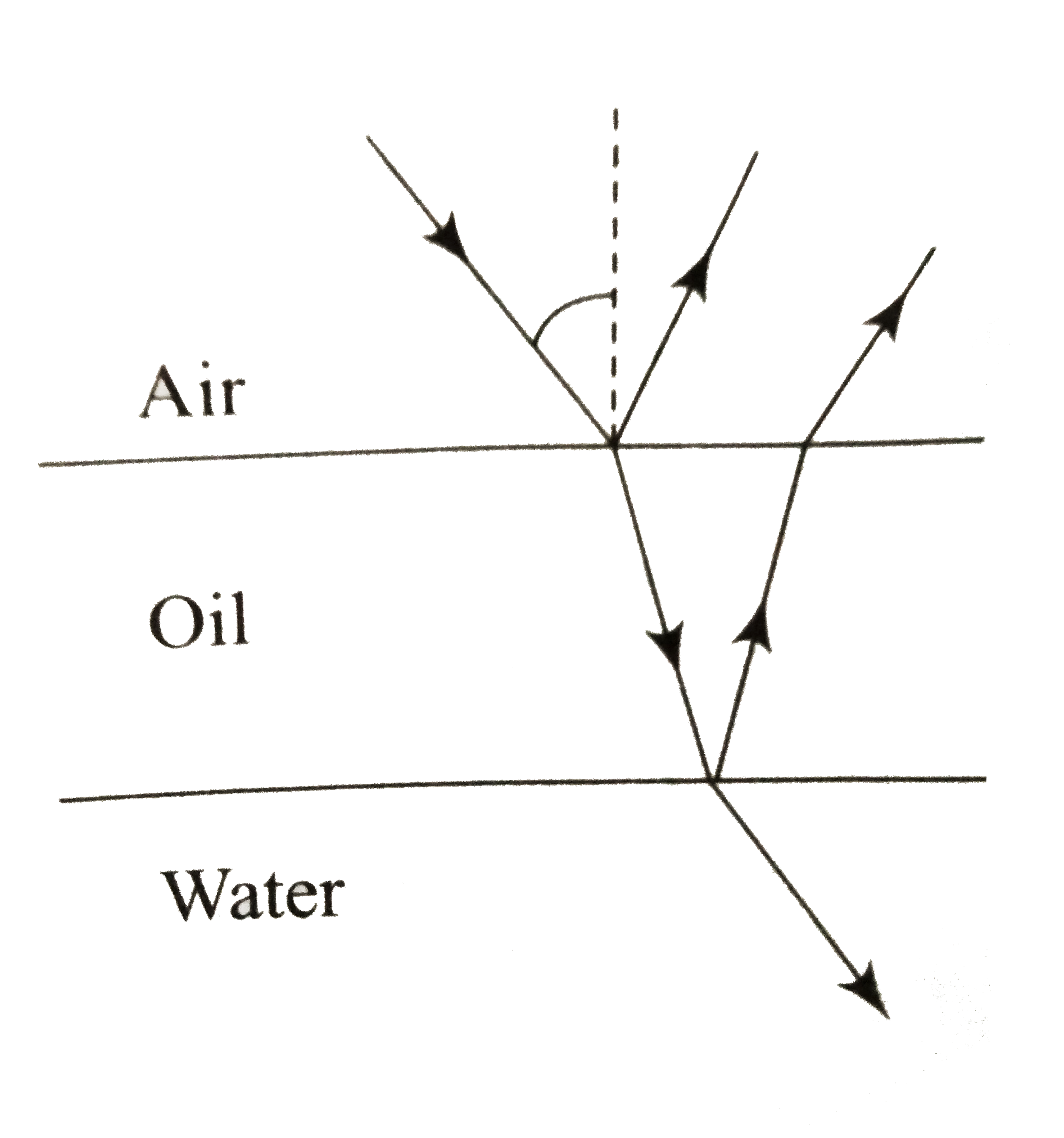
The light reflected from the top of the oil film undergoes phase reversal. Since `1.45 gt 1.33`, the light reflected from the bottom undergoes no reversal. For constructive interference of reflected light, we then have
`2 n t = (m + (1)/(2)) lambda`
or `lambda_(m) = (2 n t)/(m + (1)/(2)) = (2(1.45)(280nm))/(m + (1)/(2))`
substituting for m gives:
`m = 0, lambda_(0) = 1620 nm` (infrared)
`m = 1, lambda_(1) = 54 nm` (green)
`m = 2 lambda_(2) = 325 nm` (ultraviolet)
Both infrared and ultraviolet lights are invisible to the human eye, so the dominant color in reflected light is green.
b. The dominant wavelengths in the transmitted light are those that produce destuctive interference in the reflected light The condition for destructive interference upon reflection is
`2 nt = m lambda`
or `lambda_(m) = (2nt)/(m) = (812 nm)/(m)`
substituting for m gives
`m = 1, lambda_(1) = 812 nm` (near infrared)
`m = 2, lambda_(2) = 406 nm` (violet)
`m = 3, lambda_(3) = 271 nm` (ultraviolet)
Of these, the only wavelength visible to the human eye (and hence the dominant wavelength observed in hte transmitted light) is 406 nm. Thus, the dominant color in the transimitted light is violet.
Promotional Banner

Topper's Solved these Questions

  • WAVE OPTICS

    CENGAGE PHYSICS|Exercise Exercise 2.2|22 Videos
  • WAVE OPTICS

    CENGAGE PHYSICS|Exercise Subjective|11 Videos
  • WAVE OPTICS

    CENGAGE PHYSICS|Exercise Solved Examples|10 Videos
  • THERMODYNAMICS

    CENGAGE PHYSICS|Exercise QUESTION BANK|34 Videos
  • WAVES

    CENGAGE PHYSICS|Exercise QUESTION BANK|38 Videos

Similar Questions

Explore conceptually related problems

Oil floating on water looks cloured due to interference of light. What should be the approximate thickness of the film for such effects to be visible ?

A parallel beam of white light is incident normally on a water film 1.0 x 10^-4 cm thick. Find the wavelength in the visible range (400 nm-700 nm) which are strongly transmitted by the film Refractive index of water = 1.33.

When white light is incident normally an oil film of thickness 10^-4 cm and refractive index. 1.4 then the wavelength which will not be seen in the reflected system of light is

A thin film of refractive index 1.5 and thickness 4 xx 10^(-5) cm is illuminated by light normal to the surface. What wavelength within the visible spectrum will be intensified in the reflected beam?

A glass plate (n=1.53) that is 0.485 mu m thick and surrounded by air is illuminated by a beam of white light normal to the plate. (a) What wavelengths (in air) within the limits of the visible spectrum (lambda = 400 "to" 700 nm) are intensified in the reflected beam ? (b) What wavelengths within the visible spectrum are intensified in the transmitted light?

A 4.0 xx 10^(2) nm thick film of kerosene (n = 1.2) is floating on water. White light is normally incident on the film. What is the visible wavelength in air that has a maximum intensity after the light is reflected? Note: The visible wavelength range is 380 nm to 750 nm.

A soap bubble (n = 1.33) is floating in air. If the thickness of the bubble wall is 115 nm, what is the wavelength of the light that is most strongly reflected?

Assertion: The colour of the oil film on the surface of water continuously changes. Reason: The colour of the light reflected by the oil film depends upon its thickness.

A thin soap film of thickness 3 xxx 10^(-7)m and mu = 1.5 is spreaded on a glass surface. When white light is normally incident on this sheet, find the colour which will be reflected strongly by the film. [4500Å]

