Home
Class 12
CHEMISTRY
In terms of CFT explain why a d^(9) octa...

In terms of `CFT` explain why a `d^(9)` octahedral complex with six identical ligands is not expected tom have all size `m-L` distane identical .

Text Solution

Verified by Experts
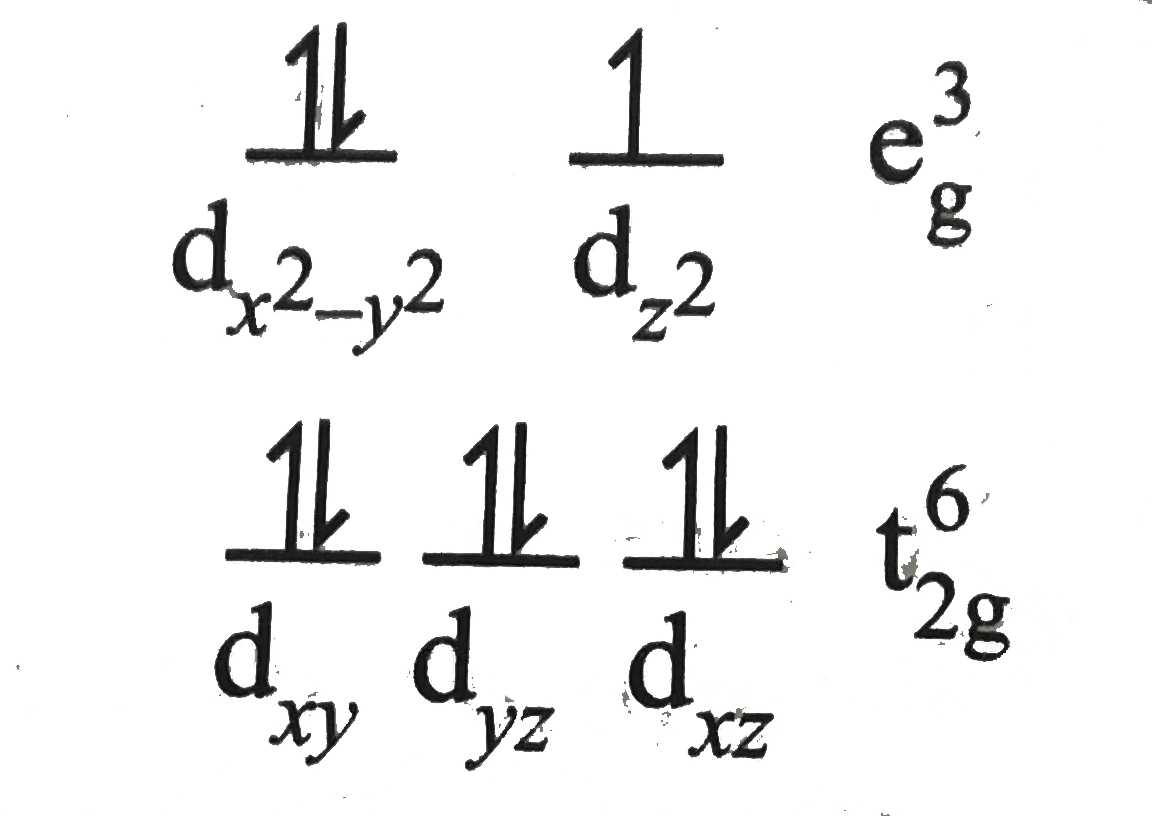
For `d^(9)` octahedral complex the configuration will be `t_(2g) ^(6) e_(g)^(3)`

One of the `e_(g)` orbitals is completely filled and other is half filled and hence interation with the ligands is expected to be different .
Promotional Banner

Topper's Solved these Questions

  • COORDINATION COMPOUNDS

    CENGAGE CHEMISTRY|Exercise Ex 7.1 Subjective (Terminology)|5 Videos
  • COORDINATION COMPOUNDS

    CENGAGE CHEMISTRY|Exercise Ex 7.1 Subjective (Effective Atomic Number (Ean))|3 Videos
  • COORDINATION COMPOUNDS

    CENGAGE CHEMISTRY|Exercise Archives Subjective|18 Videos
  • CHEMICAL KINETICS

    CENGAGE CHEMISTRY|Exercise Archives Subjective|23 Videos
  • D AND F BLOCK ELEMENTS

    CENGAGE CHEMISTRY|Exercise Archives Subjective|29 Videos

Similar Questions

Explore conceptually related problems

Velence bond theroy describes the bonding in complexs in terms of coordinate -covalent bond resulting from overlap filled ligand orbitals with vacant metal hybrid orbitals This theory explains magnetic behaviour and geometrical shape of coordination compounds Magnetic moment of a complex compound can be determined experimentally and theoretically by using spin only formula Magnetic moment sqrtn (n+2)BM (where n = No. unpaired electrons) . The value of of spin only magnetic moment for octahedral complex of the following configuration is 2.84BM The correct statement is (a) d^(4) (in weak field ligand) (b) d^(2) (in weak field and in strong field ligand) (c) d^(3) (in weak field and in strong field ligand) (d) d^(5) (in strong field ligand) .

When degenerate d-orbitals of an isolated atom/ion come under influence of magnetic field of ligands, the degeneray is lost. The two set t_(2g)(d_(xy),d_(yz),d_(xz)) and e_(g) (d_(x^(2))-d_(x^(2)-y^(2)) are either stabilized or destabilized depending upon the nature of magnetic field. it can be expressed diagrammatically as: Value of CFSE depends upon nature of ligand and a spectrochemical series has been made experimentally, for tetrahedral complexes, Delta is about 4/9 times to Delta_(0) (CFSE for octahedral complex). this energy lies in visible region and i.e., why electronic transition are responsible for colour. such transition are not possible with d^(0) and d^(10) configuration. Q. Ti^(3+)(aq) . is purple while Ti^(4+)(aq) . is colourless because:

When degenerate d-orbitals of an isolated atom/ion come under influence of magnetic field of ligands, the degeneray is lost. The two set t_(2g)(d_(xy),d_(yz),d_(xz)) and e_(g) (d_(x^(2))-d_(x^(2)-y^(2)) are either stabilized or destabilized depending upon the nature of magnetic field. it can be expressed diagrammatically as: Value of CFSE depends upon nature of ligand and a spectrochemical series has been made experimentally, for tetrahedral complexes, Delta is about 4/9 times to Delta_(0) (CFSE for octahedral complex). this energy lies in visible region and i.e., why electronic transition are responsible for colour. such transition are not possible with d^(0) and d^(10) configuration. Q. Cr^(3+) form four complexes with four different ligands which are [Cr(Cl)_(6)]^(3-), [Cr(H_(2)O)_(6)]^(3+) , [Cr(NH_(3))_(6)]^(3+) and [Cr(CN)_(6)]^(3-) , the order of CFSE (Delta_(0)) in these complexes in the order:

CENGAGE CHEMISTRY-COORDINATION COMPOUNDS-Solved Examples
  1. The enthalpy of hydration of the Fe^(2+) ion is 11.4kcal//mol higher t...

    Text Solution

    |

  2. If a complexing metal of the first transition series has a di configur...

    Text Solution

    |

  3. In terms of CFT explain why a d^(9) octahedral complex with six identi...

    Text Solution

    |

  4. Derive the geometry of the complex compound corresponding to the brown...

    Text Solution

    |

  5. Which of the electronic configuration according to crystal field theor...

    Text Solution

    |

  6. Which of the electronic configuration according to crystal field theor...

    Text Solution

    |

  7. According to crystal field therory the electronic configuration of the...

    Text Solution

    |

  8. According to crystal field theory the electronic configuration of the ...

    Text Solution

    |

  9. According to crystal field theory the electronic configuration of the ...

    Text Solution

    |

  10. Corystal field splitting energy (CFSE) for the complex [Cr(H(2)O)(6)]^...

    Text Solution

    |

  11. Crystal field splitting energy (CFSE) for the complex [Cr(NH(3))(6)]^(...

    Text Solution

    |

  12. Crystal field splitting energy (CFSE) for the complex [Cr(H(2)O)(6)]^(...

    Text Solution

    |

  13. Crystal field splitting energy (CFSE) for the complex [Cr(NH(3))(6)]^(...

    Text Solution

    |

  14. Crystal field splitting energey (CFSE) for the complex [Cr(NH(3)(6)]^(...

    Text Solution

    |

  15. In which structure crystal field splitting energey (CFSE) for octahedr...

    Text Solution

    |

  16. In which structure crystal field splitting energey (CFSE) for octahedr...

    Text Solution

    |

  17. Crystal field splitting energey (CFSE) for the complex [Fe(CN)(4)]^(Θ)...

    Text Solution

    |

  18. Crystal field splitting energey (CFSE) for the complex [Fe(O)(4)]^(2-)...

    Text Solution

    |

  19. CFSE for d^(6) octahedral complex having Delta =250 and P =125kJmo1^(-...

    Text Solution

    |

  20. The enthalpy of hydration of Cr^(+2) is -460 kcal mo1^(-1) In the abse...

    Text Solution

    |

