Home
Class 11
CHEMISTRY
Using the curved-arrow notation, show th...

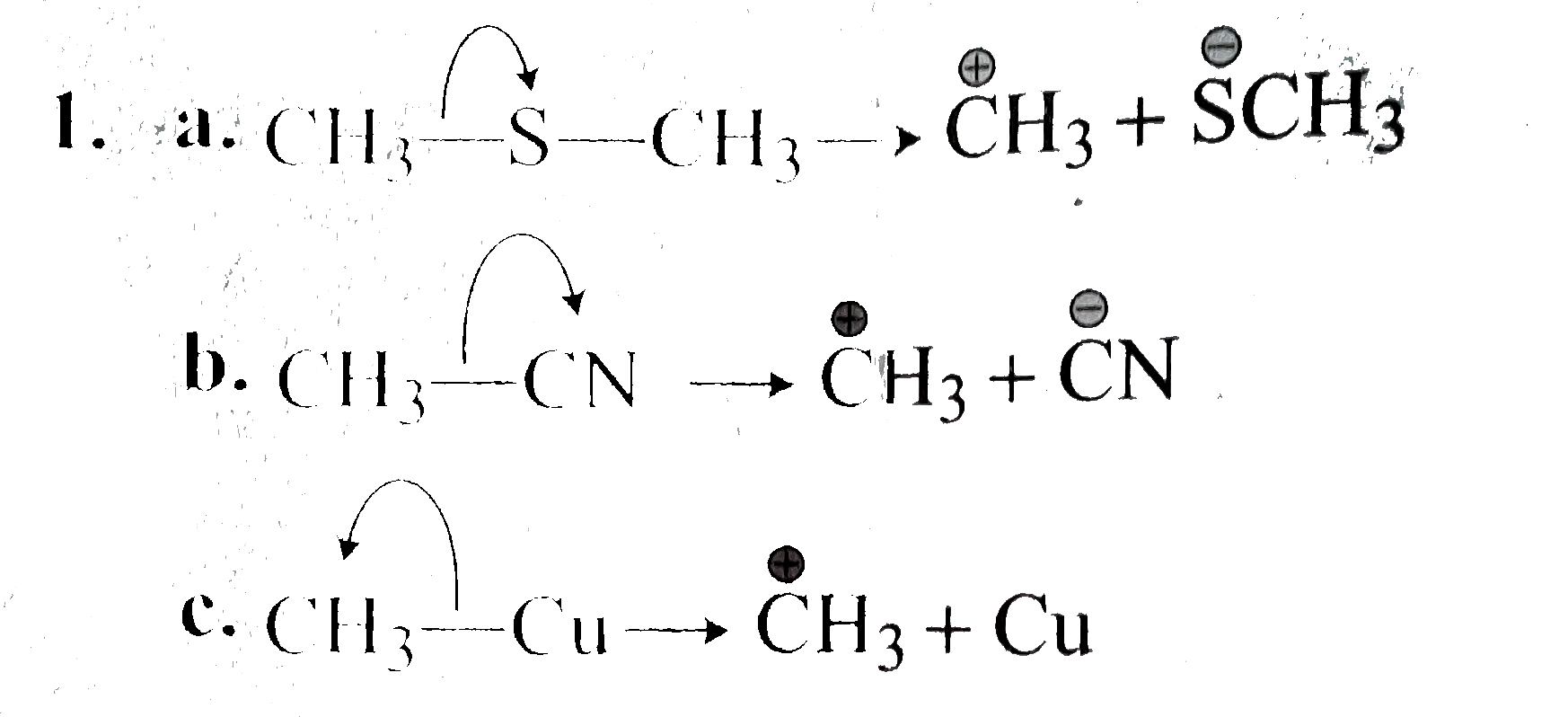
Using the curved-arrow notation, show the formation of reactive intermediates when the following convalent bonds undergo heterolytic cleavage :
(a) `CH_3 - S - CH_3`
(b) `CH_3 - CN`
( c) `CH_3 - Cu` .

Text Solution

Verified by Experts
.
(Cu is more electropositive than C)
Promotional Banner

Topper's Solved these Questions

  • GENERAL ORGANIC CHEMISTRY

    CENGAGE CHEMISTRY|Exercise Comprehension|20 Videos
  • GENERAL ORGANIC CHEMISTRY

    CENGAGE CHEMISTRY|Exercise Multiple Correct|22 Videos
  • GENERAL ORGANIC CHEMISTRY

    CENGAGE CHEMISTRY|Exercise Subjective|11 Videos
  • CLASSIFICATION AND NOMENCLATURE OF ORGANIC COMPOUNDS

    CENGAGE CHEMISTRY|Exercise Analytical and Descriptive Type|3 Videos
  • HYDROGEN, WATER AND HYDROGEN PEROXIDE

    CENGAGE CHEMISTRY|Exercise Subjective Archive (Subjective)|3 Videos

Similar Questions

Explore conceptually related problems

Using curved arrows rotation,show the formation of reactive intermediates when the following covalent bonds undergo heterolytic fission. (a) CH_(3)-CN (b) CH_(3)-Cu

Using curved-arrow notation, show the formation of reactive intermediates when convalent bonds in the following substance undergo heterolytic (polar) cleavage. (i) CH_(3)-SCH_(3) , (ii) CH_(3)-CN (iv) CH_(3)-Cu , (iv) Ag-I (v) H_(3)N^(+)-BF_(3) , (vi) Cu(-OH_(2))_(4)^(2+) Stratergy: Both bonding electrons remain with the more electronegative atom. If the bonding atom have same electronegetivities,, then the bonding electrons are taken away by the larger atom as it can sustain the negative charge more effectively.

In CH_(3)CH_(2)OH, the bond that undergoes heterolytic cleavage most readily is

In CH_(3)CH_(2)OH , the bond that undergoes heterolytic cleavage most readily is

Identify electrophilic centre in the following : (1) CH_3CH=O (2) CH_3-CN (3) CH_3 I .

Knowledge Check

  • In CH_(3)CH_(2)OH the bond that undergoes heterolytic cleavage most readily is:

    A
    `C-C`
    B
    `C-O`
    C
    `C-H`
    D
    `O-H`
  • In CH_(3)CH_(2)OH, the bond that undergoes heterolytic cleavage most readily is

    A
    `C-C`
    B
    `C-O`
    C
    `O-H`
    D
    `C-H`
  • In CH_(3)CH_(2)OH , the bond that undergoes heterolytic cleavage most readily is

    A
    C-C
    B
    C-O
    C
    C-H
    D
    O-H
  • CENGAGE CHEMISTRY-GENERAL ORGANIC CHEMISTRY-Concept
    1. Using the curved-arrow notation, show the formation of reactive interm...

      Text Solution

      |

    2. Categorise the following molecules/ions ad nucleophile or electrophile...

      Text Solution

      |

    3. Identify electrophilic centre in the following : (1) CH3CH=O (2) C...

      Text Solution

      |

    4. Which bond is more polar in the following pairs of molecules ? (a) H...

      Text Solution

      |

    5. In which (C - C) bond of (H3 overset (3)C - overset (2) C H2 - overset...

      Text Solution

      |

    6. Write the resonance structures of (1) CH3 COO^(Ө) and (2) CH2 = CH - C...

      Text Solution

      |

    7. Explain why the following two structures (I) and (II) cannot be the ma...

      Text Solution

      |

    8. Explain why (CH3)3C^(oplus) is more stable than CH3 overset (oplus) C ...

      Text Solution

      |

    9. Draw the complete structures of bromomethane, bromethane, 2-bromopropa...

      Text Solution

      |

    10. Which is expected to be more stable, (I) O2NCH2CH2O^- or (II) CH3C...

      Text Solution

      |

    11. Draw the resonance structures for the following compounds. Show the el...

      Text Solution

      |

    12. Explain why alky1 groups act as electron donors when attacted to a pi-...

      Text Solution

      |

    13. Classify the reagents shown in bonds in the following equations as nuc...

      Text Solution

      |

    14. Classify the following in one of the reaction type studied. (a) CH3C...

      Text Solution

      |

    15. What is the relationship between the members of the following pairs of...

      Text Solution

      |

    16. For the following bond cleavages, use curved-arrow to show the electro...

      Text Solution

      |

