Home
Class 11
PHYSICS
Three particles A, B and C are situated ...

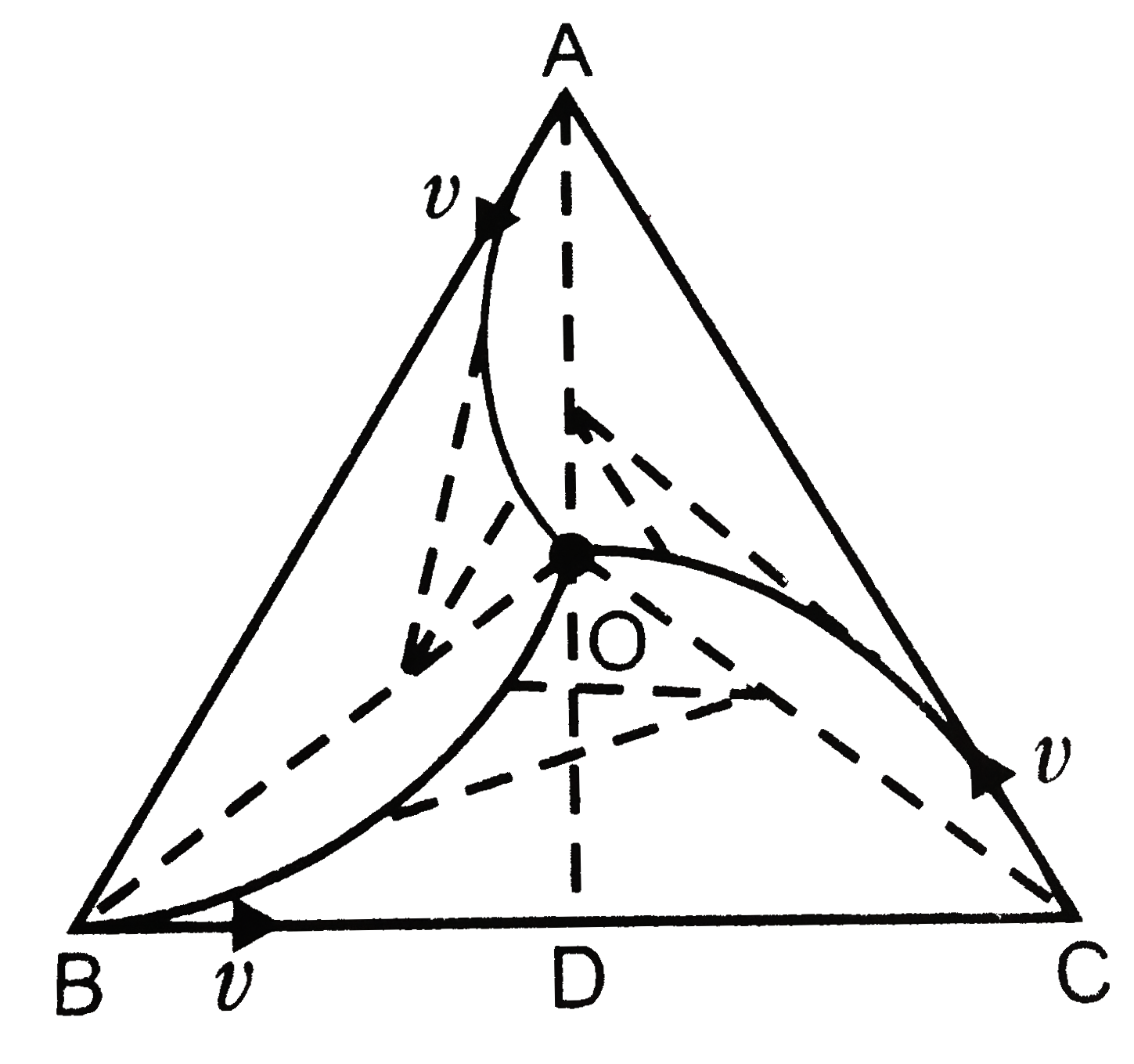
Three particles A, B and C are situated at the vertices of an equilateral triangle ABC of side d at time `t=0.` Each of the particles moves with constant speed v. A always has its velocity along AB, B along BC and C along CA. At what time will the particles meet each other?

Text Solution

Verified by Experts
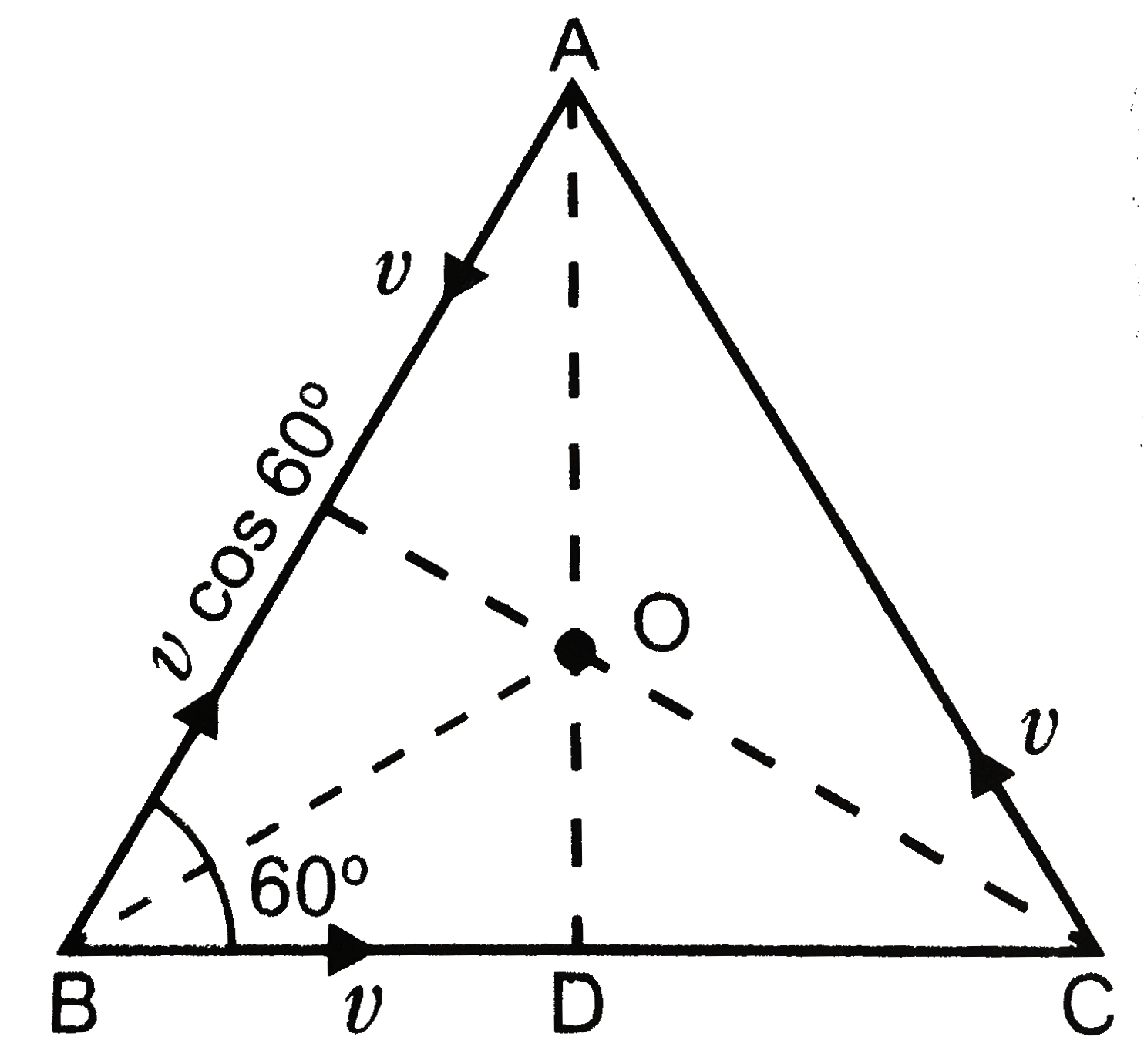
`1st` method. In 2 (a) 45, the velocity of (A) is along (AB) The velocity of (B) is along (BC) The component velocity of (B) along ` BA= v cos 60^@ = v//2 `. Thus the separation of partivles at (A) and (B) dereases with the speed` = v+ v//2 = 3 v//2 `.
.
Since, this speed is constant, the time taken in reducing the separation ` AB` from ` (A) to zero is, ltbRgt ` =a// ( 3 v//2) = 2 a//3 v`
` 2nd` method. The motion of three particles at ` A` , B` and ` C` is shown in Fig. 2 (a) 46` by solid curved lines . They will be meeting at the centroid (O) of the triangle ` ABC`. It means a particle at (A) will be covertin a distance ` AO` before meeting the other particle. The velocity of particele at (A) along
` AO = v cos 30^@ = v sqrt 3 //2`
.
distance, ` AO( = 2/3 AD = 2/3 sqrt( a^2 -a^2 //4) = a/ (sqrt3)`
Therefore, the time taken by particle at (A) to go from (A) to (O)
` (AO)/ ( v cos 30^@) = ( a //sqrt 3)/( v sqrt 3 //2 ) = ( 2a)/ (3v)`.
Promotional Banner

Topper's Solved these Questions

  • KINEMATICS

    PRADEEP|Exercise 2 Problems for practice|36 Videos
  • KINEMATICS

    PRADEEP|Exercise 3 Problems for practice|67 Videos
  • KINEMATICS

    PRADEEP|Exercise Value based|5 Videos
  • GRAVIATION

    PRADEEP|Exercise Assertion-Reason Type Questions|19 Videos
  • LAWS OF MOTION

    PRADEEP|Exercise Assertion- Reason Type Questions|17 Videos

Similar Questions

Explore conceptually related problems

Three particles A,B and C and situated at the vertices of an equilateral triangle ABC of side of length l at time t=0 ,Each of the particles move with constant speed u . A always has its velocity along AB, B along BC and C along CA .

Four particles A, B, C and D are situated at the cornerst of a square ABCD of side a at t-0 . Each of particles moves with constant speed (v). A always has its velocity along AB, B along BC, C along CB~ and D along DA . At what time will these particles meet each other ?

Three boys A,B and C are situated at the vertices of an equilateral triangle of side d at t=0. Each of the boys moves with constant speed v. A always moves towards C and C towards A, At what time and where they meet each other?

Three particles A, B, Care located at the comers of an equilateral triangle as shown in figure. Each of the particle is moving with velocity v. Then at the instant shown, the relative angular velocity of

Three particles each of mass m are palced at the corners of an equilateral triangle of side b . The gravitational potential energy of the system of particle is

Three insects A,B and C are situated at the vertices of an equillateral triangle of side 1. the insect A heads towards B,B towards C,C towards A with constant speeds v such that they always remain at the vertices of an equilateral triangle. Find the (a) time of their meeting (b) equation of path traced by one insect relative to the other.

Three particles A, B and C situated at vertices of an equilateral triangle, all moving with same constant speed such that A always move towards B, B always towards C and C always towards A . Initial seperation between each of the particle is a. O is the centroid of the triangle. Distance covered by particle A when it completes one revolution around O is

Three identical particles are located at the vertices of an equilateral triangle. Each particle moves along a meridian with equal speed towards the centroid and collides inelastically.

Three particle A, B and C situated at the vertices of an equilateral triangle starts moving simultaneously at a constant speed "v" in the direction of adjacent particle, which falls ahead in the anti-clockwise direction. If "a" be the side of the triangle, then find the time when they meet

PRADEEP-KINEMATICS-1 Problems for practice
  1. A cae is travelling along a straight line. It covers one-half of the t...

    Text Solution

    |

  2. A table clock has its minute hand 5.0 cm long. Find the average veloc...

    Text Solution

    |

  3. The science lecture theatre of a college is 10 m wide and has a dorr ...

    Text Solution

    |

  4. A ship moves due east at 12km h^(-1) for one hour and then turns exac...

    Text Solution

    |

  5. A body travelling along a straight line traversed one thired of the to...

    Text Solution

    |

  6. A drunkard waking in a borrow lane takes 6 steps forward and 4 steps...

    Text Solution

    |

  7. Two trains 90 m and 120 in length are running in opposite directions ...

    Text Solution

    |

  8. Two card are moving in the same direction with the same speed of 30 k...

    Text Solution

    |

  9. A jet airplane travelling at the speed of 500 km h^(-1) , ejects the ...

    Text Solution

    |

  10. A car (A) is moving with a speed of 40 km h^(-1) and car (B) is movin...

    Text Solution

    |

  11. Two trains 120m and 100 m in length are tunning in opposite directi...

    Text Solution

    |

  12. If a mans speed woth and against the wardr current in a river be 15 k...

    Text Solution

    |

  13. Two buses started simultanceously towards each other from towns (A) an...

    Text Solution

    |

  14. A police is chasing a culprit going n a motorbike. The motorbike cross...

    Text Solution

    |

  15. Two trains, each of length 100 m, are running on parallel tracks. One...

    Text Solution

    |

  16. Tow card are moving in the same direction with the same speed 30 km /...

    Text Solution

    |

  17. Three particles A, B and C are situated at the vertices of an equilate...

    Text Solution

    |

  18. A car travelling ast 60 km/h overtakes another car travellign at 42 km...

    Text Solution

    |

  19. The speed of a motor launch with respect to water in a stream is 8 ms^...

    Text Solution

    |

  20. Two persons (P) and (Q) are standing 54 m apart on a long moving belt...

    Text Solution

    |