Home
Class 11
PHYSICS
If acceleration of A is 2m//s^(2) to lef...

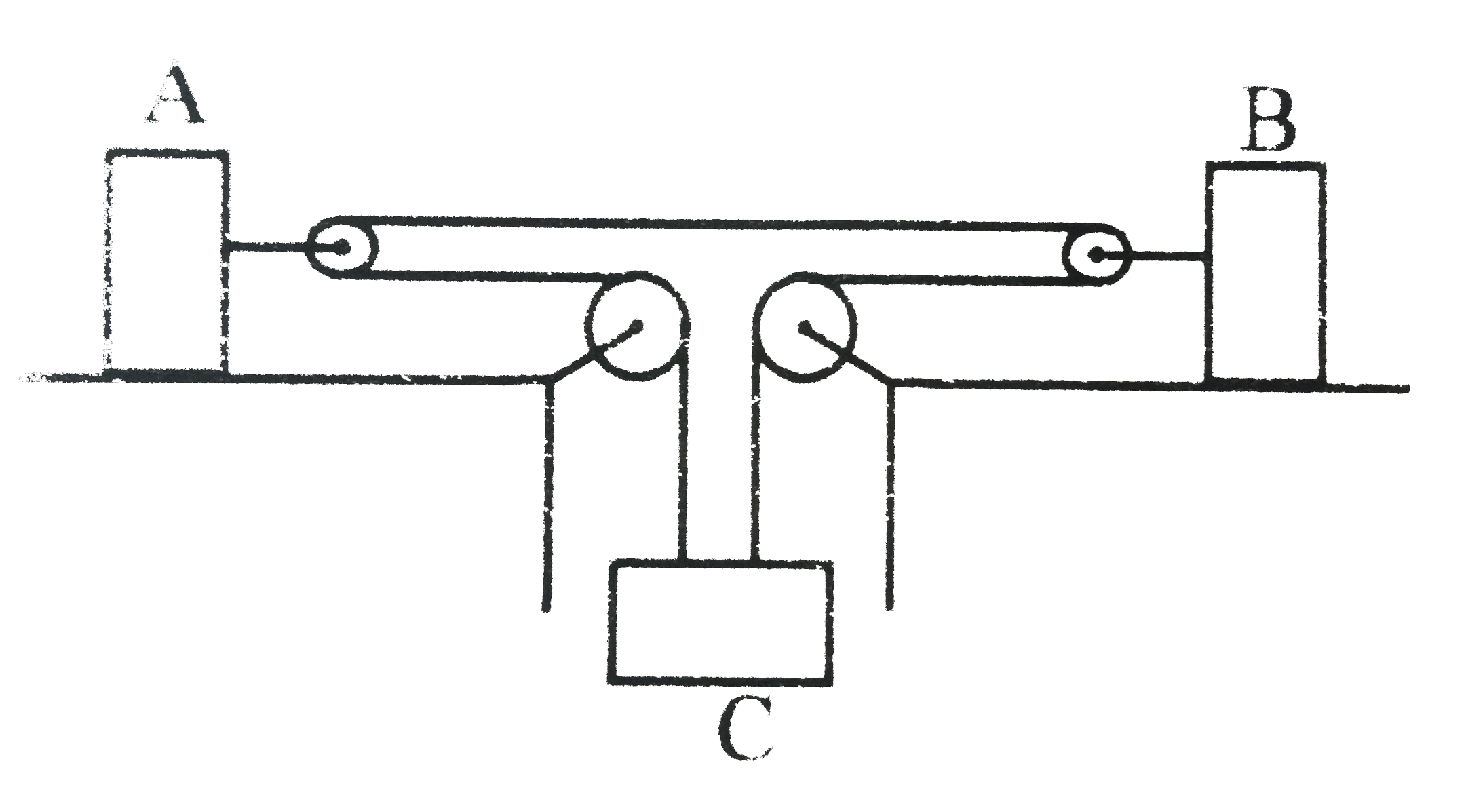
If acceleration of `A` is `2m//s^(2)` to left and acceleration of `B` is `1m//s^(2)` to left, then acceleration of `C` is-

A

`1m//s^(2) upwards`

B

`1m//s^(2)downw`

C

`2m//s^(2) downwards`

D

`2m//s^(2)upwards`

Text Solution

Verified by Experts

The correct Answer is:
A

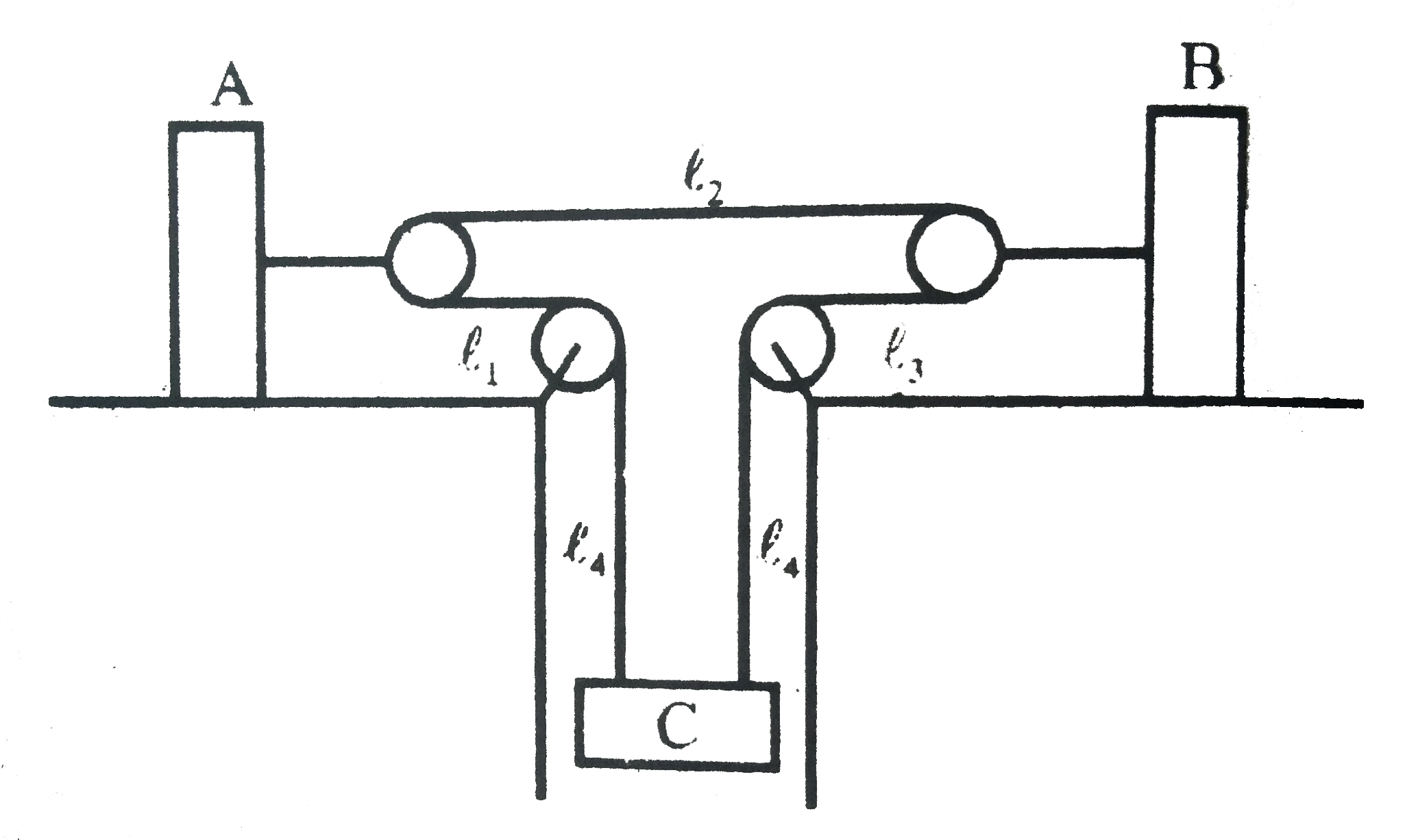
`l_(1) +l_(2) +l_(3) +2l_(4) =` constant
`(dl_(1))/(dt) +(dl_(2))/(dt) +(dl_(3))/(dt) +2(dl_(4))/(dt) = 0`
`(d^(2)l_(1))/(dt^(2)) +(d^(2)l_(2))/(dt^(2)) +(d^(2)l_(3))/(dt^(2)) +2(d^(2)l_(4))/(dt^(2)) = 0`

`2+(2-1) -1+2(d^(2)1_(4))/(dt^(2)) =0`
`a_(B) = - 1m//s^(2)`
`a_(B) = 1m//s^(2) uarr`
Promotional Banner

Similar Questions

Explore conceptually related problems

In the figure acceleration of A is 1m//s^(2) upward, acceleration of B is 7m//s^(2) upward acceleration of C is 2m//s^(2) upward. The acceleration of D will be.

At a certain moment of time, acceleration of the block A is 2 m//s^(2) . Upward and acceleration of block B is 3 m//s^(2) upward. The acceleration of block C is ( masses of pulleys and string are negligible )

If acceleration of A is 2m//s^(2) which is smaller than acceleration of B then the value of frictional force applied by B on A is

A force of 5N gives a mass m_(1) , an acceleration of m//s^(2) , and a mass m_(2) , an acceleration of 24 m//s^(2) . What acceleration would it give if both the masses are tied together?

A force of 2N gives a mass m_(1) an acceleration of 5m//s^(2) and a mass m_(2) an acceleration of 7m//s^(2) . What acceleration would be produced if both the masses are tied together?

A force produces an acceleration of 5" m/s"^(2) in a body and same force an acceleration of 15 "m/s"^(2) in another body. The acceleration produced by the same force when applied to the combination of two bodies will be -

A force of 5N gives a mass m_(1) , an acceleration of 10m//s^(2) , and a mass m_(2) , an acceleration of 20m//s^(2) . What acceleration would it give if both the masses were tied together?

The acceleration due to gravity is 9.8m//s^(2)

Two particles P and Q are moving on circle. At a certain instant of time both the particles and diametrically opposite and P has tangential acceleration 8 m//s^(2) and centripetal acceleration 5 m//s^(2) whereas Q has only e centripetal acceleration of 1 m//s^(2) . At that instant acceleration ("in" m//s^2) of P with respect to Q is

If acceleration of block B is 4 m//s^(2) upward & that of C is 6 m//s^(2) downward. Find acceleration of A :-

