Home
Class 11
PHYSICS
A block of base 10 cm xx 10 cm and heigh...

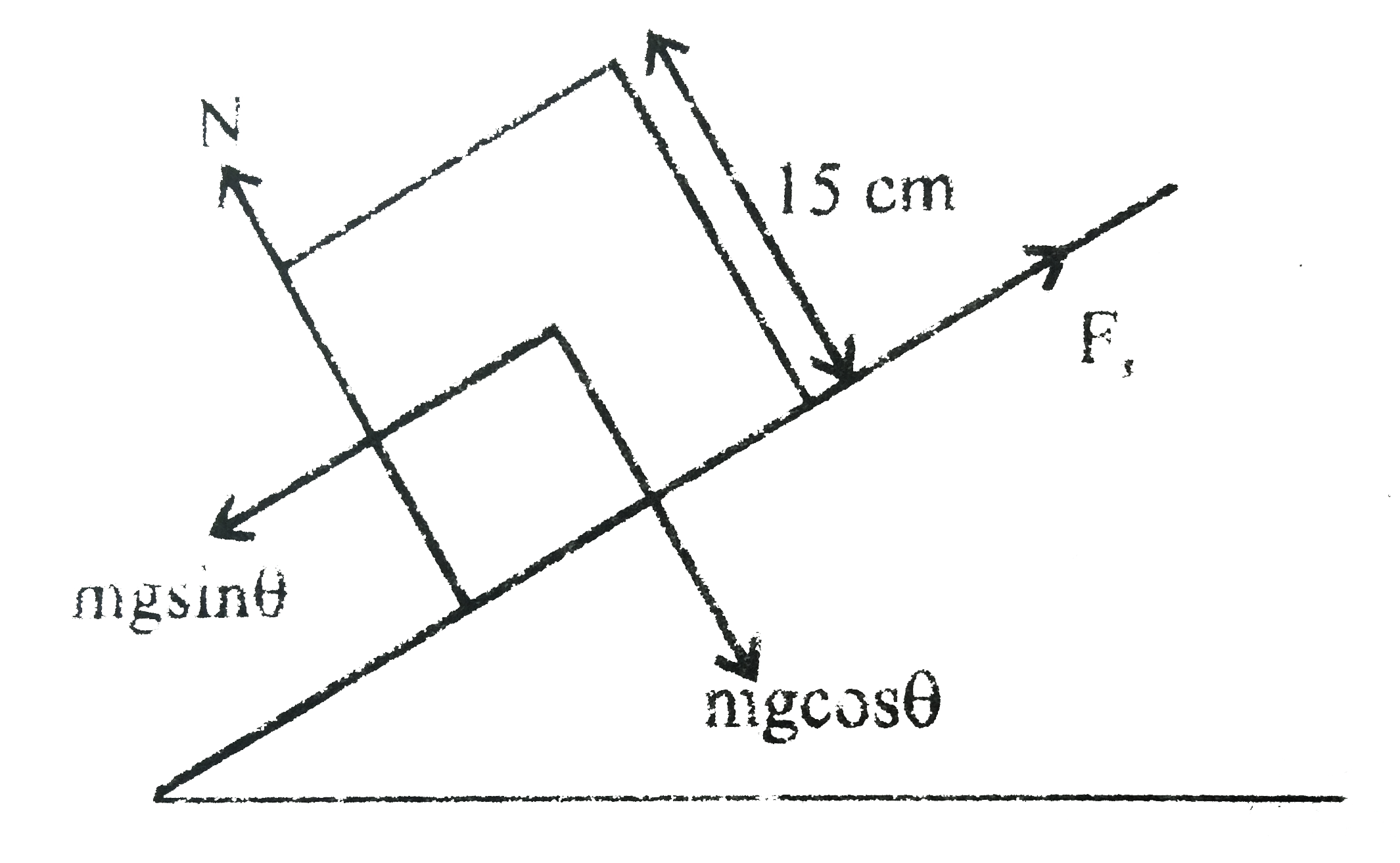
A block of base `10 cm xx 10 cm` and height `15 cm` is kept on an inclined plane. The corfficient of friction between them is `sqrt(3)`. The inclination `theta` of this inclined plane from the horizontal plane is gradually increased from `0^@`. Then

A

at `theta = 30^@`, the block will starts sliding down the plane

B

the block will remain at rest on the plane up to certain `theta` and then it will topple

C

at `theta = 60^@`, the block will start sliding down the plane and continue to do so at higher angles.

D

at `theta = 60^@`, the block will start sliding down the plane and on further increasing `theta`, it will topple at certain `theta`.

Text Solution

Verified by Experts

The correct Answer is:
B

The block will start sliding down (if it does not topple) at angle of repose.
ie, `mu = tan theta` :. `theta = 60^@`
The block will start toppling (if it does not slide at angle `theta` id
`mg sin theta((15)/(2)) = mg cos theta ((10)/(2)) rArr theta_(t), = tan^(-1) ((2)/(3))`
.
:. As `theta_(t) gt theta_(s)` block will first topple before it slides.
Promotional Banner

Similar Questions

Explore conceptually related problems

A block is stationary on an inclined plane If the coefficient of friction between the block and the plane is mu then .

A block with a square base measuring axxa and height h, is placed on an inclined plane. The coefficient of friction is mu . The angle of inclination (theta) of the plane is gradually increased. The block will

A block with a square base measuring axa and height h , is placed on an inclined place. The coefficient of friction is m . The angle of inclination (theta) of the plane is gradually increased. The block will.

A block of mass m rests on a rough inclined plane. The coefficient of friction between the surface and the block is µ. At what angle of inclination theta of the plane to the horizontal will the block just start to slide down the plane?

A block of mass m is placed at rest on an inclination theta to the horizontal.If the coefficient of friction between the block and the plane is mu , then the total force the inclined plane exerts on the block is

A block A is kept on a rough inclined plane. Initially theta = 0 . The co-efficient of kinetic friction between A and the inclined plane is sqrt(3) The angle theta is increased slowly. When theta becomes 60^(@) , then :

An ice cube is kept on an inclined plane of angle 30^(@) . The coefficient to kinetic friction between the block and incline plane is 1//sqrt(3) . What is the acceleration of the block ?

The acceleration of 10 kg block on the inclined plane is

A block of mass m is placed on a rough inclined plane. The corfficient of friction between the block and the plane is mu and the inclination of the plane is theta .Initially theta=0 and the block will remain stationary on the plane. Now the inclination theta is gradually increased . The block presses theinclined plane with a force mgcostheta . So welding strength between the block and inclined is mumgcostheta , and the pulling forces is mgsintheta . As soon as the pulling force is greater than the welding strength, the welding breaks and the blocks starts sliding, the angle theta for which the block start sliding is called angle of repose (lamda) . During the contact, two contact forces are acting between the block and the inclined plane. The pressing reaction (Normal reaction) and the shear reaction (frictional force). The net contact force will be resultant of both. Answer the following questions based on above comprehension: Q. If mu=(3)/(4) then what will be frictional force (shear force) acting between the block and inclined plane when theta=30^@ :

