Home
Class 12
CHEMISTRY
Graph between log k and 1//T [k rate con...

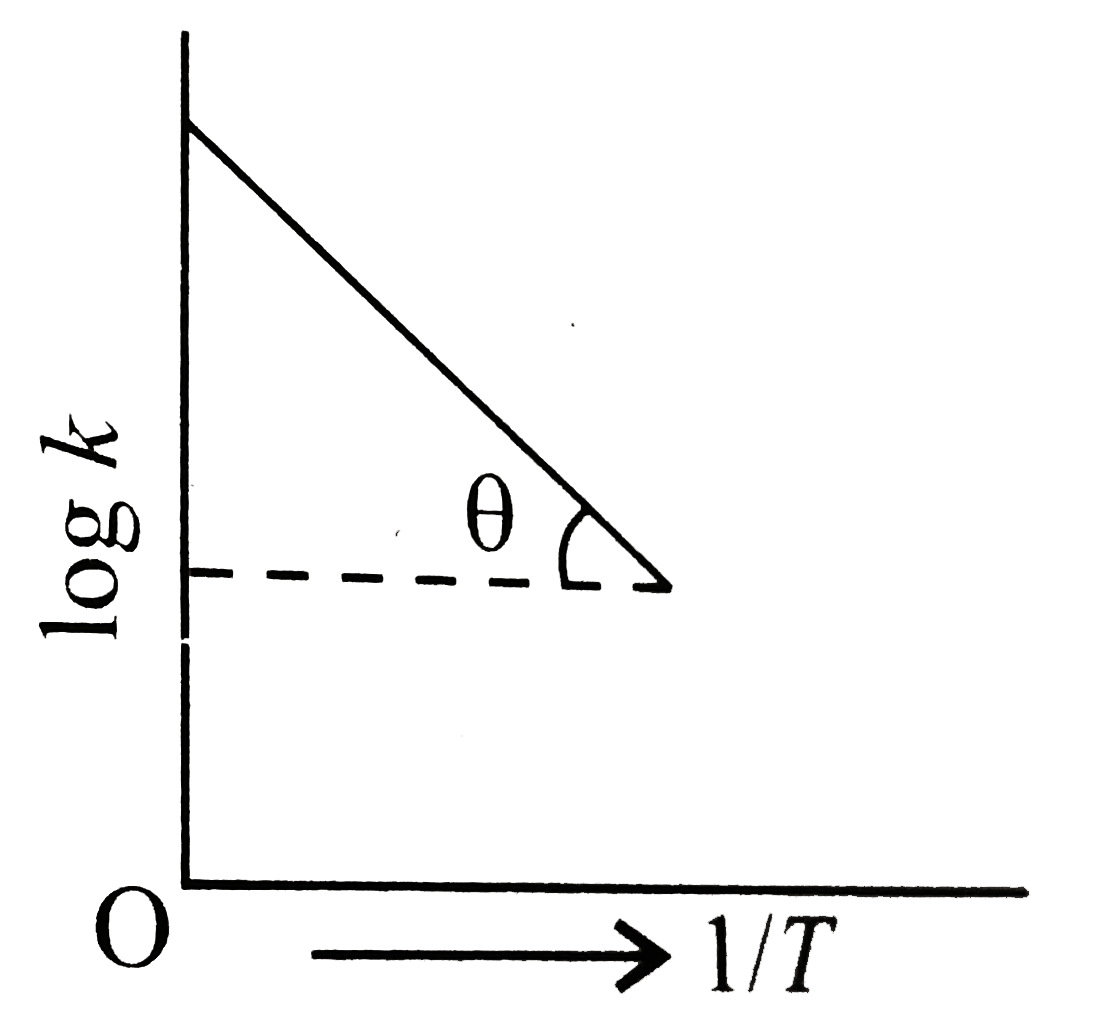
Graph between `log k` and `1//T` [`k` rate constant `(s^(-1))` and `T` and the temperature `(K)`] is a straight line with `OX =5, theta = tan^(-1) (1//2.303)`. Hence `-E_(a)` will be

A

`2.303 xx 2 cal`

B

`2//2.303 cal`

C

`2 cal`

D

None of these

Text Solution

Verified by Experts

The correct Answer is:

C

`log_(10)K vs.(1)/(T)` is linear,
slope `= (-E_(A))/(2.303 R)` intercept `= log_(10)A`
Since, `|tan theta| = (1)/(2.303)`
`:. (E_(A))/(2.303R ) = (1)/(2.303) rArr E_(a) = R = 2 cal`
Promotional Banner

Topper's Solved these Questions

  • CHEMICAL KINETICS

    A2Z|Exercise Parallel Reaction, Consecutive Reaction, Special Cases Of First-Order Reactions|25 Videos
  • CHEMICAL KINETICS

    A2Z|Exercise Section B - Assertion Reasoning|21 Videos
  • CHEMICAL KINETICS

    A2Z|Exercise Initial Rate Method And Ostwaid Method|18 Videos
  • BIOMOLECULES

    A2Z|Exercise Section D - Chapter End Test|30 Videos
  • COORDINATION COMPOUNDS

    A2Z|Exercise Section D - Chapter End Test|30 Videos

Similar Questions

Explore conceptually related problems

Graph between log k and (1)/(T) (k is rate constant in s^(-1) and T is the temperature in K) is a straight line. As shown in figure if OX = 5 and slope of the line =- (1)/(2.303) then E_(a) is :

The graph between log k versus 1//T is a straight line.

A graph plotted between log k vs (1)/(T) is represented by

The graph between the log K versus 1/T is a straight line. The slope of the line is

If a graph is plotted between ln k and 1//T for the first order reaction, the slope of the straight line so obtained is given by

Rate constant k varies with temperature by equation log k (min^(-1)) = log 5 - (2000 kcal)/(RT xx 2.303) . We can conclude that

Knowledge Check

  • Graph between log k and 1 // T [k is rate constant ( s^(-1) ) and T the temperature (K)] is a straight line with OX = 5, theta = tan^(-1)(1 // 2.303) . Hence- E_(a) will be

    A
    `2.303 xx 2` cal
    B
    `2 // 2.303` cal
    C
    2 cal
    D
    none
  • Graph between log k and 1//T [where K is rate constant in s^(-1) and T is the temperature (in K) is a straight line with Hence, E_(a) will be

    A
    `2.303 xx 2` cal
    B
    `2/(2.303) cal`
    C
    2 cal
    D
    None of these
  • Graph between log k and (1)/(T) (k is rate constant in s^(-1) and T is the temperature in K) is a straight line. As shown in figure if OX = 5 and slope of the line =- (1)/(2.303) then E_(a) is :

    A
    `2.303 xx 2 cal`
    B
    `(2)/(2.303) cal`
    C
    2 cal
    D
    none of these
  • A2Z-CHEMICAL KINETICS-Arrhenius Equation, Effect Of Temprature And Effect Of Catalysts
    1. Graph between log k and 1//T [k rate constant (s^(-1)) and T and the t...

      Text Solution

      |

    2. Rate of which reactions increases with temperature:

      Text Solution

      |

    3. Which of the following statement is not true according to collision th...

      Text Solution

      |

    4. The activation energies of two reactions are E(a1) and E(a2) with E(a1...

      Text Solution

      |

    5. Which one is correct for K = A e^(-E(a)//RT ?

      Text Solution

      |

    6. The slope of the line graph of log k versus 1//T for the reaction N(2)...

      Text Solution

      |

    7. For a zero order reaction. Which of the following statement is false:

      Text Solution

      |

    8. A large increase in the rate of a reaction for a rise in temperature i...

      Text Solution

      |

    9. The rate constant (K') of one reaction is double of the rate constant ...

      Text Solution

      |

    10. The energy of activations for forward and backward change for an endot...

      Text Solution

      |

    11. The maximum value of activation energy is equal to:

      Text Solution

      |

    12. The rate constant, the activation energy, and the Arrhenius parameter ...

      Text Solution

      |

    13. Which is incorrect from the theory of Arrhenius's equation ?

      Text Solution

      |

    14. Rate of a reaction can be expressed by Arrhenius equation as: k = Ae...

      Text Solution

      |

    15. The Delta H value of the reaction H(2)+Cl(2) hArr 2HCl is -44.12 kcal....

      Text Solution

      |

    16. The Activation energy for a chemical reaction mainly depends upon

      Text Solution

      |

    17. A molecule of gas is struck by another molecule of the same gas, the f...

      Text Solution

      |

    18. Activation energy of a chemical reaction can be determined by

      Text Solution

      |

    19. The energies of activation for forward and reverse reaction for A(2)+...

      Text Solution

      |

    20. ArarrB, DeltaH= -10 KJ mol^(-1), E(a(f))=50 KJ mol^(-1), then E(a) of ...

      Text Solution

      |
