A
B
C
D
Text Solution
Verified by Experts
The correct Answer is:



Topper's Solved these Questions
MOTION IN A STRAIGHT LINE
NARAYNA|Exercise Integer Type Question|13 VideosMOTION IN A STRAIGHT LINE
NARAYNA|Exercise Single Answer Question|8 VideosMOTION IN A STRAIGHT LINE
NARAYNA|Exercise Passage Type Questions|16 VideosMOTION IN A PLANE
NARAYNA|Exercise Level-II(H.W)|31 VideosNEWTONS LAWS OF MOTION
NARAYNA|Exercise PASSAGE TYPE QUESTION|6 Videos
Similar Questions
Explore conceptually related problems
NARAYNA-MOTION IN A STRAIGHT LINE-Multiple Answer Question
- Which of the following statements is//are correct ?
Text Solution
|
- A particle moves along a straight line its velocity dipends on time as...
Text Solution
|
- A particle moves with an initial v(0) and retardation alphav, where v ...
Text Solution
|
- A particle is moving along the x-axis whose position is given by x= 4...
Text Solution
|
- A particle of mass m moves on the x- axis as follows : it starts fro...
Text Solution
|
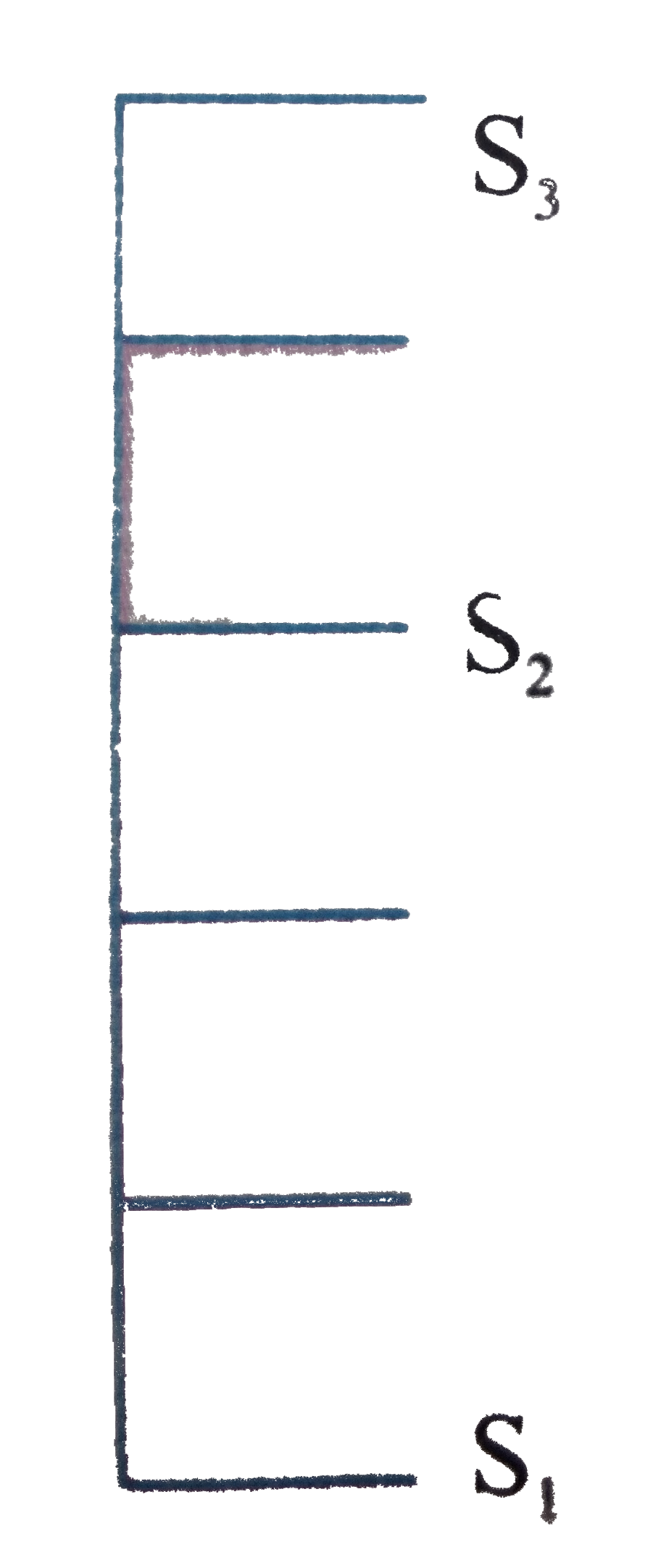
- S(1),S(2) and S(3) are the different sizes of windows 1,2 and 3 respec...
Text Solution
|
- At t=0, an arrow is fired vertically upwards with a speed of 100 m s^(...
Text Solution
|
- From the top of a tower of height 200 m, a ball A is projected up with...
Text Solution
|
- The figure shows the velocity (v) of a particle plotted against time (...
Text Solution
|
- A particle moves in a straight line with the velocity as shown in. At ...
Text Solution
|
- If the velocity of the particle is given by v=sqrt(x) and initially pa...
Text Solution
|
- Starting from rest a particle is first accelerated for time t1 with co...
Text Solution
|
- Two particles A and B start from rest at the origin x=0 and move along...
Text Solution
|
- Two particles A and B start from rest at the origin x=0 and move along...
Text Solution
|
- Two particles A and B start from rest at the origin x=0 and move along...
Text Solution
|
- A balloon starts rising with constant acceleration 2 m//s^(2) from gro...
Text Solution
|
- A balloon starts rising with constant acceleration 2 m//s^(2) from gro...
Text Solution
|
- A balloon starts rising with constant acceleration 2 m//s^(2) from gro...
Text Solution
|
- The velocity time plot for a particle moving on straight line is show...
Text Solution
|
- The displacement of a particle as a function of time is shown in . It ...
Text Solution
|