Home
Class 12
PHYSICS
A converging lens forms a real image I o...

A converging lens forms a real image `I` on its optic axis. A rectangular galss slab of refractive index `mu` and thickness `t` is introduced between the lens and `I`. `I` will move

A

away from the lens by `(mu-1)`

B

towards the lens by `t(mu-1)`

C

away from the lens by `t((mu-1)/(mu))`

D

towards the lens by `t((mu-1)/(mu))`

Text Solution

Verified by Experts

The correct Answer is:
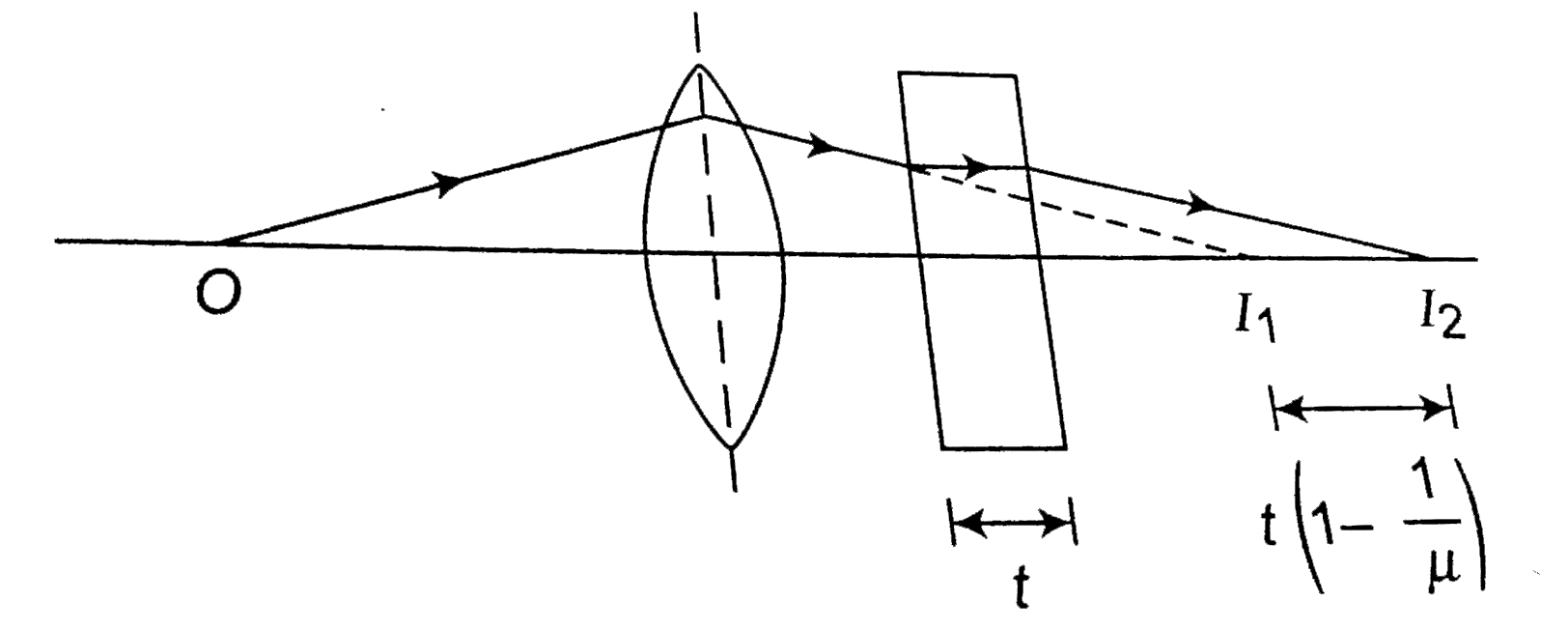
C


Shift of image by slab:
`t(1-(1)/(mu))=t((mu-1)/(mu))` away from lens
Promotional Banner

Topper's Solved these Questions

  • REFRACTION AT SPHERICAL SURFACES

    CP SINGH|Exercise EXERCISES|105 Videos
  • REFLECTION OF LIGHT

    CP SINGH|Exercise EXERCISES|67 Videos
  • REFRACTION OF LIGHT BY PLANE SURFACES

    CP SINGH|Exercise Exercises|110 Videos

Similar Questions

Explore conceptually related problems

A point object O is placed at a distance of 41 cm from a convex lens of focal length f = 20 cm on its principal axis. A glass slab of thickness 3 cm and refractive index mu = 1.5 is placed between the lens and the object with its faces perpendicular to the principal axis of the lens. Image of the object is formed at point I_(1) . Now the glass slab is tilted by an angle of theta = 1° (as shown in the Figure) and the final image is formed at I_(2) . Calculate the distance between points I_(1) and I_(2) . Consider only paraxial rays for the lens and near normal incidence for the glass slab.

P is a point on the axis of a concave mirror. The image of P, formed by the mirror, coincides with P. A rectangular glass slab of thickness t and refractive index mu is now introduced between P and the mirror. For the image of P to coincide with P again, the mirror must be moved

An object 240 cm in front of a lens forms a sharp image on a screen 12 cm behind the lens. A glass slab 1 cm thick, having refractive index 1.50 is placed between the lens and the screen with its refracting faces perpendicular to the principal axis of the lens. (a) By how much distance the object must be moved so as to again cast a sharp image on the screen? (b) Another identical glass slab is interposed between the object and the lens. How much further the object shall be moved so as to form a sharp image on the screen.

A parallel beam of light is incident on a lens of focal length 10 cm. A parallel slab of refractive index 1.5 and thickness 3 cm is placed on the other side of the lens. Find the distance of the final image from the lens. .

A parallel beam of light is incident on a lens of focal length 10cm. A parallel slab of refractive index 1.5 and thickness 3 cm is placed on the other side of the lens. The nature of the final image from the lens slab combination is: (Assume rays paraxial)

A point object is placed at a distance of 25cm from a convex lens. Its focal length is 22cm. A glass slab of refractive index 1.5 is inserted between the lens and the object, then the image is formed at infinity. Find the thickness of the glass slab (in cm).

A convex lens form a real image of a point object placed on its principal axis. If the upper half of the lens is painted black, the image will

Rays from a lens are converging toward a point P, a shown in Figure. How much thick glass plate having refractive index 1.6 must be located between the lens and point P, so that the image will be formed at P^(') ?

A convex forms a real image of a poinnt object placed on its principal axis. If the upper half of the lens is painted black

A point object is placed at a distance of 25cm from a convex lens of focal length 20cm .If a glass slab of thickness t and refractive index 1.5 is inserted between the lens and object.The image is formed at infinity .Find the thickness?

CP SINGH-REFRACTION AT SPHERICAL SURFACES-EXERCISES
  1. A combination of two thin lenses with focal lengths f(1) and f(2) resp...

    Text Solution

    |

  2. The position of fical image formed by the given lens combination from ...

    Text Solution

    |

  3. An object is placed 12 cm to the left of a converging lens of focal le...

    Text Solution

    |

  4. A converging lens forms a real image I on its optic axis. A rectangula...

    Text Solution

    |

  5. A lens forms a sharp image on a screen. On inserting a parallel sided ...

    Text Solution

    |

  6. A real image of an object is formed by a conex lens at the bottom of a...

    Text Solution

    |

  7. A concave mirrorr of focal length f(1) is placed at a distance of d fr...

    Text Solution

    |

  8. A concave lens of focal length 20 cm placed in contact with ah plane m...

    Text Solution

    |

  9. The distance between a convex lens and a plane mirror is 10 cm. The pa...

    Text Solution

    |

  10. A luminous object is placed at a distance of 30 cm from the convex len...

    Text Solution

    |

  11. An object is placed at 15 cm from a convex lens of focal length 10 cm....

    Text Solution

    |

  12. A convex lens of focal length 40cm is held at a distance 12cm coaxiall...

    Text Solution

    |

  13. The focal length of a plano-convex lens is f and its refractive index ...

    Text Solution

    |

  14. An equi-convex lens, having radius of curvature 33 cm is placed on a h...

    Text Solution

    |

  15. A convex lens of focal length 15 cm is placed on a plane mirror. An ob...

    Text Solution

    |

  16. A convex lens is placed in contact with a mirrorr as shown. If he spac...

    Text Solution

    |

  17. A plano-convex lens when silvered on the plane side behaves line a con...

    Text Solution

    |

  18. A plano-convex lens of focal length 30 cm has its plane surface silver...

    Text Solution

    |

  19. A pin is placed 10cm in front of a convex lens of focal length 20cm, m...

    Text Solution

    |

  20. A plano convex lens of refractive index 1.5 and radius of curvature 30...

    Text Solution

    |

