Home
Class 11
PHYSICS
Two ships, V and W, move with constant v...

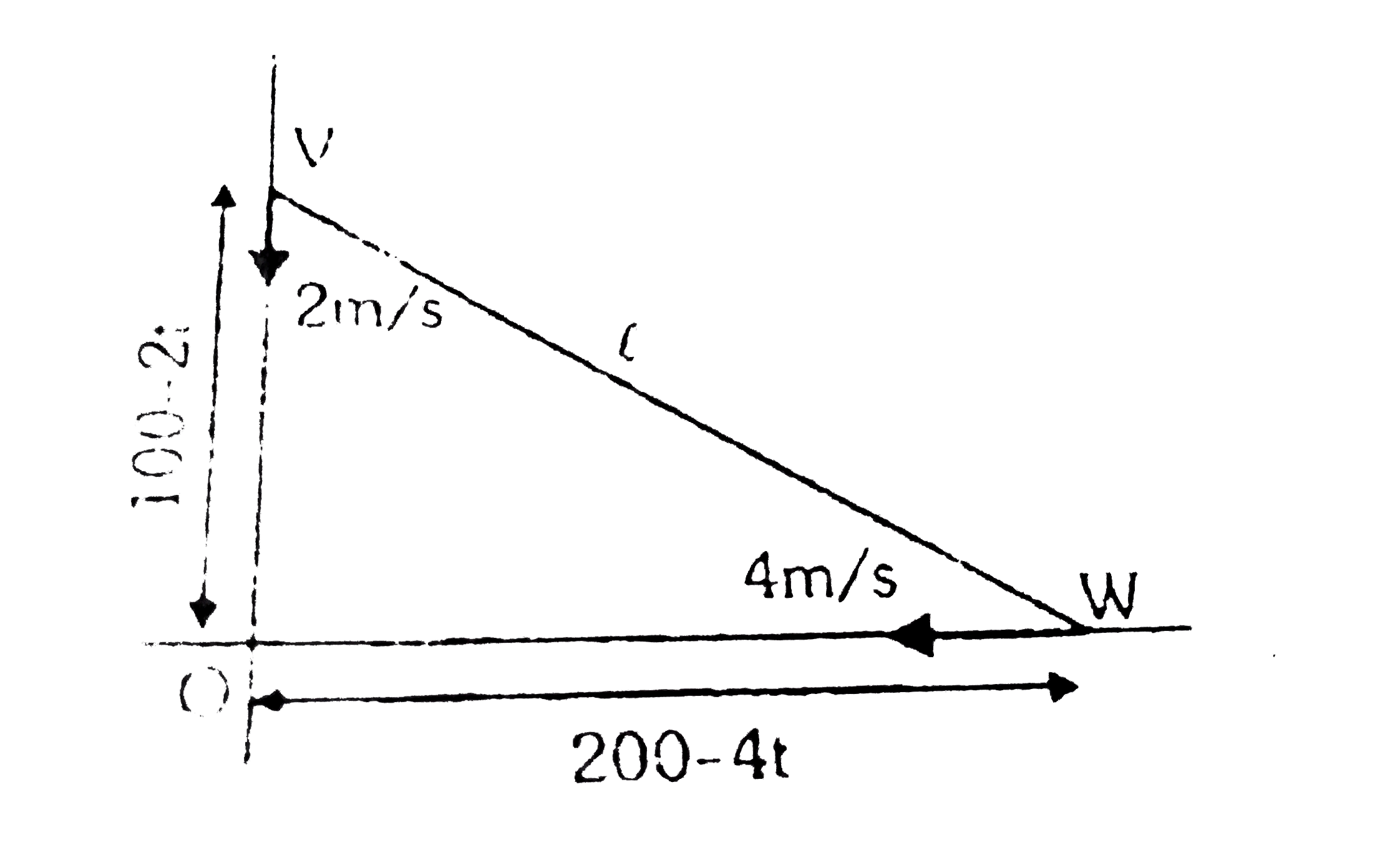
Two ships, V and W, move with constant velocities `2 ms^(-1)` and `4 ms^(-1)` along two mutually perpendicular straight tracks toward the intersection point O. At the moment `t=0`, the ships V & W were located at distances `100 m` and `200 m` respectively from the point O.
The distance between them at time t is :-

A

`a^(2)y+bx^(2)=0`

B

`a^(2)y=bx^(2)`

C

`y=b/a^(2) x`

D

`ay^(2)=b^(2)x`

Text Solution

Verified by Experts

The correct Answer is:
B

`l=sqrt((100-2t)^(2)+(200-4t)^(2))`
Promotional Banner

Topper's Solved these Questions

  • MISCELLANEOUS

    ALLEN|Exercise Comprehension 3|5 Videos
  • MISCELLANEOUS

    ALLEN|Exercise Comprehension 4|6 Videos
  • MISCELLANEOUS

    ALLEN|Exercise Comprehension 1|5 Videos
  • KINEMATICS (MOTION ALONG A STRAIGHT LINE AND MOTION IN A PLANE)

    ALLEN|Exercise BEGINNER S BOX-7|8 Videos
  • PHYSICAL WORLD, UNITS AND DIMENSIONS & ERRORS IN MEASUREMENT

    ALLEN|Exercise EXERCISE-IV|8 Videos

Similar Questions

Explore conceptually related problems

Two ships, V and W, move with constant velocities 2 ms^(-1) and 4 ms^(-1) along two mutually perpendicular straight tracks toward the intersection point O. At the moment t=0 , the ships V & W were located at distances 100 m and 200 m respectively from the point O. The distance between them will be shortest at t= ........

Two ships, 1 and 2, move with constant velocities 3 m/s and 4 m/s along two mutually perpendicular straight tracks toward the intersection point O. At the moment t = 0 the ships were located at the distances 120 m and 200 m from the point O. How soon will the distance between the ships become the shortest and what is it equal to ?

Two particles, 1 and 2, move with constant velocities v_1 and v_2 along two mutually perpendicular straight lines toward the intersection point O. At the moment t=0 the particles were located at the distances l_1 and l_2 from the point O. How soon will the distance between the particles become the smallest? What is it equal to?

Two particles A and B move with constant velocities v_(1) and v_(2) along two mutually perpendicular strainght lines. Towards the intersection point O. At moment t = 0 the particle were located at distance l_(1) and l_(2) from O respectively. Find the time when they are nearest and also this shortest distance

Two particles are moving along two long straight lines, in the same plane with same speed equal to 20 cm//s. The angle between the two linse is 60^@ and their intersection point isO. At a certain moment, the two particles are located at distances 3m and 4m from O and are moving twowards O. Subsequently, the shortest distance between them will be

Two particles move with constant velocities towards point O along straight lines in a plane as shown. The shortest distance A and B is

Two points A and B located in diametrically opposite directions of a point charge of +2 muC at distances 2.0 m and 1.0 m respectively from it. Determine the potential difference V_(A)-V_(B)

Two boats, A and B , move away from a point P at the middle of a river along the mutually perpendicular straight lines. Boat A moves along the river and boat B across the river. Having moved off equal distance from point P the boats returned. find the ratio of times of motion of boats (t_(A))/(t_(B)) if v=etau(etagt1) . ( v : velocity of boat with respect to water. u : stream velocity)

Ram Shyam are walking on two perpendicular tracks with speed 3ms^(-1) and 4 ms^(-1) , respectively. At a certain moment (say t = 0s), Ram and Shyam are at 20 m and 40 m away from the intersection of tracks, respectively, and moving towards the intersection of the tracks. Shortest distance between them subsequently is

A straight conductor 0.1 m long moves in a uniform magnetic field 0.1 T. The velocity of the conductor is 15ms^(-1) and is directed perpendicular to the field. The emf induced between the two ends of the conductor is

