Home
Class 11
PHYSICS
A positively charged thin metal ring of ...

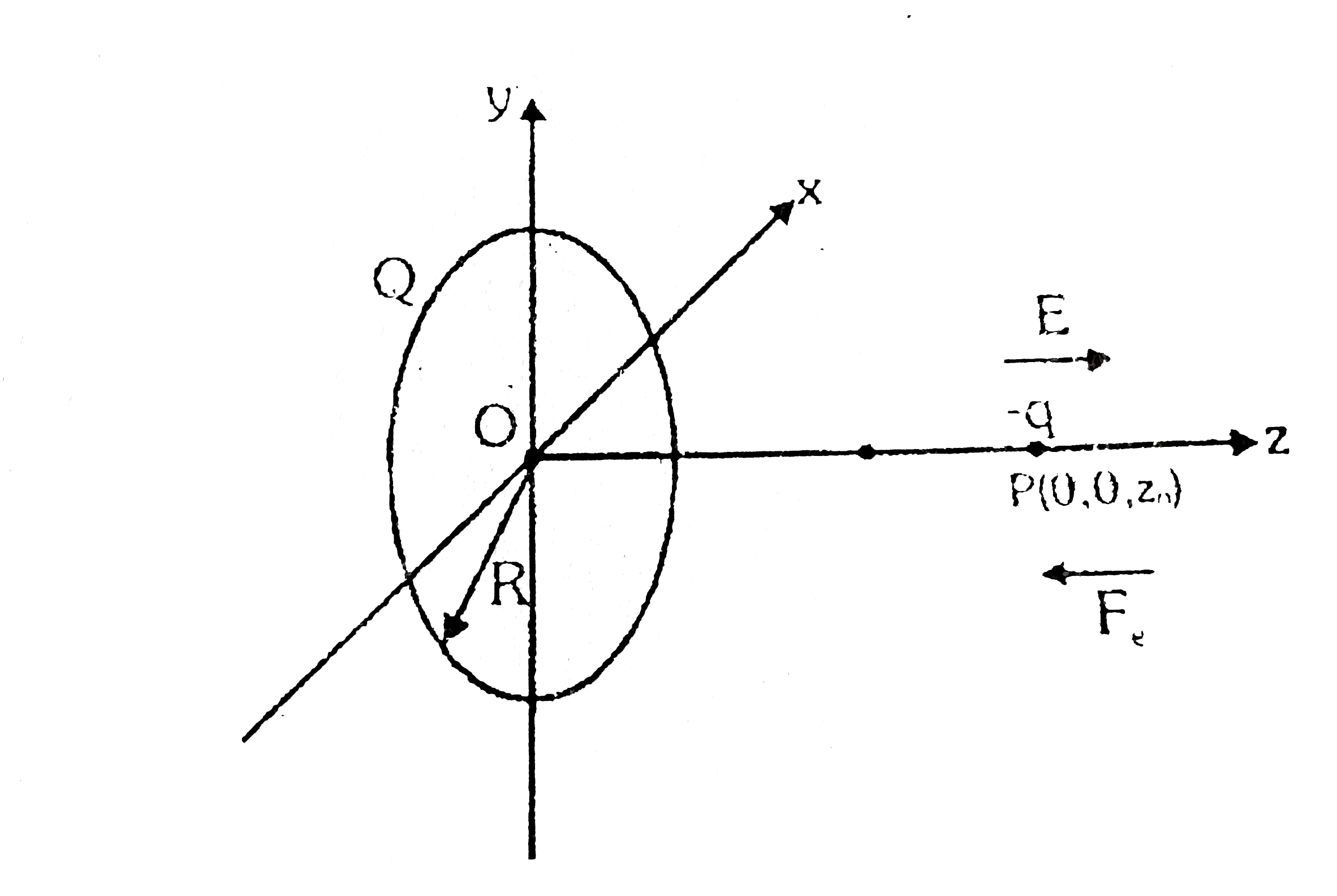
A positively charged thin metal ring of radius R is fixed in the xy plane with its centre at the origin O. A negatively charged particle P is released from rest at the point `(0, 0, z_0)` where `z_0gt0`. Then the motion of P is

A

pariodic for all values of `z_(0)` satisfying `0 lt z_(0) lt oo`

B

simple harmonic for all values of `z_(0)` satisfying `0 lt z_(0) le R`

C

approximately simple harmonic provided `z_(0) lt lt R`

D

such that P crosses O and continues to move along negative z-axis towards `z=-oo`

Text Solution

Verified by Experts

The correct Answer is:
A, C

Let Q be the charge on the ring, the negative charge -q is released from point `P (0, 0, z_(0))`. The electric field at P due to the charged ring will be along positive z-axis and its magnitude will be
`E=1/(4piepsilon_(0))(Qz_(0))/((R^(2)+z_(0)^(2))^(3//2))`
`E=0` at centre of the ring because `z_(0)=0`
Therefore, force on charge P will be towards centre as shown, and its magnitude is
`F_(e)=qE=1/(4piepsilon_(0))(Qq)/((R^(2)+z_(0)^(2))^(3//2)).z_(0)` ...(i)

Similarly, when it courses the origin, the force is again towards centre O.
Thus, the motion of the particle is periodic for all values of `z_(0)` lying between 0 and `oo`.
Secondly, if `z_(0) lt lt R, (R^(2)+z_(0)^(2))^(3//2)~~R^(3)`
`z_(0) lt lt R, (R^(2)+z_(0)^(2))^(3//2)~~R^(3)`
`Fe~~-1/(4piepsilon_(0)).(Qq)/R^(3).z_(0)` (From Eq. 1)
i.e., the restoring force `F_(e) prop -z_(0)`. Hence, the motion of the particle will be simple harmonic. (Here negative sign implies that the force is towards its mean position).
Promotional Banner

Topper's Solved these Questions

  • MISCELLANEOUS

    ALLEN|Exercise REASONING TYPE|1 Videos
  • MISCELLANEOUS

    ALLEN|Exercise MATCH THE COLUME TYPE|1 Videos
  • MISCELLANEOUS

    ALLEN|Exercise Exercise-05(B)|19 Videos
  • KINEMATICS (MOTION ALONG A STRAIGHT LINE AND MOTION IN A PLANE)

    ALLEN|Exercise BEGINNER S BOX-7|8 Videos
  • PHYSICAL WORLD, UNITS AND DIMENSIONS & ERRORS IN MEASUREMENT

    ALLEN|Exercise EXERCISE-IV|8 Videos

Similar Questions

Explore conceptually related problems

A circular ring of radius R with uniform positive charge density lambda per unit length is located in the y z plane with its center at the origin O. A particle of mass m and positive charge q is projected from that point p( - sqrt(3) R, 0,0) on the negative x - axis directly toward O, with initial speed V. Find the smallest (nonzero) value of the speed such that the particle does not return to P ?

A circular ring of radius R with uniform positive charge density lambda per unit length is located in the y-z plane with its centre at the origin O. A particle of mass m and positive charge q is projected from the point P (Rsqrt3, 0, 0) on the positive x-axis directly towards O, with an initial speed v. Find the smallest (non-zero) value of the speed v such that the particle does not return to P.

A circular ring of mass M and radius R is placed in YZ plane with centre at origin. A particle of mass m is released from rest at a point x = 2R. Find the speed with which it will pass the centre of ring .

A circular ring lying in the x-y plane with its centre at the origin carries a uniformly distributed positive charge. The variation of the electric field E at the point (0,0,z) is correctly represented by the graph is

A circular coil with 100 turns and radius 20 cm is kept in Y-Z plane with its centre at the origin. Find the magnetic field at point (20 cm, 0, 0) if coil carries a current of 2.0 A.

A circular ring of radius R and uniform linear charge density +lamdaC//m are kept in x - y plane with its centre at the origin. The electric field at a point (0,0,R/sqrt(2)) is

Two equal negative charges are fixed at points and on y-axis. A positive charge Q is released from rest at the point on the x-axis. The charge Q will:

Two equal positive charges , Q , are fixed at points (0 , d) and (0 , -d) on the y -axis. A charged particle having charge -q and mass m is released from rest at point (d,0) on the x -axis . Discuss the motion of charged particle.

