Home
Class 12
CHEMISTRY
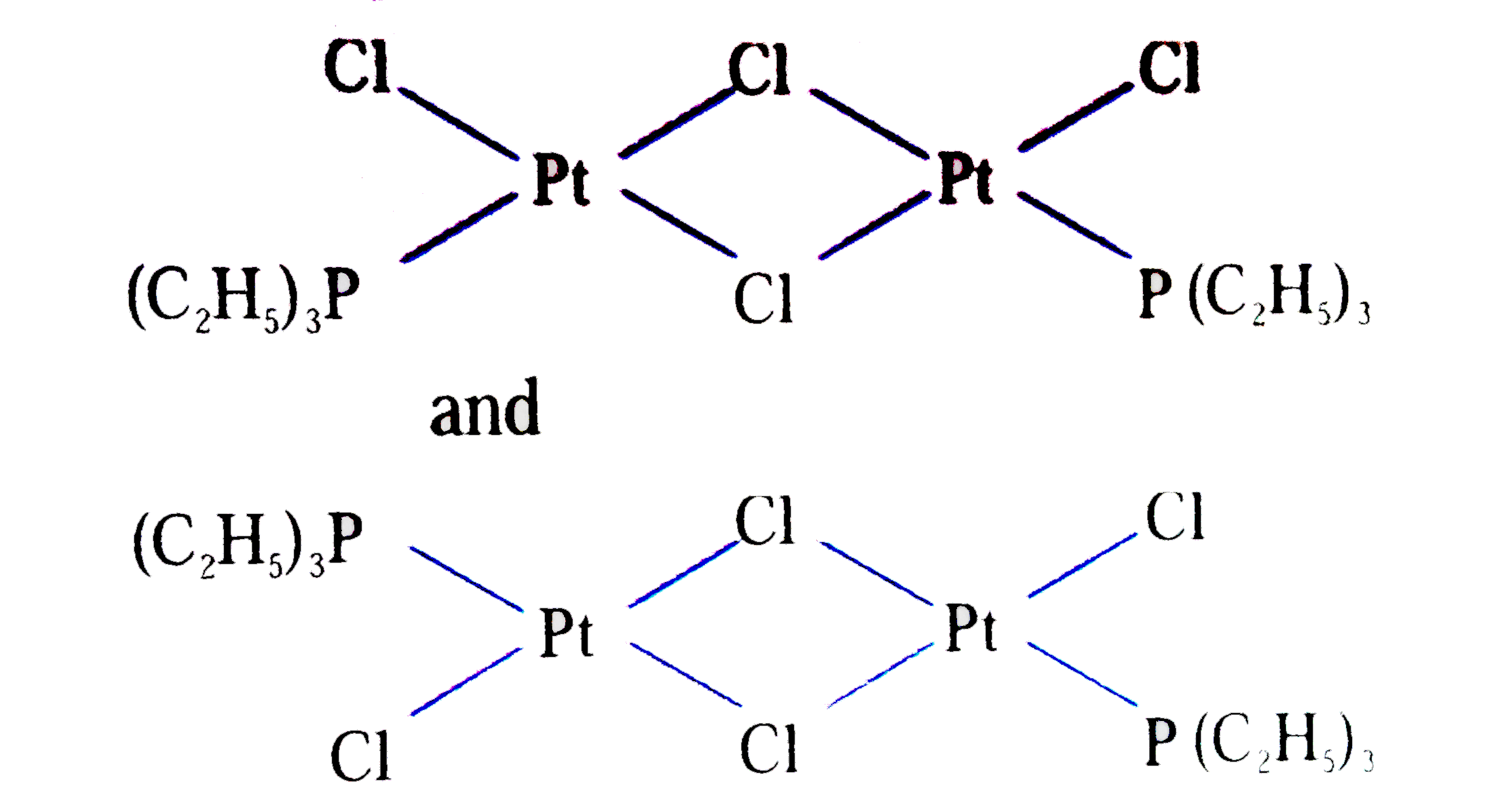
The Complexes given below show:...

The Complexes given below show:

A

Optical isomerism

B

coordination isomers

C

Geometrical isomerism

D

Bridged isomerism

Text Solution

Verified by Experts

The correct Answer is:

C

Cis and trans with respect to `Cl^(-)` ligands.
Promotional Banner

Topper's Solved these Questions

  • COORDINATION COMPLEXES

    NARAYNA|Exercise EXERCISE -3|15 Videos
  • COORDINATION COMPLEXES

    NARAYNA|Exercise EXERCISE -4|19 Videos
  • COORDINATION COMPLEXES

    NARAYNA|Exercise EXERCISE -1|25 Videos
  • CO-ORDINATE COMPOUNDS

    NARAYNA|Exercise Exercise-4|60 Videos
  • D - BLOCK ELEMENTS

    NARAYNA|Exercise CHECK YOUR GRASP|7 Videos

Similar Questions

Explore conceptually related problems

The complexes given below are –

The table given below shows the number of customers (in thousand) visiting 2 shopping complexes A and B from january 2017 to June 2017. What was the percentage change in number of customers to complex B from March to April?

The table given below shows the number of customers (in thousand) visiting 2 shopping complexes A and B from january 2017 to June 2017. What is the total number of customers (in thousands) in the 2 complexes in the month of April?

The table given below shows the number of customers (in thousand) visiting 2 shopping complexes A and B from january 2017 to June 2017. What is the average number of customers (in thousands) in complex B from February to May?

The table given below shows the number of customers (in thousand) visiting 2 shopping complexes A and B from january 2017 to June 2017. What is the maximum difference (in thousands) between the numbers of customers in the 2 complexes among the given months?

The figure given below shows the constellation 'Ursa Major.

The figure given below shows a cell undergoing meiosis. Which of the option below shows the next stage in the process?

Which of the sequences given below shows the correct increasing order of energy?

NARAYNA-COORDINATION COMPLEXES-EXERCISE -2
  1. The Complexes given below show:

    Text Solution

    |

  2. For the complex ion dichloro bis (ethylene diamine) cobalt (III), sele...

    Text Solution

    |

  3. [Pd(NH(3))(2)(SCN)(2)] and [Pd(NH(3))(2)(NCS)(2)] are :

    Text Solution

    |

  4. Which one of the following will be able to show geometrical isomerism ...

    Text Solution

    |

  5. The total number possible isomers for the complex compound [Cu^(II)(NH...

    Text Solution

    |

  6. Cis-trans isomerism is found in square planar complexes of molecular f...

    Text Solution

    |

  7. Which complex is likely to show optical activity :

    Text Solution

    |

  8. The number of bridged carbonyl groups in Mn(2)(CO)(10) is :

    Text Solution

    |

  9. The oxidation number of Co in the complex ion

    Text Solution

    |

  10. Which of the following statements is correct?

    Text Solution

    |

  11. Geometrical isomerism can be shown by

    Text Solution

    |

  12. [Co(en)3]^(3+) ion is expected to show

    Text Solution

    |

  13. The number of geometrical isomers for octahedral [CoCl(4)(NH(3))(2)]^(...

    Text Solution

    |

  14. Which of the following statements is incorrect?

    Text Solution

    |

  15. Which one of the following is an example of coordination isomerism?

    Text Solution

    |

  16. The two compounds pentaamminesulphatocobalt (III)bromide and pentaammi...

    Text Solution

    |

  17. Select the correct code about complex [Cr(NO(2))(NH(3))(5)][ZnCl(4)] :...

    Text Solution

    |

  18. Isoomerisms exhibited by [Cr(NH(3))(2)(H(2)O)(2)Cl(2)]^(+) are

    Text Solution

    |

  19. Of the following complex ions which one can form a chelate with ethyle...

    Text Solution

    |

  20. [Pt(NH(3))(NO(2))Ph(NH(2)OH)]^(+), the no. of geometrical isomers incl...

    Text Solution

    |
