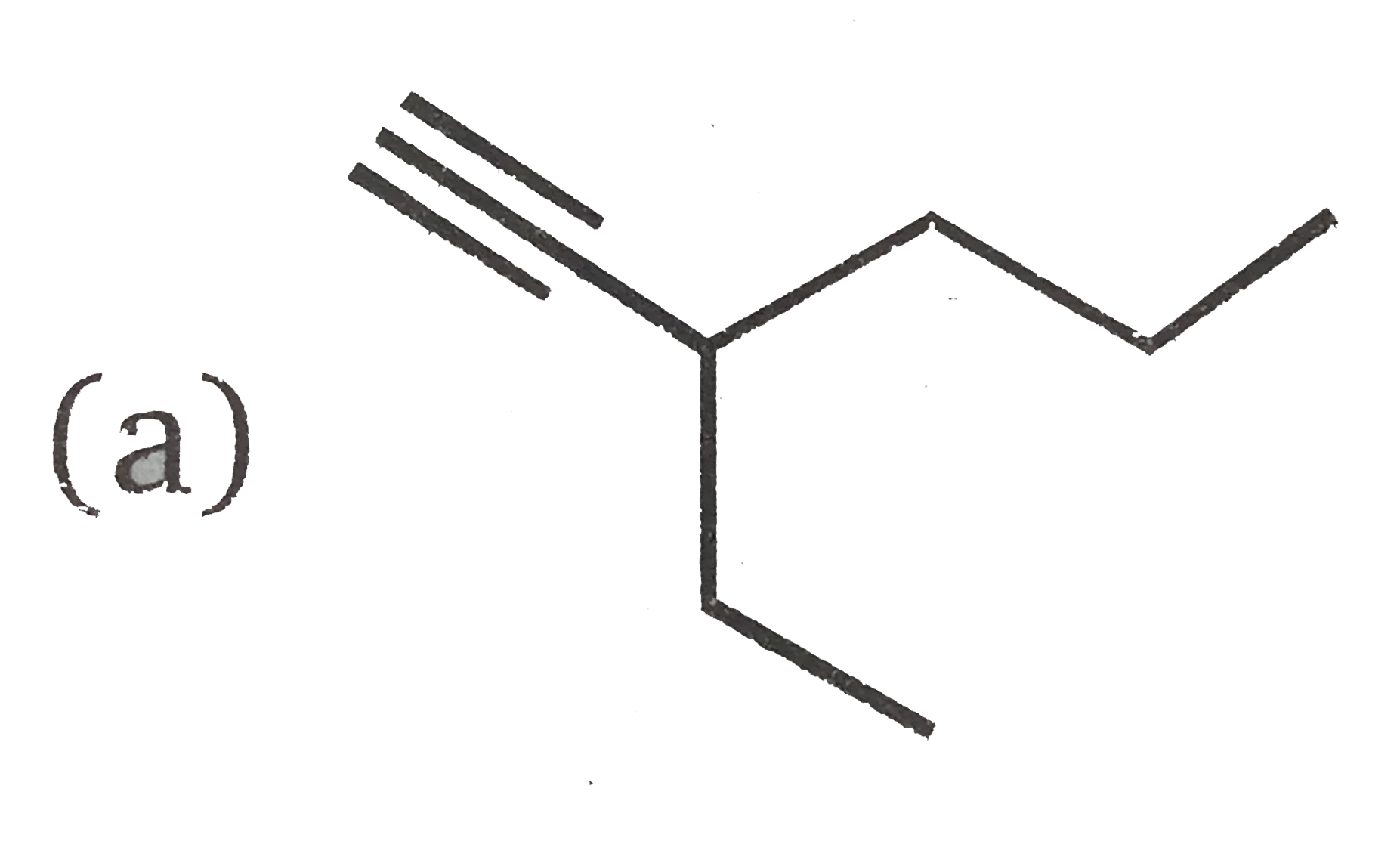
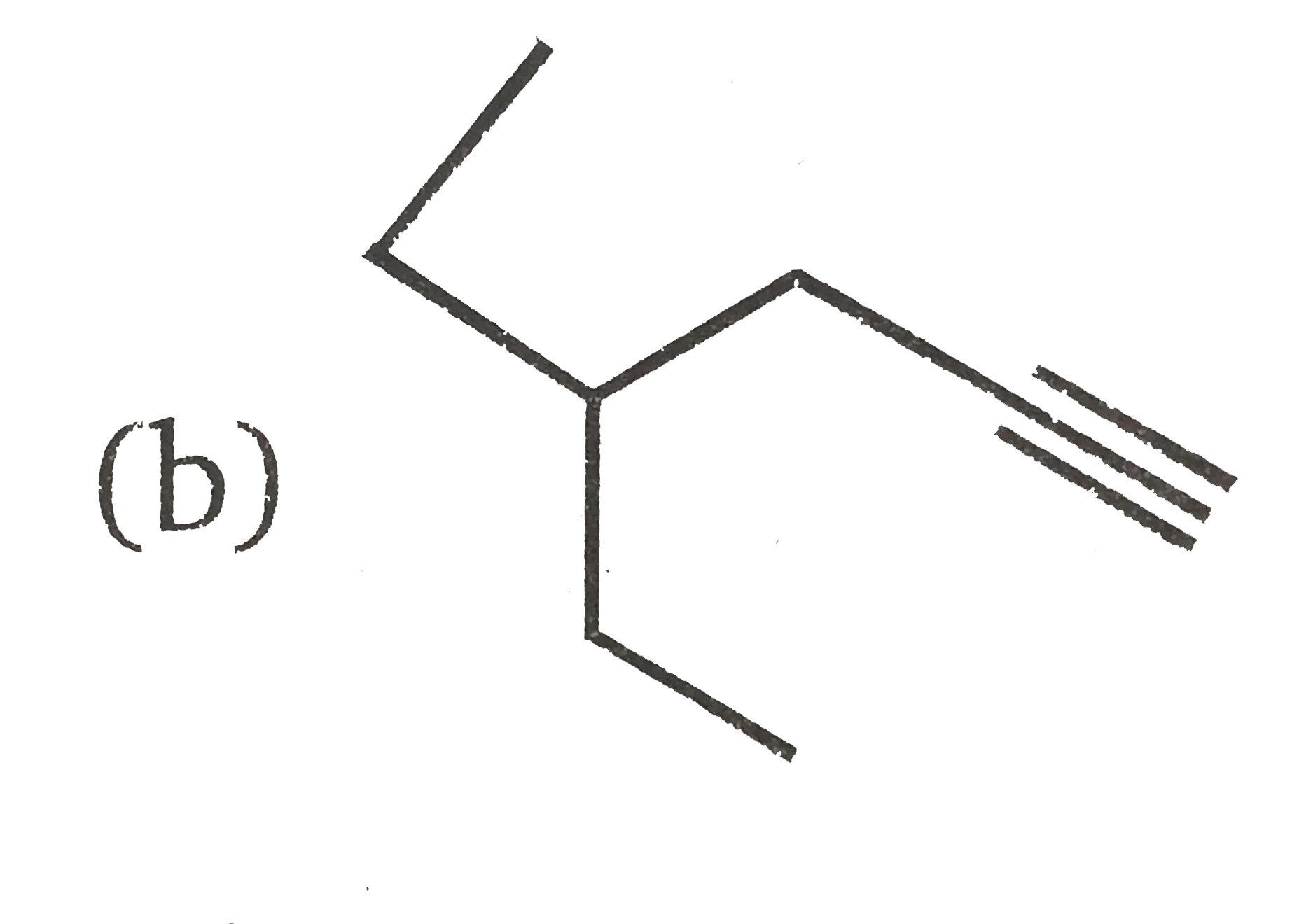
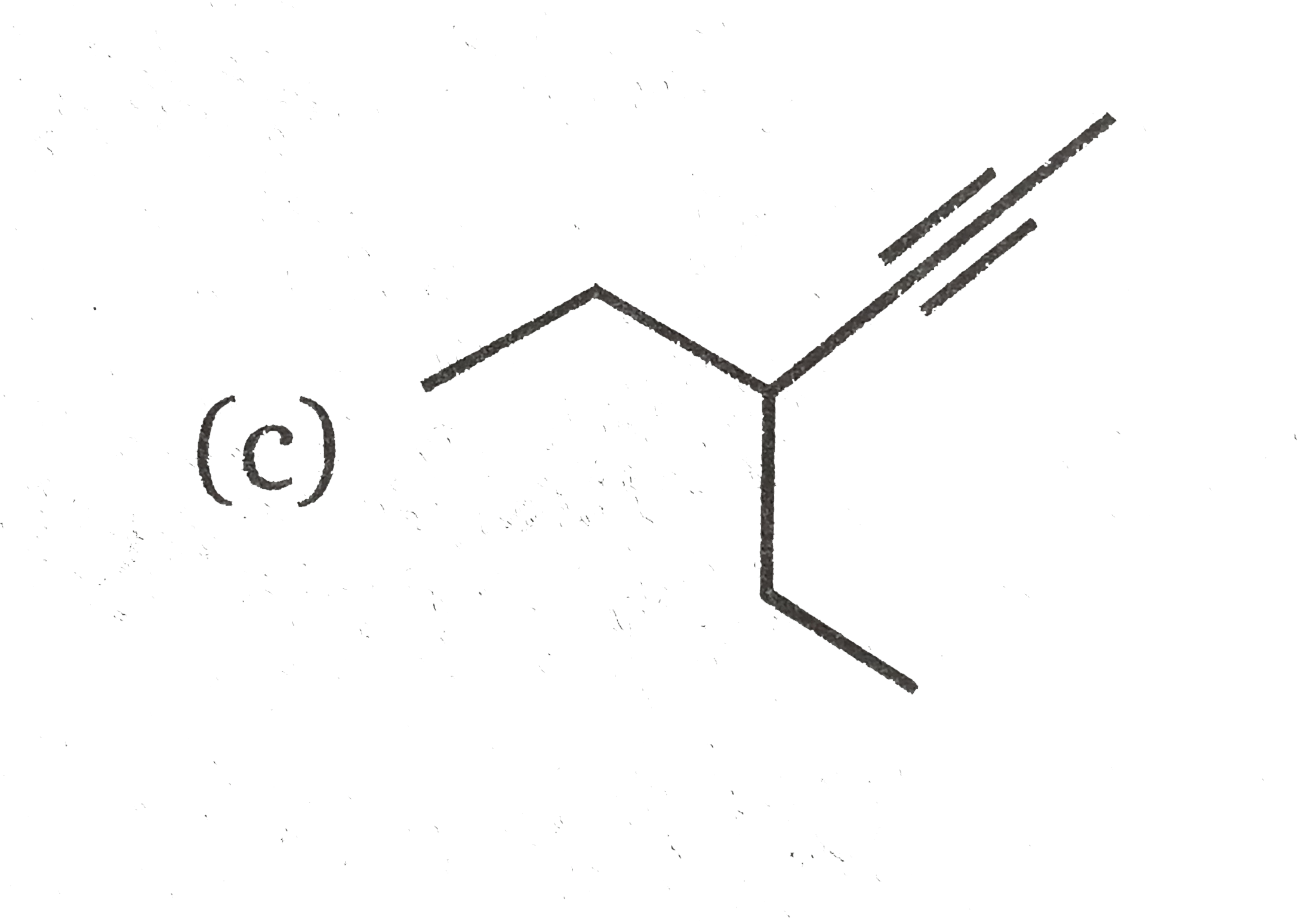
Which alkyne will give 3-ethylhexane on catalytic hydrogenation?
A
B
C
D
All of these
Text Solution
AI Generated Solution
The correct Answer is:
To determine which alkyne will yield 3-ethylhexane upon catalytic hydrogenation, we can follow these steps:
### Step 1: Understand the structure of 3-ethylhexane
3-ethylhexane is a six-carbon chain (hexane) with an ethyl group (C2H5) attached to the third carbon. The structure can be represented as follows:
- Main chain: CH3-CH2-CH(CH2CH3)-CH2-CH2-CH3
### Step 2: Identify the alkyne that can produce this structure
To produce 3-ethylhexane through catalytic hydrogenation, we need to consider the structure of the alkyne that can be reduced to this alkane.
### Step 3: Consider possible alkynes
1. **Alkyne A**: 3-ethyl-1-butyne (CH3-C≡C-CH2-CH2-CH3)
- When hydrogenated, it will yield 3-ethylhexane.
2. **Alkyne B**: 2-butyne (CH3-C≡C-CH3)
- This alkyne will not yield 3-ethylhexane upon hydrogenation.
3. **Alkyne C**: 1-heptyne (CH3-C≡C-CH2-CH2-CH2-CH3)
- This alkyne will yield 3-ethylhexane upon hydrogenation.
### Step 4: Verify the hydrogenation process
When we perform catalytic hydrogenation on the identified alkynes:
- **For Alkyne A**:
- The triple bond is reduced to a double bond, and then to a single bond, resulting in 3-ethylhexane.
- **For Alkyne C**:
- The triple bond is also reduced similarly, leading to the same product.
### Conclusion
Both Alkyne A (3-ethyl-1-butyne) and Alkyne C (1-heptyne) will yield 3-ethylhexane upon catalytic hydrogenation. Therefore, the answer is that both A and C are correct.
### Final Answer
Alkynes A and C will give 3-ethylhexane on catalytic hydrogenation.
---
To determine which alkyne will yield 3-ethylhexane upon catalytic hydrogenation, we can follow these steps:
### Step 1: Understand the structure of 3-ethylhexane
3-ethylhexane is a six-carbon chain (hexane) with an ethyl group (C2H5) attached to the third carbon. The structure can be represented as follows:
- Main chain: CH3-CH2-CH(CH2CH3)-CH2-CH2-CH3
### Step 2: Identify the alkyne that can produce this structure
To produce 3-ethylhexane through catalytic hydrogenation, we need to consider the structure of the alkyne that can be reduced to this alkane.
...
Topper's Solved these Questions
HYDROCARBONS (ALKYNES)
MS CHOUHAN|Exercise Level 1 (Q.1 To Q.30)|2 Videos
HYDROCARBONS (ALKENES)
MS CHOUHAN|Exercise LEVEL - 2|1 Videos
IONIC REACTIONS (NUCLEOPHILIC SUBSTITUTION AND ELIMINATON REATIONS OF ALKYL HALIDES)
MS CHOUHAN|Exercise ADDITIONAL OBJECTIVE QUESTIONS (Matrix Match Type )|2 Videos
Similar Questions
Explore conceptually related problems
Which alkyne gives 3-ethylhexane on catalytic hydroenation?
How many structural isomeric alkenes give 2,3- Diemthylpentane on catalytic hydrogenation
Acetone oxime on catalytic hydrogenation gives
Which of the following alkene can give 3-methylpentane on hydrogenation
Which of the following alkene on catalytic hydrogenation gives cis and trans-isomers?
MS CHOUHAN-HYDROCARBONS (ALKYNES)-Level 1 (Q.1 To Q.30)