Home
Class 10
BIOLOGY
Describe the structure and functioning o...

Describe the structure and functioning of nephrons.

Text Solution

Verified by Experts
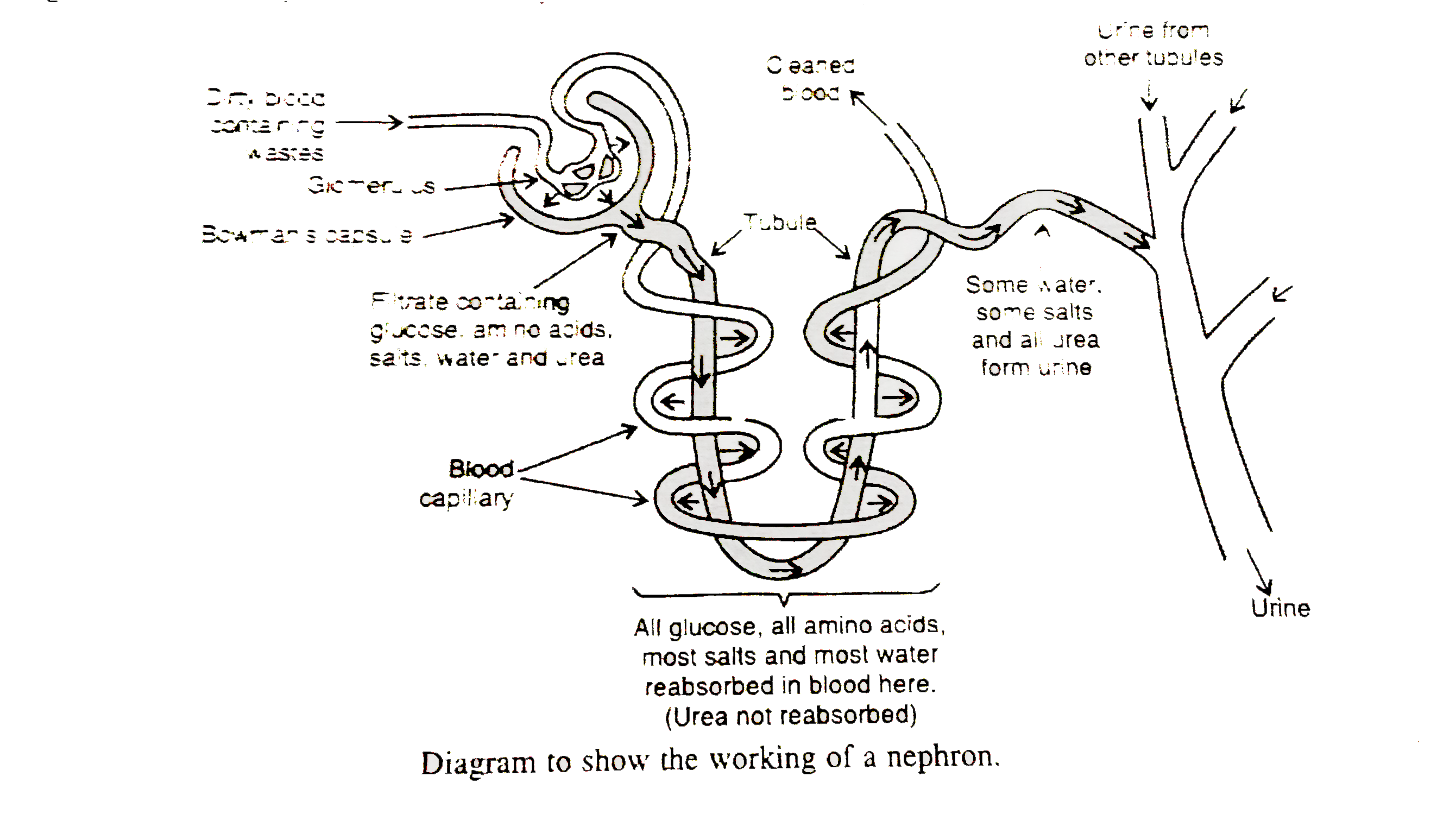
The nephron has a cup-shaped bag at its upper end which is called Bowman's capsule. The lower end of Bowman's capsule is tube-shaped and it is called a tubule. The Bowman's capsule and the tubule taken together make a nephron (Each kidney has about 1 million nephrons). One end of the tubule is connected to

Bowman's capsule and its other end is connected to a urine-collecting duct of the kidney. The Bowman's capsule contains a bundle of capillaries which is called glomerulus. One end of glomerulus is attached to renal artery which brings the dirty blood containing the urea waste in it. The other end of glomerulus comes out of Bowman's capsule as a blood capillary, surrounds the tubule of nephron and finally joins a renal vein (putting urea-free clean blood into it). The function of glomerulus is to filter the blood passing through it.
The dirty blood containing waste like urea (brought by renal artery) enters the glomerulus. The glomerulus filters this blood. During filtration, the substances like glucose, amino acids, salts, water and urea, etc., present in the blood pass into Bowman's capsule and then enter the tubule of nephron. When the filtrate containing useful substances as well as the waste substances through the tubule, then the useful substances like all glucose, all amino acids, most salt, and most water, etc., are reabsorbed into the blood through blood capillaries surrounding the tubule. Only the waste substances urea, some unwanted salts and excess water remain behind in the tubule. The liquid left behind in the tubule of nephron is urine. The nephron carries this urine into the collecting duct of the kidney from where it is carried to ureter. From the ureter, urine passes into urinary bladder. Urine is stored in the bladder for some time ultimately passed out of the body through urethra.
Promotional Banner

Topper's Solved these Questions

  • LIFE PROCESSES

    LAKHMIR SINGH & MANJIT KAUR|Exercise very short answer type question|1 Videos
  • LIFE PROCESSES

    LAKHMIR SINGH & MANJIT KAUR|Exercise short answer type question|3 Videos
  • LIFE PROCESSES

    LAKHMIR SINGH & MANJIT KAUR|Exercise question based on high order thinking skills|1 Videos
  • HOW DO ORGANISMS REPRODUCE

    LAKHMIR SINGH & MANJIT KAUR|Exercise QUESTIONS BASED ON HIGH ORDER THINKING SKILLS (HOTS)|27 Videos
  • MANAGEMENT OF NATURAL RESOURCES

    LAKHMIR SINGH & MANJIT KAUR|Exercise VALUE BASED QUESTIONS|25 Videos

Similar Questions

Explore conceptually related problems

Describe the structure and function of ATP.

Describe the structure and functions of nucleus.

Describe the structure and functions of nucleus.

Describe the structure and functions of epithelium.

Describe the structure and function of thyroid gland.

Describe the structure and functions of areolar connective tissue.

Describe structure and functions of bone.

Describe the structures and function of androecium and gynoecium

LAKHMIR SINGH & MANJIT KAUR-LIFE PROCESSES-Exercise
  1. How are water and minerals transported in plants?

    Text Solution

    |

  2. How is food transported in plants?

    Text Solution

    |

  3. Describe the structure and functioning of nephrons.

    Text Solution

    |

  4. What are the methods used by plants to get rid of excretory products

    Text Solution

    |

  5. How is the amount of urine produced regulated?

    Text Solution

    |

  6. The kidneys in human beings are a part of the system for

    Text Solution

    |

  7. The xylem in plants are responsible for

    Text Solution

    |

  8. The autotrophic mode of nutrition requires

    Text Solution

    |

  9. The breakdown of pyruvate to give carbon dioxide, water and energy tak...

    Text Solution

    |

  10. How are fats digested in our bodies? Where does this process take plac...

    Text Solution

    |

  11. What is the role of saliva in the digestion of food?

    Text Solution

    |

  12. What are the necessary conditions for autotrophic nutrition and what a...

    Text Solution

    |

  13. What are the differences between aerobic and anaerobic respiration? Na...

    Text Solution

    |

  14. How are the alveoli designed to maximise the exchange of gases?

    Text Solution

    |

  15. What would be the consequences of a deficiency of haemoglobin in our b...

    Text Solution

    |

  16. Describe double circulation of blood in human beings. Why is it necess...

    Text Solution

    |

  17. What are the differences between the transport of materials in xylem a...

    Text Solution

    |

  18. Compare the functioning of alveoli in the lungs and nephrons in the ki...

    Text Solution

    |

  19. What is the difference between a reflex action and walking?

    Text Solution

    |

  20. What happens at the synapse between two neurons?

    Text Solution

    |

