Home
Class 12
PHYSICS
The velocity v of a particle moving alon...

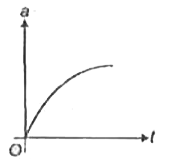
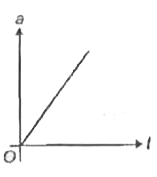
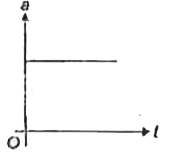
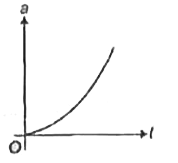
The velocity v of a particle moving along x - axis varies with ist position (x) as `v=alpha sqrtx`, where `alpha` is a constant. Which of the following graph represents the variation of its acceleration (a) with time (t)?

A

B

C

D

Text Solution

AI Generated Solution

The correct Answer is:

To solve the problem, we need to find the relationship between acceleration \( a \) and time \( t \) for a particle whose velocity \( v \) varies with position \( x \) as \( v = \alpha \sqrt{x} \). ### Step-by-Step Solution: 1. **Understanding the Given Relation**: The velocity of the particle is given by: \[ v = \alpha \sqrt{x} \] where \( \alpha \) is a constant. 2. **Finding Acceleration**: Acceleration \( a \) is defined as the rate of change of velocity with respect to time: \[ a = \frac{dv}{dt} \] We can use the chain rule to express this in terms of position: \[ a = \frac{dv}{dx} \cdot \frac{dx}{dt} \] Here, \( \frac{dx}{dt} \) is the velocity \( v \). 3. **Calculating \( \frac{dv}{dx} \)**: We need to differentiate \( v \) with respect to \( x \): \[ v = \alpha \sqrt{x} \] Differentiating: \[ \frac{dv}{dx} = \frac{\alpha}{2\sqrt{x}} \] 4. **Substituting Back into the Acceleration Formula**: Now substituting \( \frac{dv}{dx} \) and \( v \) into the acceleration formula: \[ a = v \cdot \frac{dv}{dx} = \alpha \sqrt{x} \cdot \frac{\alpha}{2\sqrt{x}} = \frac{\alpha^2}{2} \] This shows that the acceleration \( a \) is a constant value, independent of \( x \). 5. **Relating Acceleration to Time**: Since the acceleration \( a \) is constant, it does not change with time. Therefore, the graph representing the variation of acceleration \( a \) with time \( t \) will be a horizontal line. 6. **Conclusion**: The correct graph representing the variation of acceleration \( a \) with time \( t \) is a horizontal line, indicating that acceleration is constant. ### Final Answer: The graph that represents the variation of acceleration \( a \) with time \( t \) is a horizontal line (constant acceleration). ---
Promotional Banner

Topper's Solved these Questions

  • MOTION IN A STRAIGHT LINE

    AAKASH INSTITUTE|Exercise ASSIGNMENT (SECTION - C)|37 Videos
  • MOTION IN A STRAIGHT LINE

    AAKASH INSTITUTE|Exercise ASSIGNMENT (SECTION - D)|15 Videos
  • MOTION IN A STRAIGHT LINE

    AAKASH INSTITUTE|Exercise ASSIGNMENT (SECTION - A)|60 Videos
  • MOTION IN A PLANE

    AAKASH INSTITUTE|Exercise Assignement section -J (Aakash Challengers Questions)|4 Videos
  • MOTION IN STRAIGHT LINE

    AAKASH INSTITUTE|Exercise Assignment (SECTION - J)|2 Videos

Similar Questions

Explore conceptually related problems

Which of the following graph(s) represent retardation ? [v : velocity, t : time, x : position]

The velocity (upsilon) of a particle moving along X-axis varies with its position x as shown in figure. The acceleration (a) of particle varies with position (x) as

The graph shown the variation with times t of the velocity v of an object . Which one of the following graphs best represents the variation of acceleration a of the object with time t ?

The velocity (v) of a particle of mass m moving along x-axis is given by v=alphasqrt(x) , where alpha is a constant. Find work done by force acting on particle during its motion from x=0 to x=2m :-

The velocity of a particle moving in the x direction varies as V = alpha sqrt(x) where alpha is a constant. Assuming that at the moment t = 0 the particle was located at the point x = 0 . Find the acceleration.

The position of a particle moving along x-axis varies with time t according to equation x=sqrt(3) sinomegat-cosomegat where omega is constants. Find the refion in which the particle is confined.

The velocity of a particle moving in the positive direction of the X-axis varies as V=Ksqrt(S) where K is a positive constant. Draw V-t graph.

The velocity of a particle moving in the positive direction of x -axis varies as v = alpha sqrt(x) where alpha is positive constant. Assuming that at the moment t = 0 , the particle was located at x = 0 , find (i) the time dependance of the velocity and the acceleration of the particle and (ii) the mean velocity of the particle averaged over the time that the particle takes to cover first s meters of the path.

A body starting from the the rest moves along a straight line with constant acceleration. Which one of the following graphs represents the variation of speed(v) and distance(s)?

AAKASH INSTITUTE-MOTION IN A STRAIGHT LINE-ASSIGNMENT (SECTION - B)
  1. The velocity v of a body moving along a straight line varies with time...

    Text Solution

    |

  2. The relation between position (x) and time (t) are given below for a p...

    Text Solution

    |

  3. The velocity v of a particle moving along x - axis varies with ist pos...

    Text Solution

    |

  4. The velocity (upsilon) of a particle moving along X-axis varies with i...

    Text Solution

    |

  5. A ball is dropped from an elevator moving upward with acceleration 'a'...

    Text Solution

    |

  6. The velocity (v) - time (t) graph for a particle moving along x - axis...

    Text Solution

    |

  7. The speed - time graph for a body moving along a straight line is show...

    Text Solution

    |

  8. The acceleration (a)-time(t) graph for a particle moving along a strai...

    Text Solution

    |

  9. A ball is thrown upward with speed 10 m/s from the top to the tower re...

    Text Solution

    |

  10. A ball dropped from the top of tower falls first half height of tower ...

    Text Solution

    |

  11. An object thrown verticallly up from the ground passes the height 5 m ...

    Text Solution

    |

  12. A particle is thrown vertically upwards. If its velocity is half of th...

    Text Solution

    |

  13. A particle starts with initial speed u and retardation a to come to re...

    Text Solution

    |

  14. Which of the following speed - time (v - t) graphs is physically not p...

    Text Solution

    |

  15. A particle travels half the distance of a straight journey with a spee...

    Text Solution

    |

  16. The acceleration - time graph for a particle moving along x - axis is ...

    Text Solution

    |

  17. A body falling a vertically up with initial velocity 52 m/s from the g...

    Text Solution

    |

  18. A body falling from a vertical height of 10 m pierces through a distan...

    Text Solution

    |

  19. When a particle is thrown vertically upwards, its velocity at one thir...

    Text Solution

    |

  20. A body is dropped from a height H. The time taken to cover second half...

    Text Solution

    |
