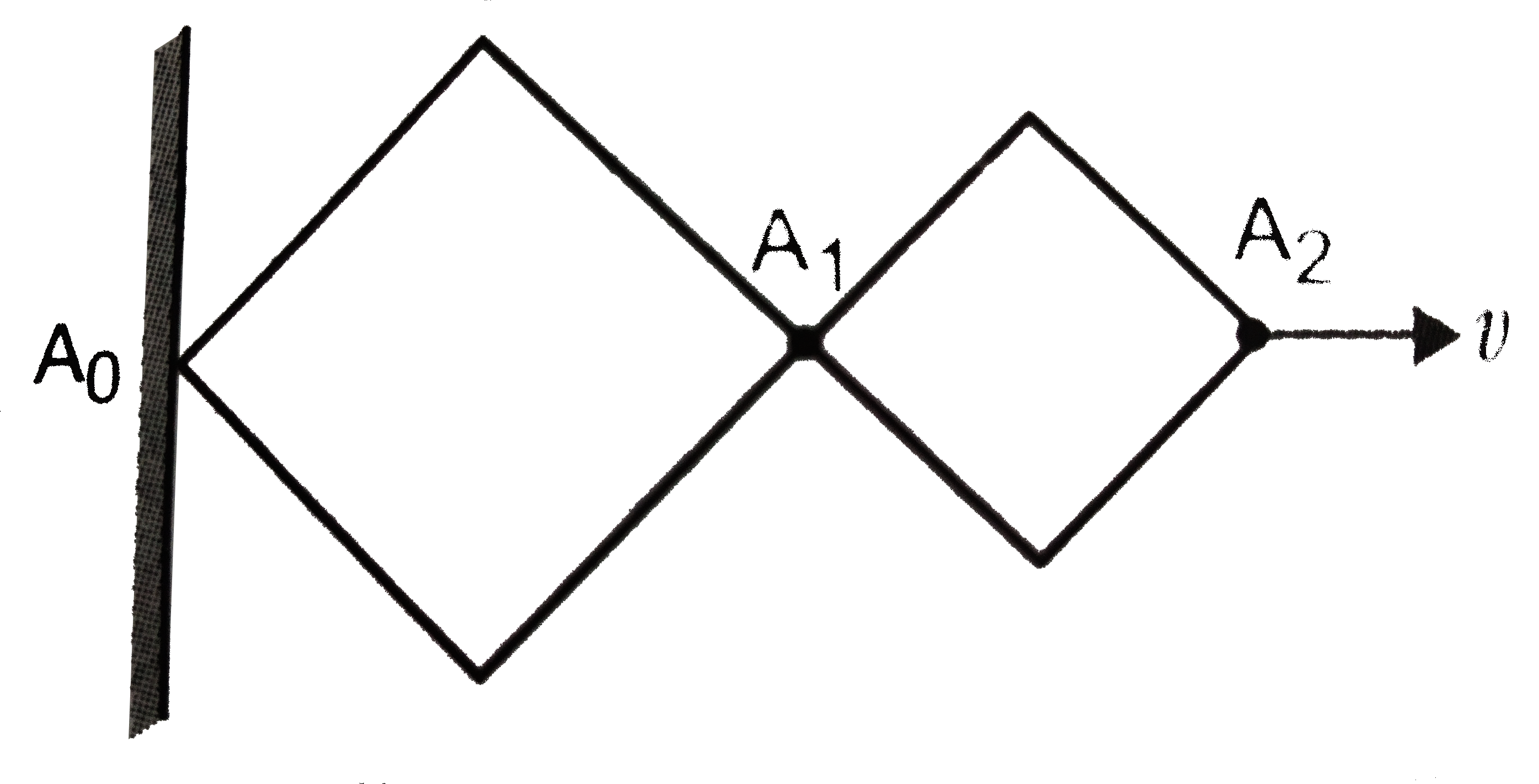
The given construction as shown in Fig. 2 (HT) .3, consists of two rhombus with the ratio ` 3: 2`, The vertex `A_2` moves In the horizontal direction with a velocity ` v`. Find the velocity of ` A_1`.
The given construction as shown in Fig. 2 (HT) .3, consists of two rhombus with the ration 3: 2, The vetex A_2 moves In the horizontal direction with a velocity v . Find the velocity of A_1 .
A hinged construction consists of three rhombs with the ratio of sides 3 : 2 : 1 (Fig). Vertex A_(3) moves in the horizontal direction at a velocity v. Determine the velocities of vertices A_(1), A_(2) and B_(2) at the instant when the angles of the construction are 90^(@)
If block A is moving horizontally with velocity v_(A) , then find the velocity of block B at the instant as shown in fig.
For the pulley system shown in fig. each of the cables at A and B is given a velocity of 2ms^(-1) in the direction of the arrow. Determine the upward velocity v of the load m.
Two particles of mass m and 2 m moving in opposite directions collide elastically with velocities v and 2v. Find their velocities after collision.
Figure-1.52 showns a hemisphere and a supported rod. Hemisphere is moving in right direction with a uniform velocity v_(2) and the end of rod which is in contact with ground is moving in left direction with a velocity v_(1) . Find the rate at which the angle theta is changing in terms of v_(1), v_(2) , R and theta .
System is shown in fig. and wedge is moving toward left with speed 2ms^(-1) . Find the velocity of the block B.
In fig., blocks A and B move with velocities v_(1) and v_(2) along horizontal direction. Find the ratio of v_(1)//v_(2)
Two balls of masses m and 2m moving in opposite directions collide head on elastically with velocities v and 2v . Find their velocities after collision.
AAKASH INSTITUTE-MOTION IN STRAIGHT LINE-Assignment (SECTION - J)