Home
Class 11
PHYSICS
Block of mass m rests on the plank B of ...

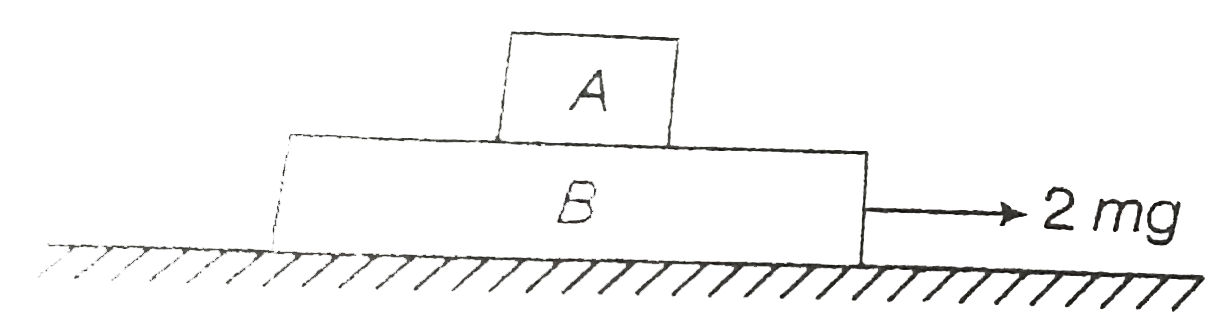
Block of mass m rests on the plank B of mass 3m which is free to slide on a frictionless horizontal surface. The coefficient of friction between the block and plank is 0.2. If a horizontal force of magnitude 2 mg is applied to the plank B, the acceleration of A relative to the plank and relative to the ground respectively, are

A

`0,(g),(2)`

B

`0,(2g)/(3)`

C

`(3g)/(5),(g)/(5)`

D

`(2g)/(5),(g)/(5)`

Text Solution

Verified by Experts

The correct Answer is:
D

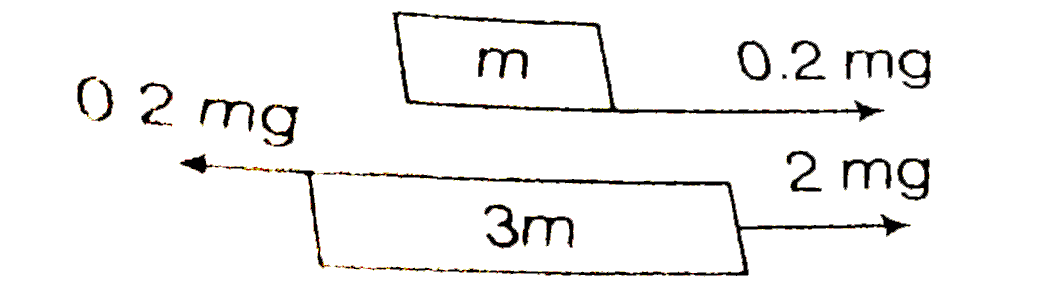
(d) Block A moves due to friction. Maximum value of friction can be `mum_(A)g`. Therefore, maximum acceleration of A can be `(mu mg)/(m_(a))` or `mug=0.2g=(g)/(5)`. When force 2 mg is applied on lower block, common acceleration (if both move together) will be,

`a=("Net force")/("Total mass")=(2 mg)/(4m)=(g)/(2)`
Since a =g/2 is greater than maximum acceleration of A which can be give to it by friction. Therefore slipping will take place.
`a_(A)=0.2g=(g)/(5)`
`a_(B)=(2mg-0.2 mg)/(3m)=0.6 g=(3g)/(5)`
`a_(AB)=a_(A)-a_(B)=+((g)/(5)-(3g)/(5))`
`=(-2g)/(5)`(in backward direction)
Promotional Banner

Topper's Solved these Questions

  • LAWS OF MOTION

    DC PANDEY|Exercise Assertion and reason|28 Videos
  • LAWS OF MOTION

    DC PANDEY|Exercise Match the columns|7 Videos
  • LAWS OF MOTION

    DC PANDEY|Exercise Check point 5.4|20 Videos
  • KINEMATICS 1

    DC PANDEY|Exercise INTEGER_TYPE|15 Videos
  • LAWS OF THERMODYNAMICS

    DC PANDEY|Exercise Level 2 Subjective|18 Videos

Similar Questions

Explore conceptually related problems

A bolck of mass m =2 kg is placed on a plank of mass M = 10 kg, which is placed on a smooth horizontal plane as shown in the figure. The coefficient of friction between the block and the plank is mu=(1)/(3) . If a horizontal force F is applied on the plank, then the maximum value of F for which the block and the plank move together is (g=10m//s^(2))

A block of mass m=2kg of shown dimensions is placed on a plank of mass M = 6Kg which is placed on smooth horizontal plane. The coefficient of friction between the block and the plank is mu=1/3 . If a horizontal froce F is applied on the plank, then find the maximum value of F (in N) for which the block and the plank move together

A block A of mass m is over a plank B of mass 2m . Plank B si placed over a smooth horizontal surface. The coefficient of friction between A and B is (1)/(2) . Blocks A is given a velocity V_(0) towards right. Then

A bar of mass m_(1) is placed on a plank of mass m_(2) which rests on a smooth horizontal plane . The coefficient of friction between the surfaces of bar and plank is k . The plank is subjected to a horizontal force F depending on time t as F = at , where a is a constant . The moment of time t_(0) at which the plank starts sliding is :

A block A of mass m is placed over a plank B of mass 2m. Plank B is placed over a smooth horizontal surface. The coefficient of friction between A and B is (1)/(2) block A is given a velocity v_(0) towards right. Accelration of B relative to A is

A plank of mass 3m is placed on a rough inclined plane and a man of mass m, the coefficient of friction between the board and inclined plane is mu = 0.5 , the minimum acceleration of man so that plank does not slide is :

A block A of mass m is placed over a plank B of mass 2m plank B is placed over a smooth horizontal surface .The coefficient of friction between A and B is 0.4 Block A is given a velocity v_(0) toward right Find acceleration (in ms^(-2) of B relative to A

A solid sphere of mass m and radius R is placed over a plank of same mass m . There is sufficient friction between sphere and plank to prevent slipping. When a horizontal force F is applied at centre of sphere, acceleration of the plank is

A block is kept on a rough horizontal plank. The coefficient of friction between the block and the plank is 1/2 . The plank is undergoing SHM of angular frequency 10 rad/s. The maximum amplitude of plank in which the block does not slip over the plank is (g= 10 m/ s^(2) )

DC PANDEY-LAWS OF MOTION-Chapter exercises (A) Taking it together
  1. Two blocks of masses m =5kg and M =10kg are connected by a string pass...

    Text Solution

    |

  2. A man of mass m stands on a platform of equal mass m and pulls himself...

    Text Solution

    |

  3. Block of mass m rests on the plank B of mass 3m which is free to slide...

    Text Solution

    |

  4. A ball is dropped on the floor from a height of 10m. It rebounds to a ...

    Text Solution

    |

  5. A chain of mass M and length L is held vertical by fixing its upper en...

    Text Solution

    |

  6. A 40 N block is supported by two ropes. One rope is horizontal and oth...

    Text Solution

    |

  7. Consider the shown arrangement. Assume all surfaces to be smooth. If ...

    Text Solution

    |

  8. In the above problem normal reaction between ground and wedge will hav...

    Text Solution

    |

  9. Starting from rest a body slides down a 45^(@) inclined plane in twice...

    Text Solution

    |

  10. A block of mass 0.1 is held against a wall applying a horizontal force...

    Text Solution

    |

  11. A block of mass m is given an initial downward velocity v(0) and left ...

    Text Solution

    |

  12. A block of mass m slides down an inclined plane which makes an angle t...

    Text Solution

    |

  13. The upper half of an inclined plane with inclination phi is perfectly ...

    Text Solution

    |

  14. Pushing force making an angle theta to the horizontal is applied on a ...

    Text Solution

    |

  15. In the arrangement shown in figure, there is a friction force between ...

    Text Solution

    |

  16. Two masses m and M are attached with strings as shown. For the system ...

    Text Solution

    |

  17. A man has fallen into a ditch of width d and two of his friends are sl...

    Text Solution

    |

  18. Two beads A and B move along a semicircular wire frame as shown in fig...

    Text Solution

    |

  19. Two blocks of masses m and 2 m are placed one over the other as shown ...

    Text Solution

    |

  20. If a body looses half of its velocity on penetrating 3 cm in a wooden ...

    Text Solution

    |

