

Home
Class 12
CHEMISTRY
The major product formed on nitration of...

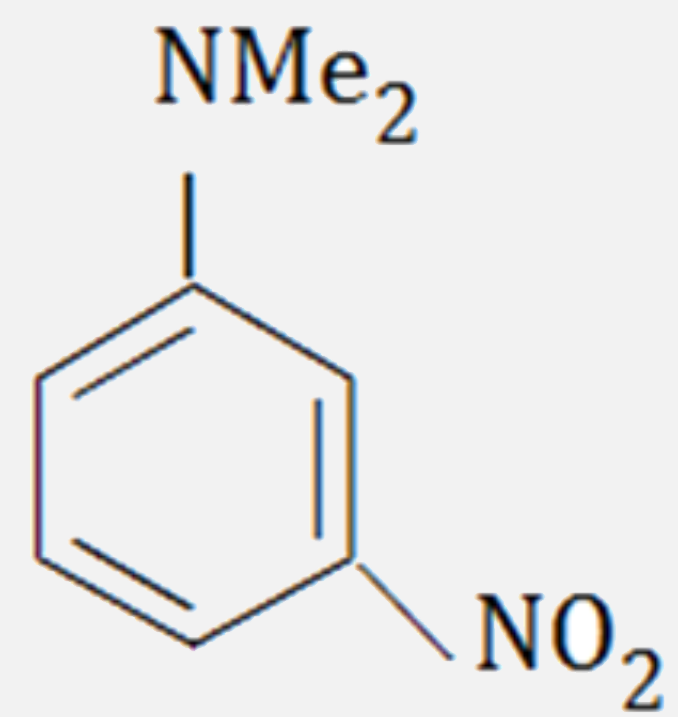
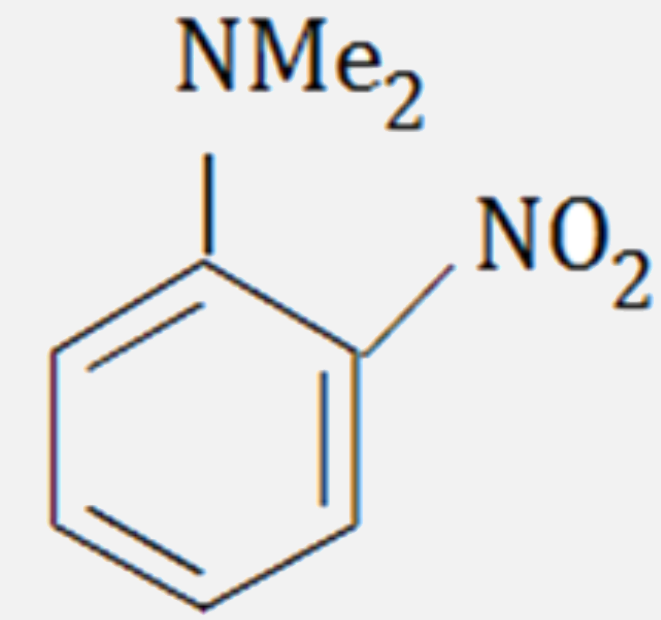
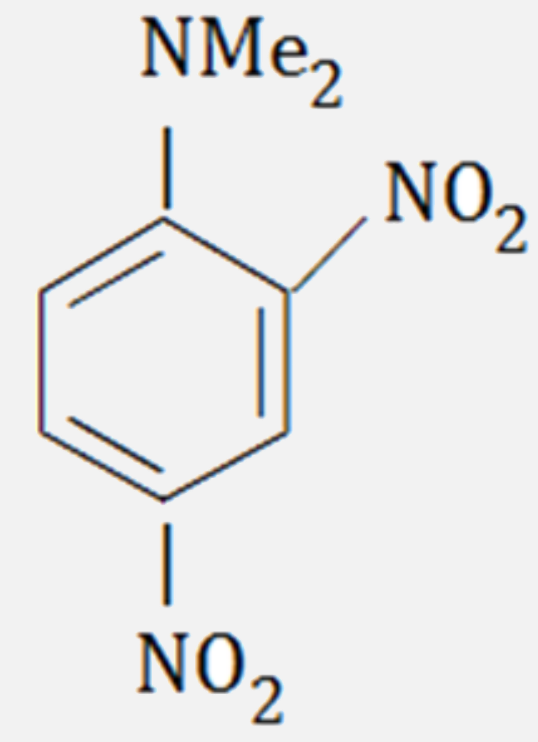
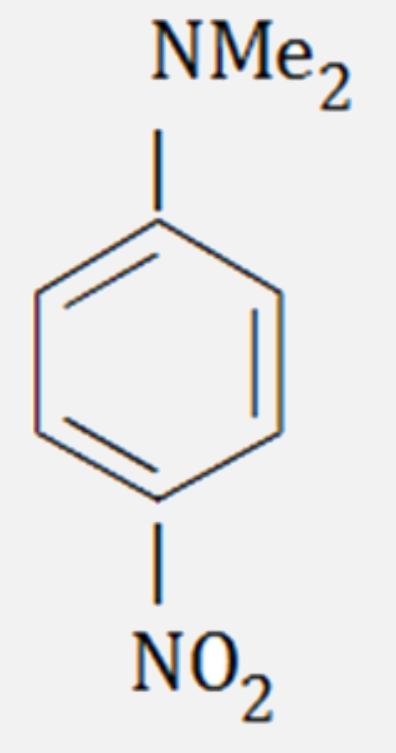
The major product formed on nitration of N, N - dimethylaniline with conc. `H_2SO_4,NHO_3` mixture is

A

B

C

D

Text Solution

AI Generated Solution

The correct Answer is:
To determine the major product formed from the nitration of N,N-dimethylaniline with a concentrated mixture of sulfuric acid (H₂SO₄) and nitric acid (HNO₃), we can follow these steps: ### Step-by-Step Solution: 1. **Identify the Structure of N,N-Dimethylaniline**: - N,N-dimethylaniline is an aniline derivative where two methyl groups are attached to the nitrogen atom. The structure can be represented as: \[ \text{C}_6\text{H}_5\text{N}(\text{CH}_3)_2 \] - The nitrogen atom has a lone pair of electrons that can donate electron density to the aromatic ring. 2. **Understand the Nitration Reaction**: - Nitration involves the introduction of a nitro group (NO₂) into the aromatic ring. The nitrating agent in this case is the mixture of concentrated H₂SO₄ and HNO₃, which generates the electrophile \( \text{NO}_2^+ \). 3. **Effect of Electron-Donating Groups**: - The two methyl groups attached to the nitrogen are electron-donating groups (+M effect), which increase the electron density at the ortho and para positions of the aromatic ring. However, under strong acidic conditions, the lone pair of the nitrogen is protonated, making it a deactivating group. 4. **Protonation of the Amino Group**: - In concentrated acidic conditions, the nitrogen atom in N,N-dimethylaniline gets protonated, losing its ability to donate electron density effectively to the ring. This results in the nitrogen acting as a deactivating group. 5. **Nitration Position Preference**: - Due to the deactivating effect of the protonated nitrogen, the electron density at the ortho and para positions decreases. The meta position, however, retains some electron density because it is less affected by the deactivating group. - Therefore, the nitro group will preferentially attack the meta position. 6. **Final Product**: - The major product formed from the nitration of N,N-dimethylaniline under these conditions will be 3-nitro-N,N-dimethylaniline, where the nitro group is located at the meta position relative to the dimethylamino group. ### Conclusion: The major product formed from the nitration of N,N-dimethylaniline with concentrated H₂SO₄ and HNO₃ is **3-nitro-N,N-dimethylaniline**.
Promotional Banner

Topper's Solved these Questions

  • NTA NEET TEST 64

    NTA MOCK TESTS|Exercise CHEMISTRY|45 Videos
  • NTA NEET TEST 80

    NTA MOCK TESTS|Exercise CHEMISTRY|45 Videos

Similar Questions

Explore conceptually related problems

The major product formed in the reaction is : +HNO_(3)overset("conc."H_(2)SO_(4))rarr

Kl when heated with conc . H_2SO_4 , it forms

Conc. HNO_(3)+H_(2)SO_(4) mixture gives

What is the major product formed when butan-2-ol is treated with conc. H_(2)SO_(4) at 443 K ?

the major product obtained in the reaction of oxalic acid with conc, H_(2)SO_(4) upon heating are

Give the majore product formed when each of the following is heated in the presence of conc. H_(2)SO_(4) or H_(3)PO_(4)

A student tried to synthesis 4-nitro-N, N-dimethylaniline from N, N-dimethylaniline via electrophilic aromati substitution using nitric acid (HNO_3) and sulphuric acid (H_2SO_4) . To his surprice, the major product he obtained was 3-nitro-N, N-dimethylaniline. Why the disigned reaction failed to provide the desired product, 4-nitro-N, N-dimethylaniline?

The product formed, when glycol is heated with conc. H_(2)SO_(4) , is :

NTA MOCK TESTS-NTA NEET TEST 79-CHEMISTRY
  1. 0.85% aqueous solution of NaNO(3) is apparently 90% dissociated at 27^...

    Text Solution

    |

  2. What is spectrochemical series?

    Text Solution

    |

  3. The major product formed on nitration of N, N - dimethylaniline with c...

    Text Solution

    |

  4. How many grams of a dibasic acid (Mol. Wt. =200) should be present in ...

    Text Solution

    |

  5. Which of the following compounds would be most ionic in character ?

    Text Solution

    |

  6. Consider the following reaction at equilibrium 2Fe^(2+)(aq)+Cu^(2+)to2...

    Text Solution

    |

  7. Find the incorrect statement

    Text Solution

    |

  8. The numbers of radial nodes of 3s and 2p orbitals are respectively:

    Text Solution

    |

  9. The hyperconjugative stabilities of tert-butyl cation and 2-butene, re...

    Text Solution

    |

  10. The crystals of ferrous sulphate on heating give

    Text Solution

    |

  11. 2,4 - DNP is obtained by reacting hydrazine hydrate with which of the ...

    Text Solution

    |

  12. On heating with dilute sulphuric acid, naphthalene - 1 sulphonic acid ...

    Text Solution

    |

  13. Consider the following reduction processes : Zn^(2+)+2e^(-)toZn(s), ...

    Text Solution

    |

  14. The following compounds have been arranged in order of their increasin...

    Text Solution

    |

  15. Among the carboxylic acid shown below, the ones that exhibit stereoiso...

    Text Solution

    |

  16. Which of the following statements is correct about heat of combustion?

    Text Solution

    |

  17. An organic compound undergoes first decompoistion. The time taken for ...

    Text Solution

    |

  18. Aniline can be distinguished from methyl amine by its reaction with

    Text Solution

    |

  19. C2 - epimer of D - Glucose is

    Text Solution

    |

  20. Which of the following alkene in acid catalysed hydration form 2-methy...

    Text Solution

    |