Home
Class 12
CHEMISTRY
Following two graphs are based on the co...

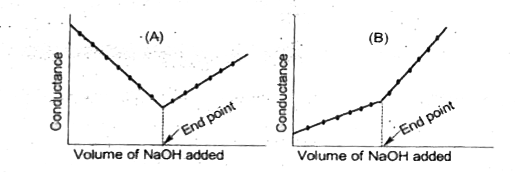
Following two graphs are based on the conductometric titration of acid-base reaction. Answer the questions given at the end of it.

Select correct statement,

A

Graph A is for weak monobasic acid while graph B is for monobasic strong acid

B

Graph A is for strong monobasic add and graph B is for weak dibasic acid

C

Graph A is for weak monobasic acld and graph B is for weak dibasic acid

D

Graph A is for strong monobasic acid and graph B is for weak monobasic acid

Text Solution

Verified by Experts

The correct Answer is:

D
Promotional Banner

Topper's Solved these Questions

  • ELECTROCHEMISTRY

    FIITJEE|Exercise (Comprehension -IV)|4 Videos
  • ELECTROCHEMISTRY

    FIITJEE|Exercise (Comprehension -V)|8 Videos
  • ELECTROCHEMISTRY

    FIITJEE|Exercise (Comprehension -II)|5 Videos
  • CONCEPT OF ACIDS AND BASES

    FIITJEE|Exercise SINGLE INTEGER ANSWER TYPE QUESTIONS|4 Videos
  • ELECTROPHILIC AROMATIC SUBSTITUTION

    FIITJEE|Exercise NUMERICAL BASED QUESTIONS INDICATED BY DIGITAL INTERGER|1 Videos

Similar Questions

Explore conceptually related problems

acid base titration,iodometric titration

Acid base titration

question based on redox titration,acid base titration

The correct answer to above question is based on

Isohydric Solutions, Acid-Base Titrations

which of the following plots will obtained for a conductometric titration of strong acid against a weak base?

Knowledge Check

  • Go through the following flow sheet. Based on, it answer the questions given at the end of it. Select correct statement(s):

    A
    `CO_(2)` makes the solution of (B) acidic and converts (B) into `FeCI_(2)(C)`.
    B
    `CO_(2)` makes the solution of (B) basic and converts it into `Na_(2)Cr_(2)O_(7)`
    C
    `CO_(2)` makes the solution of (B) acidic and converts it into `Na_(2)Cr_(2)O_(7)`
    D
    None of the above is correct
  • The correct answer to above question is based on

    A
    Acceleration due to gravity in vacuum is same irrespective of size and mass of the body
    B
    Acceleration due to gravity in vacuum depends on the mass of the body
    C
    There is no acceleration due to gravity in vacuum
    D
    In vacuum there is resistance offered to the motion of the body and this resistance depends on the mass of the body
  • Go through the following flow sheet. Based on, it answer the questions given at the end of it. Compound (A) is:

    A
    `CuCI_(2)`
    B
    `FeCI_(3)`
    C
    `FeCI_(2)`
    D
    `CrCI_(3)`
