
Home
Class 12
CHEMISTRY
Hydrolysis of dimethyldichloro silane , ...

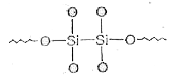
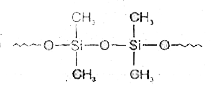
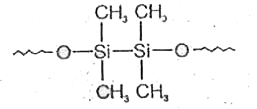
Hydrolysis of dimethyldichloro silane , `(CH_(3))_(2) SiCl_(2)` followed by condensation polymerisation yields straight chain polymer of

A

B

C

D

Text Solution

AI Generated Solution

The correct Answer is:

To solve the question regarding the hydrolysis of dimethyldichlorosilane, `(CH₃)₂SiCl₂`, and the subsequent condensation polymerization, we can proceed with the following steps: ### Step-by-Step Solution: 1. **Understanding the Hydrolysis Reaction**: - Dimethyldichlorosilane, `(CH₃)₂SiCl₂`, reacts with water during hydrolysis. The chlorine atoms are replaced by hydroxyl groups (OH). - The reaction can be represented as: \[ (CH₃)₂SiCl₂ + 2H₂O \rightarrow (CH₃)₂Si(OH)₂ + 2HCl \] 2. **Formation of Silanol**: - The product of hydrolysis is dimethylsilanediol, `(CH₃)₂Si(OH)₂`. This compound contains two hydroxyl groups attached to the silicon atom. 3. **Condensation Polymerization**: - The silanol groups can undergo condensation reactions. During this process, the hydroxyl groups can react with each other, leading to the elimination of water molecules and the formation of siloxane (Si-O-Si) linkages. - The general reaction for condensation can be represented as: \[ n \, (CH₃)₂Si(OH)₂ \rightarrow \text{Polymer} + (n-1) H₂O \] 4. **Structure of the Polymer**: - The resulting polymer will have a backbone of silicon atoms connected by oxygen atoms, with methyl groups attached to the silicon. The structure can be depicted as: \[ \text{[Si(CH₃)₂O]}_n \] - This indicates a straight-chain polymer where `n` represents the number of repeating units. 5. **Final Product**: - The final product is a straight-chain polymer of dimethylsiloxane, which can be represented as: \[ \text{(Si(CH₃)₂O)}_n \] ### Conclusion: The hydrolysis of dimethyldichlorosilane followed by condensation polymerization yields a straight-chain polymer of dimethylsiloxane.
Promotional Banner

Similar Questions

Explore conceptually related problems

(CH_(3))_(2) SiCl_(2) on hydrolysis and on subsequent polymerisation will produce :

Which of the following polymers is prepared by condensation polymerisation ?

Which one of the following polymers in not obtained by condensation polymerisation ?

Which of the following polymers is prepared by condensation polymerisation?
