Home
Class 12
PHYSICS
What is modulation? Explain the types of...

What is modulation? Explain the types of modulation with necessary diagrams.

Text Solution

Verified by Experts
Modulation: For long distance transmission, the low frequency baseband signal (input signal) is superimposed onto a high frequency radio signal by a process called modulation. There are 3 types of modulation based on which parameter is modified. They are (i) Amplitude modulation (ii) Frequency modulation, and (iii) Phase modulation.
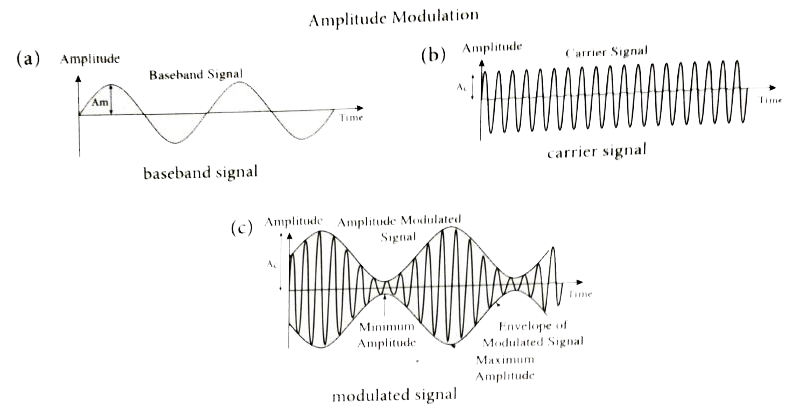
(i) Amplitude Modulation (AM): If The amplitude of the carrier signal is modified according to the instantaneous amplitude of the baseband signal, then it is called amplitude modulation. Here the frequency and the phase of the carrier signal remain constant Amplitude modulation is used in radio and TV broadcasting.

The signal shown in figure() is the message signal or baseband signal that carries information figure (b) shows the high frequency carrier signal and figure (e) gives the amplitude modulated signal. We can see clearly that the carrier wave is modified in proportion to the amplitude of the baseband signal.
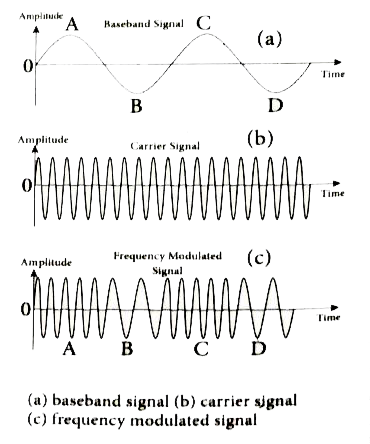
(ii) Frequency Modulation (FM):The frequency of the carrier signal is modified according to the instantaneous amplitude of the baseband signal in frequency modulation. Here the amplitude and the phase of the carrier signal remain constant. Increase in the amplitude of the baseband signal increases the frequency of the carrier signal and vice versa. This leads to compressions and rarefactions in the frequency spectrum of the modulated wave. Louder signal leads to compressions and relatively weaker signals to rarefactions When the amplitude of the baseband signal is zero in Figure (a), the frequency of the modulated signal is the same as the carrier signal. The frequency of the modulated wave increases when the amplitude of the baseband signal increases in the positive direction (A, C). The increase in amplitude in the negative half cycle (B, D) reduces the frequency of the modulated wave (Figure (c)).

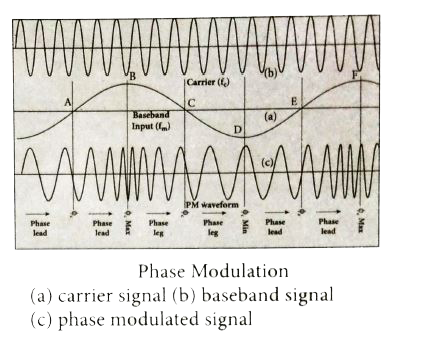
(iii) Phase Modulation (PM): The instantaneous amplitude of the baseband signal modifies the phase of the carrier signal keeping the amplitude and frequency constant is called phase modulation. This modulation is used to generate frequency modulated signals. It is similar to frequency modulation except that the phase of the carrier is varied instead of varying frequency. The carrier phase changes according to modulating signal goes positive, the amount of phase lead increases with the amplitude of the modulating signal. Due to this, the carrier signal is compressed or its frequency is increased. On the other hand, the negative half cycle of the baseband signal produces a phase lag in the carrier signal. This appears to have stretched the frequency of the carrier wave. Hence similar to frequency modulated wave, phase modulated wave also comprises of compressions and rarefactions. When the signal voltage is zero (A, C and E) the carrier frequency is unchanged.
Promotional Banner

Topper's Solved these Questions

  • SAMPLE PAPER-1 (SOLVED)

    FULL MARKS|Exercise Questions|28 Videos
  • SAMPLE PAPER-07 (SOLVED )

    FULL MARKS|Exercise (PART - IV)(Answer all the questions.)|10 Videos
  • SAMPLE PAPER-16 (UNSOLVED)

    FULL MARKS|Exercise PART-IV|10 Videos

Similar Questions

Explore conceptually related problems

Explain the three type of duplication with necessary diagram.

What is diabetes? Explain the types.

Explain the type of reproduction in Hydra with a diagram.

What is endosperm ? Explain the types.

What is Flora? Explain the types.

What is endosperm ? Explain the types.

What is regeneration? Explain its types.

What is protostele? Explain its types.

FULL MARKS-SAMPLE PAPER-1 (SOLVED)-Questions
  1. Calculate the magnetic field inside a solenoid when the number of turn...

    Text Solution

    |

  2. Two cells each of 5V are connected in series across a 8 Omega resisto...

    Text Solution

    |

  3. Write a note on transformer.

    Text Solution

    |

  4. Discuss the alpha decay process with example.

    Text Solution

    |

  5. Obtain the expression for the energy stored in a parallel plate capaci...

    Text Solution

    |

  6. Explain any three recent advancements in medical technology.

    Text Solution

    |

  7. Two light sources with amplitudes 5 units and 3 units respectively int...

    Text Solution

    |

  8. An electron moves in a circular orbit with a uniform speed v. It produ...

    Text Solution

    |

  9. Give the construction and working of photo emissive cell.

    Text Solution

    |

  10. In the circuit shown in the figure, the input voltage Vi = +5 V, V(BE)...

    Text Solution

    |

  11. Obtain the expression for electric field due to an uniformly charge sp...

    Text Solution

    |

  12. Write any five properties of electromagnetic waves.

    Text Solution

    |

  13. What is modulation? Explain the types of modulation with necessary dia...

    Text Solution

    |

  14. Find the expression for the mutual inductance between a pair of coils ...

    Text Solution

    |

  15. Derive the expression for the radius of the orbit of the electron and ...

    Text Solution

    |

  16. Discuss the working of cyclotron in detail.

    Text Solution

    |

  17. Obtain lens maker's formula and medium its signification. Lens maker'...

    Text Solution

    |

  18. Explain the construction and working of a full wave rectifier.

    Text Solution

    |

  19. An electron is accelerated through a potential difference of 81V. What...

    Text Solution

    |

  20. A cell supplies a current of 0.9 A through a 1 Omega resistor and a cu...

    Text Solution

    |