Home
Class 12
MATHS
Find the equations of the circles which ...

Find the equations of the circles which pass through the origin and cut off chords of length `a` from each of the lines `y=xa n dy=-x`

Text Solution

Verified by Experts

The correct Answer is:
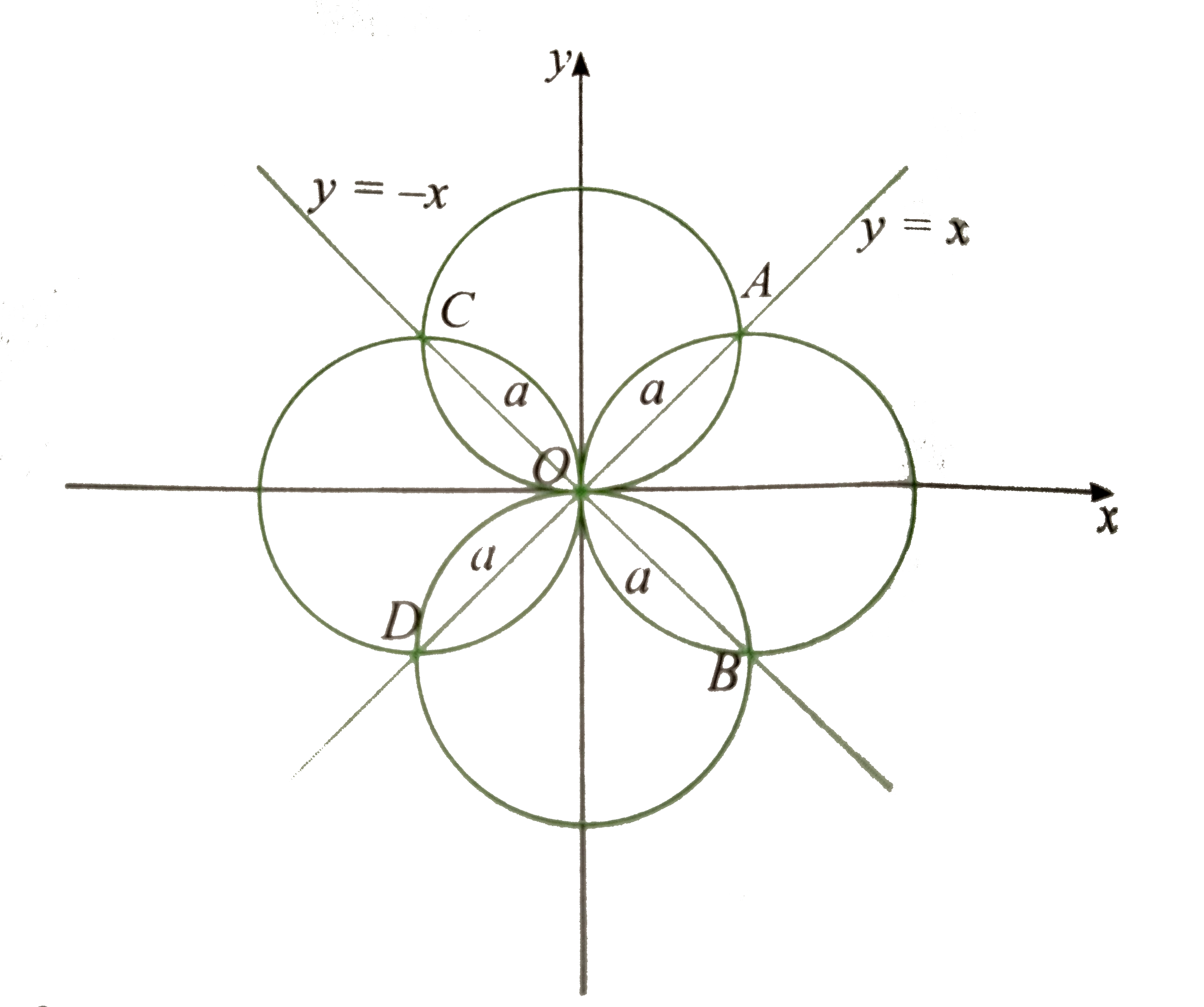
`x^(2)+y^(2)+- sqrt(2)ax=0` and `x^(2)+y^(2)+- sqrt(2)ay=0`


In the figure, length of chords OA and AB that cut off by the circles is a.
`:. A-= ((a)/(sqrt(2)),(a)/(sqrt(2)))` and `B-= ((a)/(sqrt(2)),-(a)/(sqrt(2)))`, which are end points of diameters.
Therefore, the equation of circle is
`(x-(a)/(sqrt(2)))(x-(a)/(sqrt(2)))+(y-(a)/(sqrt(2)))(y+(a)/(sqrt(2)))=0`
or `x^(2)+y^(2)-sqrt(2)ax=0`
Circles with AC and BD as diametere are given by `x^(2)+y^(2)+- sqrt(2) ay=0`
Promotional Banner

Similar Questions

Explore conceptually related problems

Find the equations of the circles which pass through the origin and cut otf chords of length a from each of the lines y=x and y=-x

Find the equation to the circle which passes through the origin and cut off equal chords of length 'a' from the straight lines y=x and y=-x

Find the equation of the circle which passes through the origin and cut off equal chords of sqrt(2) units from the lines y=x and y=-x

Find the equation of the circle , which passes through the origin and cuts off intercepts a and b from the axes.

Find the equation of the circle which passes through the origin and cuts off chords of lengths 4 and 6 on the circle concentric with the circle x^(2)+y^(2)-6x+12y+15=0 and double of its area.

Find the locus of the centre of a circle which passes through the origin and cuts off a length 2l from the line x=c .

Equation of the circle which passes through the origin and cuts off intercepts of length 2 units from negative co-ordinate axes , is

Find the equation of the circle which passes through the origin and cuts off intercepts 6 and 8 from the positive parts of x and y axes respectively.

Find the equation of the circle which passes through the origin and cuts off intercepts 3 and 4 from the positive parts of the axes respectively.

