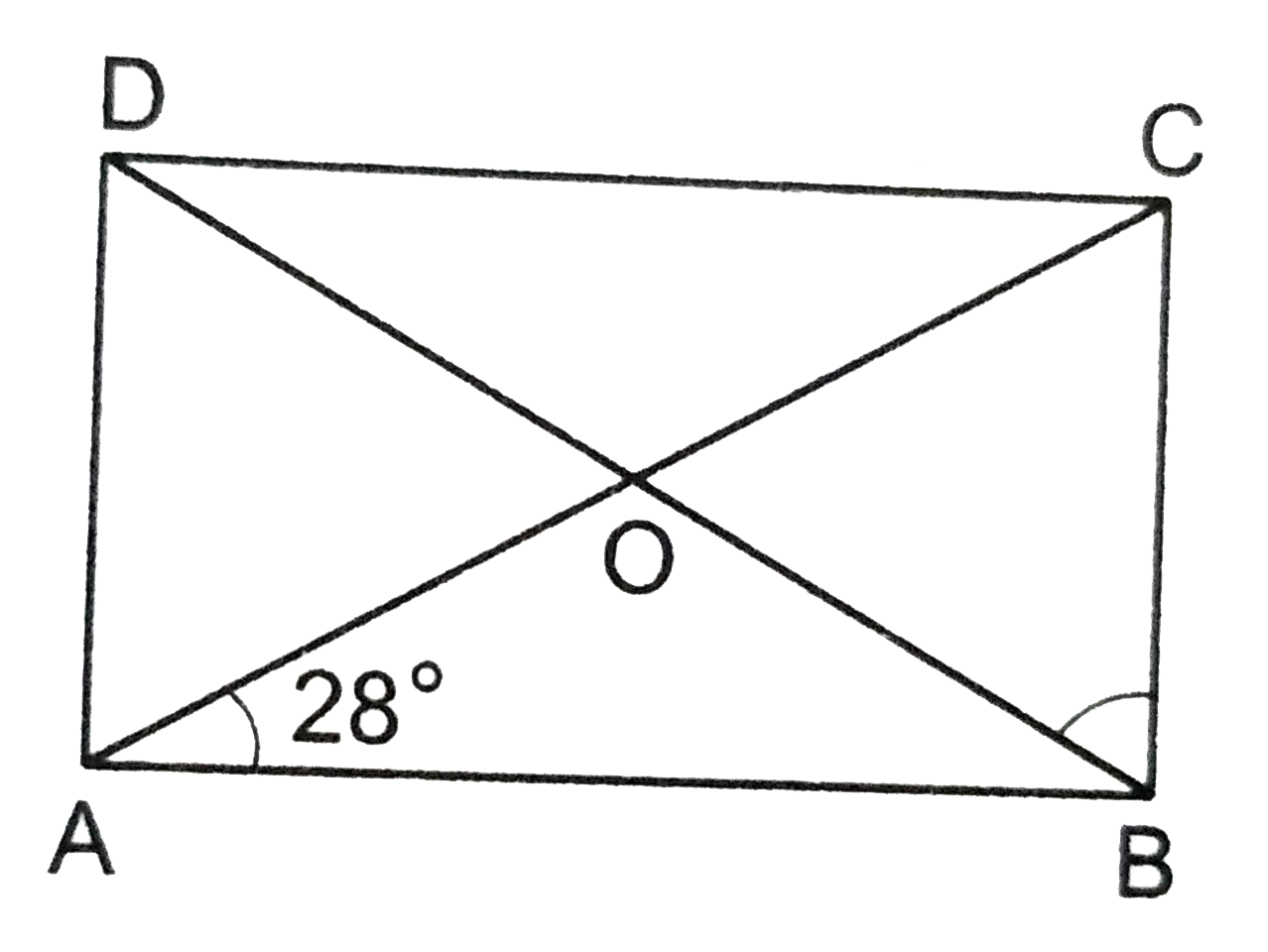
In the adjoining figure, ABCD is a rectangle whose diagonals AC and BD intersect at O. If `angle OAB =28^(@), " find " angle OBC.`
Text Solution
Verified by Experts
We know that the diagonals of a rectangle are equal and bisect each other. `therefore OA =OB rArr angle OBA = angle OAB =28^(@)`. Also, each angle of a rectangle measures `90^(@)`. `therefore angle ABC =90^(@) rArr angle OBA + angle OBC =90^(@)` `therefore 28^(@)+angle OBC =90^(@) rArr angle OBA =(90^(@)-28^(@))=62^(@).`
In the given figure, ABCD is a rectangle whose diagonals AC and BD intersect at 0. If angleOAB = 28^(@) , then angleOBC is equal to
If ABCD is a quadrilateral whose diagonals AC and BD intersect at O, then
The diagonals of a rectangle ABCD intersect in O.if angle BOC=68^(@), find angle ODA
The diagonals of rectangle ABCD intersect at O . If angleAOD=40^(@) , then find angleOAD
In a rectangle ABCD, diagonals AC and BD intersect at O. If angleOAB=35^(@), find : (a)angleABC(b)angleABO(c)angleCO (d)angle BOC)
In the adjacent figure , ABCD is a rhombus whose diagonals AC and BD intersect at a point O. If side AB=10 cm and diagonal BD=16 cm , find the length of diagonal AC.
ABCD is a rectangle. The diagonals AC and BD intersect at O. If AB = 32 cm and AD = 24 cm, then what is OD equal to ?
In the given figure, ABCD is a ||gm in which diagonals AC and BD intersect at O. If ar(||gm ABCD) is 52 cm^(2) then the ar(triangleAOB) =?
In the adjoining figure, ABCD is a quadrilateral. Its diagonals AC and BD intersect at point 'O'. Prove that : (a) AB+BC+CD+DA lt 2(AC+BD) (b) AB+BC+CD+DA gt (AC+BD)