Home
Class 11
CHEMISTRY
Which of the following shows geometrical...

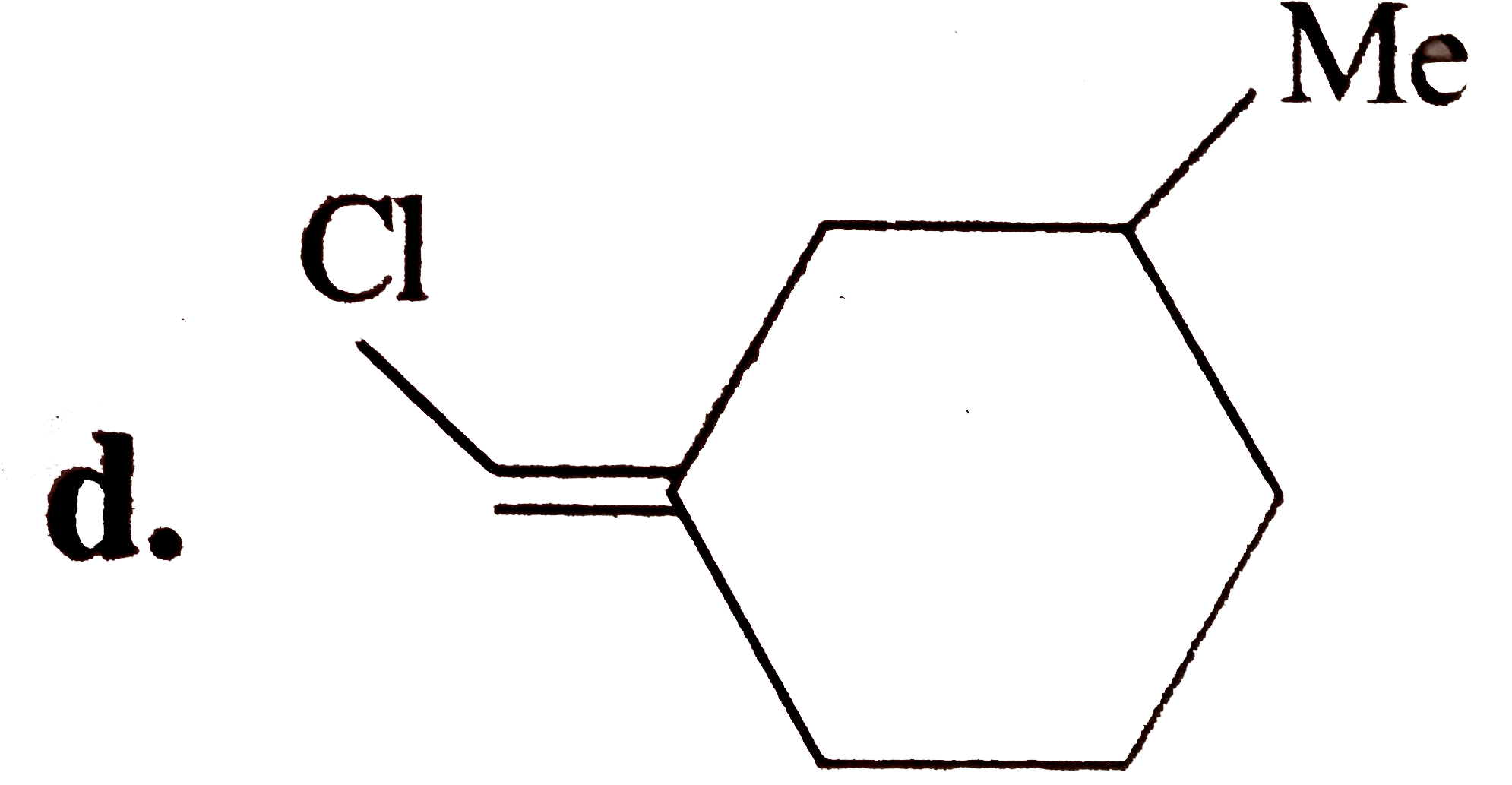
Which of the following shows geometrical isomers ?

A

`BrCH=C=C=CHBr`

B

`BrCH=C=C=CBr`

C

`CH_(2)=C=C=CHBr`

D

Text Solution

AI Generated Solution

The correct Answer is:

To determine which of the given compounds shows geometrical isomers, we need to analyze each option based on the presence of a double bond and the different substituents attached to the carbon atoms involved in that double bond. Geometrical isomers, also known as cis-trans isomers, occur when there are two different groups attached to each carbon of the double bond. ### Step-by-Step Solution: 1. **Understanding Geometrical Isomers**: - Geometrical isomers occur in compounds with a carbon-carbon double bond (C=C) when there are different substituents attached to the carbon atoms of the double bond. The two main forms are: - **Cis**: Similar groups are on the same side of the double bond. - **Trans**: Similar groups are on opposite sides of the double bond. 2. **Analyzing Compound A**: - Compound A has a structure with a carbon double bond and different substituents (H and Br) on both carbons. - It can exhibit cis (H on the same side) and trans (H on opposite sides) configurations. - **Conclusion**: Compound A shows geometrical isomers. 3. **Analyzing Compound B**: - Compound B also has a carbon double bond, but it has two bromine atoms (Br) on one carbon. - Since both substituents are the same (Br), it cannot exhibit cis-trans isomerism. - **Conclusion**: Compound B does not show geometrical isomers. 4. **Analyzing Compound C**: - Compound C has a carbon double bond with two identical hydrogen atoms attached to one of the carbons. - Since both substituents are the same (H), it cannot exhibit cis-trans isomerism. - **Conclusion**: Compound C does not show geometrical isomers. 5. **Analyzing Compound D**: - Compound D features a cyclohexane ring with a double bond and different substituents (Cl and Me) attached to the carbons involved in the double bond. - It can exhibit cis (Cl and Me on the same side) and trans (Cl and Me on opposite sides) configurations. - **Conclusion**: Compound D shows geometrical isomers. ### Final Answer: - The compounds that show geometrical isomers are **Compound A and Compound D**.

To determine which of the given compounds shows geometrical isomers, we need to analyze each option based on the presence of a double bond and the different substituents attached to the carbon atoms involved in that double bond. Geometrical isomers, also known as cis-trans isomers, occur when there are two different groups attached to each carbon of the double bond. ### Step-by-Step Solution: 1. **Understanding Geometrical Isomers**: - Geometrical isomers occur in compounds with a carbon-carbon double bond (C=C) when there are different substituents attached to the carbon atoms of the double bond. The two main forms are: - **Cis**: Similar groups are on the same side of the double bond. - **Trans**: Similar groups are on opposite sides of the double bond. ...
Promotional Banner

Topper's Solved these Questions

  • ALKENES AND ALKADIENES

    CENGAGE CHEMISTRY ENGLISH|Exercise Archives(ASSERTION-REASIOING)|4 Videos
  • ALKENES AND ALKADIENES

    CENGAGE CHEMISTRY ENGLISH|Exercise Fill in the Blanks|3 Videos
  • ALKENES AND ALKADIENES

    CENGAGE CHEMISTRY ENGLISH|Exercise Multiple Correct Answer Type|41 Videos
  • ALKANES AND CYCLOALKANES

    CENGAGE CHEMISTRY ENGLISH|Exercise Archives|13 Videos
  • ALKYNES

    CENGAGE CHEMISTRY ENGLISH|Exercise Exercises (Archives - Analytical and Desriptive Type)|4 Videos

Similar Questions

Explore conceptually related problems

Which of the folllowing shows geometrical isomerism ?

Which of the following can show geometrical isomerism?

Which of the following can show geometrical isomerism.

Which of the following will show geometrical isomerism ?

Which of the following cannot show geometrical isomerism

Which of the following will not show geometrical isomerism ?

Which of the following will not show geometrical isomerism?

Knowledge Check

  • Which of the following will form geometrical isomers?

    A
    B
    `CH_(3)CH=NOH`
    C
    D
    all of these
  • Which of the following pairs are geometrical isomers?

    A
    1.
    B
    2.
    C
    3.Both of these
    D
    4.None of the above
  • Which of the following will not show geometrical isomerism?

    A
    B
    C
    D
  • CENGAGE CHEMISTRY ENGLISH-ALKENES AND ALKADIENES-Single Correct Answer Type
    1. Which of the following shows geometrical isomers ?

      Text Solution

      |

    2. Which of the following compounds would have the same vapour pressure ?

      Text Solution

      |

    3. The product (C) and (D) are :

      Text Solution

      |

    4. The product (C) and (D) are :

      Text Solution

      |

    5. Arrange the following compounds in the decreasing order of acidic char...

      Text Solution

      |

    6. Out of the following compounds . I. Pent -1-ene, II. Pent -2-ene ...

      Text Solution

      |

    7. Compound (C) is:

      Text Solution

      |

    8. Refer to Question. When the compound (B) on ozonolysis is followed by ...

      Text Solution

      |

    9. trans -3,6-Dimethyl oct-4ene (A) exists in two diasteromer (I) and (II...

      Text Solution

      |

    10. The total number of stereoisomers for (A) is :

      Text Solution

      |

    11. An organic compound (A) (C(10)H(20))on reductive ozonolysis gives 2- m...

      Text Solution

      |

    12. If the stereochemistry about the double bond in (A) is trans, two dias...

      Text Solution

      |

    13. Compounds (B) and (C) are :

      Text Solution

      |

    14. Compound (B) and (C) are :

      Text Solution

      |

    15. The three compounds (A),(B),and (C) on hydrogenation with H(2)+Pd give...

      Text Solution

      |

    16. Which of the following will have lower pK(a) value ?

      Text Solution

      |

    17. The decreasing order of acidic character is :

      Text Solution

      |

    18. Which of the following is the correct order of stability of the foll...

      Text Solution

      |

    19. Which of the following is the most stable species ?

      Text Solution

      |

    20. Which of the following is non - aromatic in nature ?

      Text Solution

      |
