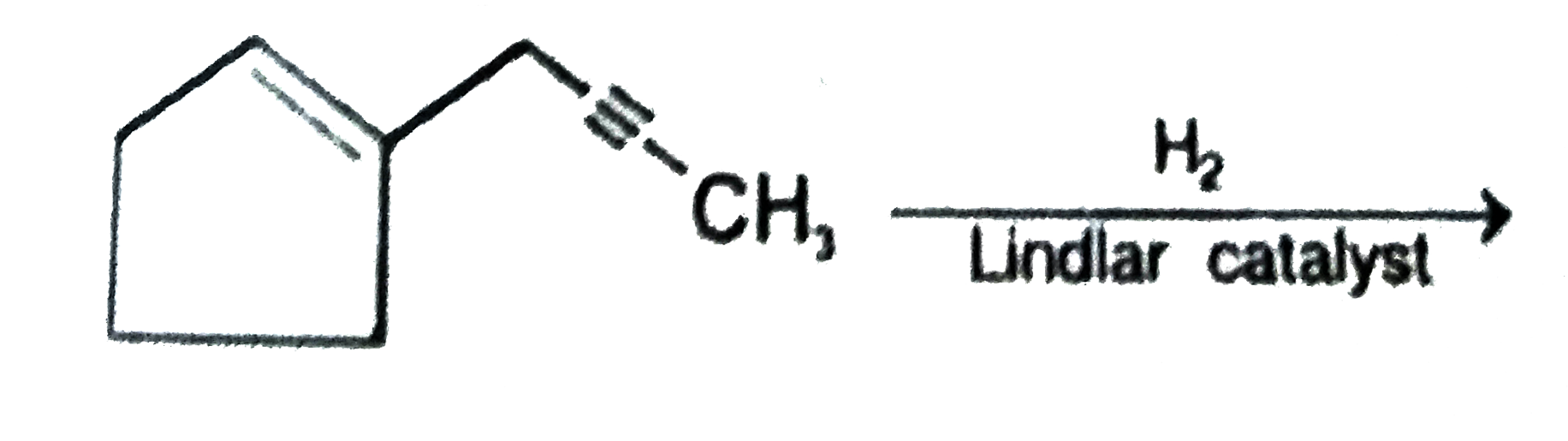
Text Solution
Verified by Experts
The correct Answer is:



Topper's Solved these Questions
REDUCTION, OXIDATION & HYDROLYSIS REACTIONS
RESONANCE ENGLISH|Exercise Part-II JEE (Main) AIEEE Problems (Previous Years)|16 VideosREDUCTION, OXIDATION & HYDROLYSIS REACTIONS
RESONANCE ENGLISH|Exercise JEE (MAIN) ONLINE PROBLEMS|13 VideosREDUCTION, OXIDATION & HYDROLYSIS REACTIONS
RESONANCE ENGLISH|Exercise Part-IV: Comprehension|10 VideosPERIODIC TABLE & PERIODICITY
RESONANCE ENGLISH|Exercise ORGANIC CHEMISTRY(BASIC CONCEPTS)|27 VideosS BLOCK ELEMENTS
RESONANCE ENGLISH|Exercise ORGANIC CHEMISTRY(Biomolecules & Polymer)|4 Videos
Similar Questions
Explore conceptually related problems
RESONANCE ENGLISH-REDUCTION, OXIDATION & HYDROLYSIS REACTIONS-Part-I : Jee (Advanced) (Previous years)
- What would be the major product in the following reactions ?
Text Solution
|
- Hydrogenation of the adjoining compound in the presence of poisoned pa...
Text Solution
|
- 1-propanol and 2-propanol can be best distinguished by :
Text Solution
|
- Statement I : Dimethyl sulphide is commonly used for the reduction of...
Text Solution
|
- On passing SO2 gas through calcium hydroxide, we get a white precipita...
Text Solution
|
- Which of the following is used for the conversion of 2 - hexyne into t...
Text Solution
|
- Silver nitrate on reaction with sodium iodide gives yellow precipitate...
Text Solution
|
- Silver nitrate on reaction with potassium chloride gives white precipi...
Text Solution
|
- Silver nitrate on reaction with sodium chromate gives red precipitate ...
Text Solution
|
- The number of optically active products obtained from the complete ozo...
Text Solution
|
- Consider all possible isomeric ketones including steroisomers of Mw=10...
Text Solution
|
- Reagent(s) which can be used to bring about the following transformati...
Text Solution
|