Home
Class 12
CHEMISTRY
A graph was plotted between the molar co...

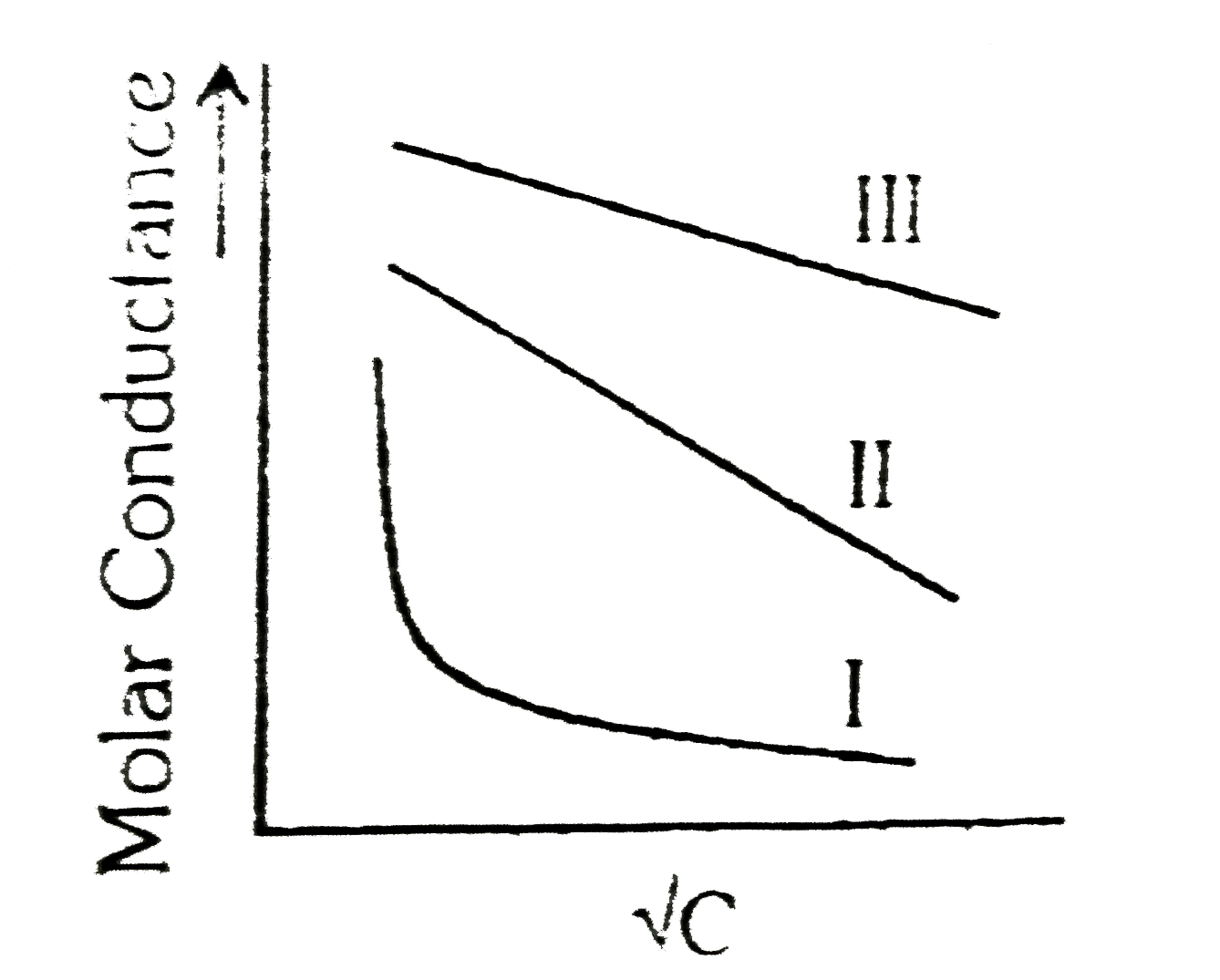
A graph was plotted between the molar conductance of various electrolytes `(HCI, KCI` and `CH_(3)COOH)` and root of their concentrations in molar per litre.

Which of the following is correct match?

A

`I (CH_(3)COOH), II (KCI), II(HCI)`

B

`I(HCI), II(KCI), II (CH_(3)COOH)`

C

`I(CH_(3)COOH), II (HCI), II (KCI)`

D

`I(KCI), II(CH_(3)COOH), II (HCI)`

Text Solution

Verified by Experts

The correct Answer is:

B

Molar conductance of `HCI` will be maximum and `CH_(3)COOH` will be minimum
because
(i) `[H^(+)]` have expectional ionic mobility
(ii) `CH_(3)COOH` is a weak electrolyte
Promotional Banner

Topper's Solved these Questions

  • ELECTROCHEMISTRY

    ALLEN|Exercise EXERCISE-03|24 Videos
  • ELECTROCHEMISTRY

    ALLEN|Exercise EXERCISE-04 [A]|55 Videos
  • ELECTROCHEMISTRY

    ALLEN|Exercise Part (II) EXERCISE-01|44 Videos
  • CHEMISTRY AT A GLANCE

    ALLEN|Exercise ORGANIC CHEMISTRY|472 Videos
  • HYDROCARBON

    ALLEN|Exercise MCQ|15 Videos

Similar Questions

Explore conceptually related problems

A graph was plotted between molar conductivity of various electrolytes (NaCl, HCl and NH_4OH ) and sqrtC (in mol L^(-1) ) . Correct set is : a. I(NaCl),II(HCl) , III( NH_4OH ) b. I(HCl),II(NaCl) , III( NH_4OH ) c. I( NH_4OH ), II(NaCl), III(HCl) d. I( NH_4OH ), II(HCl) , III(NaCl)

A certain reaction A rarr B follows the given concentration (Molarity)-time graph. Which of the following statements is/are true?

0.1M CH_(3)COOH is diluted at 25^(@)C(K_(a)=1.8xx10^(-5)) , then which of the following will be correct ?

Molar conductivity (L) m of aqueous solution of sodium stearate, which behaves as a strong electrolyte, is recorded at varying concentrations (c) of sodium stearate. Which one of the following plots provides the correct representation of micelle formation in the solution? (Critical micelle concentration (CMC) is marked with an arrow in the figures)

The variation in Lambda_m with concentration for a strong electrolyte can be represented by the equation, Lambda_m=Lambda_m^@ -AC^(1//2) The value of constant A for a given solvent and temperature depends upon the type of electrolyte i.e., cations and anions produced on dissociation of electrolyte in the solution . Which of the following statements is correct regarding variations of molar conductivity with concentration.

A graph is plotted between log V and log T for 2 mol of gas at constant pressure of 0.0821 atm . V and T are in litre and K . Which of the following statements are not correct? ( I ) The curve is straight line with slope -1 . ( II ) The curve is straight line with slope +1 . ( III ) The intercepet on Y- axis is equal to 2 . ( IV ) The intercepet on Y- axis is equal to 0.3010 .

Above plot represents the variation of molar conductance against sqrtC (where C = molar concentration of the electrolyte) . Select the correct option among following .

The following curve is obtained when molar conductivity (wedge_(m)) is plotted against the square root of concentration, c^(1//2) for two electrolytes A and B (a) How do you account for the increase in the molar conductivity of the electrolyte A on dilution. (b) As seen from the graph, the value of limiting molar conductivity (wedge_(m)^(0)) for electrolyte B cannot be obtained graphically. How can this value be obtained?1

Consider the statements S1 and S2: S1: Conductivity always increases with decrease in the concentration of electrolyte. S2: Molar conductivity always increases with decrease in the concentration of electrolyte. The correct option among the following is:

Consider the statements S1 and S2. S1: Conductivity always increase with decrease in the concentration of electrolyte S2: Molar conductivity always increases with decrease in the concentration of clectrolyte. The correct option among the following is:

ALLEN-ELECTROCHEMISTRY-EXERCISE-02
  1. The reduction potential of a hydrogen electrode at pH 10 at 298K is : ...

    Text Solution

    |

  2. The reduction potential of a half-cell consisting of a Pt electrode im...

    Text Solution

    |

  3. Consider the cell |{:(H(2)(Pt)),(1atm):} :|: {:(H(3)O^(+)(aq)),(pH =5....

    Text Solution

    |

  4. Hg(2)CI(2) is produced by the electrolytic reduction of Hg^(2+) ion in...

    Text Solution

    |

  5. The ionization constant of a weak electrolyte is 2.5 xx 10^(-5), while...

    Text Solution

    |

  6. Which of the following curve represents the variation of lambda(M) wit...

    Text Solution

    |

  7. Four moles of electrons were transferred from anode to cathode in an e...

    Text Solution

    |

  8. Equivalent conductance of BaCI(2),H(2)SO(4) & HCI at infinite are A(oo...

    Text Solution

    |

  9. Salts of A (atomic weight 7), B (atomic weight 27) and C (atomic weigh...

    Text Solution

    |

  10. During electrolysis of an aqueous solution of CuSO(4) using copper ele...

    Text Solution

    |

  11. The cost at 5 paise per kWh of operting an electric motor for 8 hour w...

    Text Solution

    |

  12. When an aqueous solution of LiCl is electrolyzed using graphite electr...

    Text Solution

    |

  13. A silver wire dipped in 0.1M HCI solution saturated with AgCI develops...

    Text Solution

    |

  14. Consider the reaction fo extraction of gold from its ore Au +2CN^(-)...

    Text Solution

    |

  15. Consider the following Galvanic cell:- By what value the cell vol...

    Text Solution

    |

  16. For the fuel cell reaction 2H(2)(g) +O(2)(g) rarr 2H(2)O(l), Deta(f)H(...

    Text Solution

    |

  17. The resistance of 0.5M solution of an electrolyte in a cell was found ...

    Text Solution

    |

  18. The dissociation constant of n-butyric acid is 1.6 xx 10^(-5) and the ...

    Text Solution

    |

  19. A graph was plotted between the molar conductance of various electroly...

    Text Solution

    |

  20. Starting with 250 ml of Au^(3+) solution 250 ml of Fe^(2+) solution, t...

    Text Solution

    |
