Home
Class 12
PHYSICS
Derive the expression for motional emf i...

Derive the expression for motional emf induced in a conductor moving in a uniform magnetic field.

Text Solution

Verified by Experts
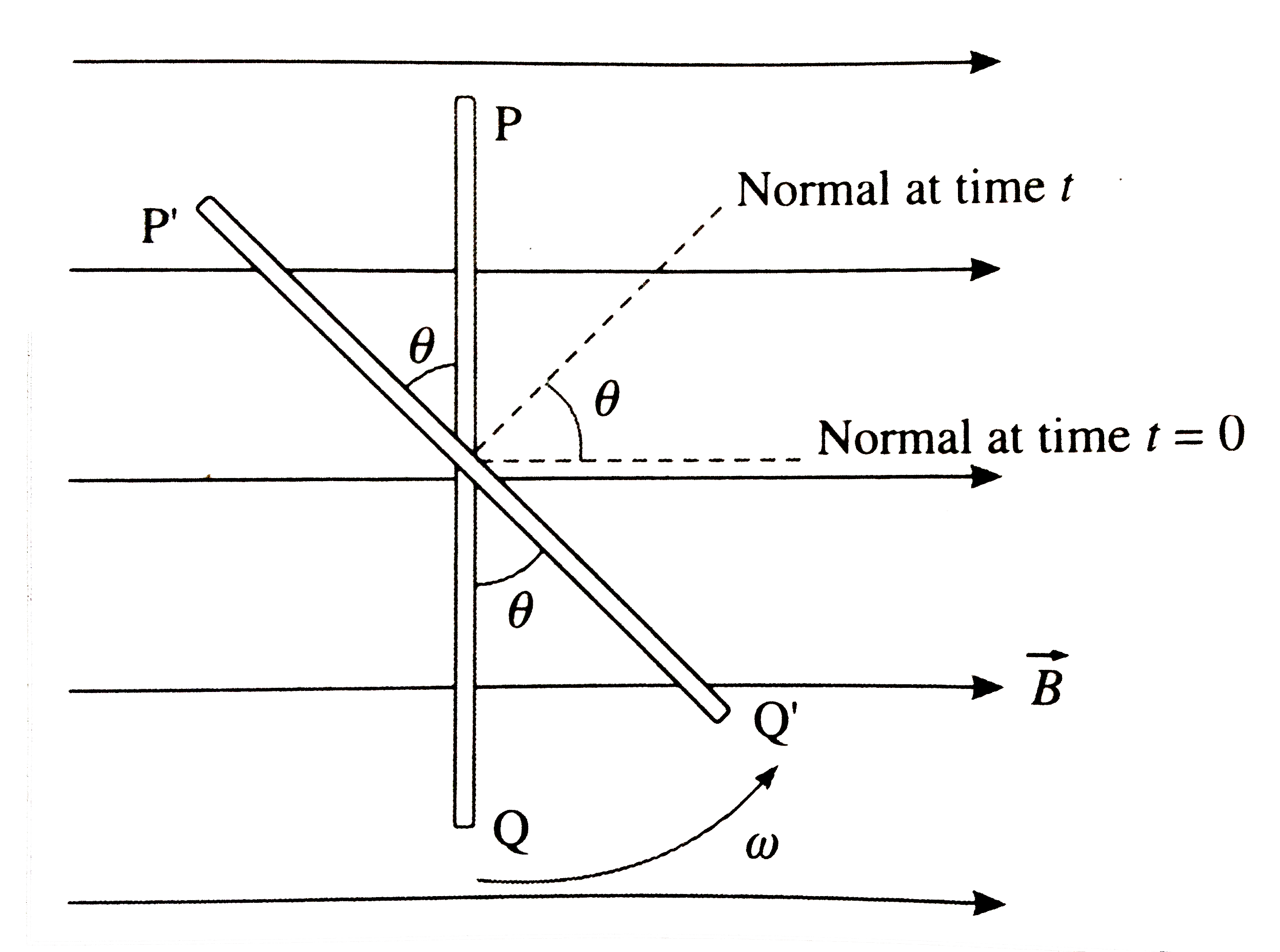
Consider a conducting coil of N turns and area A rotating with a uniform angular velocity `vec omega` about an axis in the plane of the coil, and perpendicular to a uniform magnetic field of induction `vecB`, as shown in Fig 1. The frequency of rotation of the coil is `f=omega//2pi.`

Suppose that a time t = 0, the coil is in position PQ, with its plane perpendicular to the magnetic field. In time t, the coil rotates through an angle `theta` to position P'Q'.
In this position, the normal to the plane of the coil makes an angle `theta(=omega t)` with the mgnetic field and the magnetic flux through the coil is ltbr. `Phi=N vecB *vecA=NBA cos theta =NBAcos omega t`
As the coil rotates, the changing magnetic flux induces an emf in the coil given by
`E= -(d Phi)/(dt)`
`= - (dt)/(dt)(NBA cos omega t) = - NBA(d)/(dt)(cos omega t)=NBA omega sin omega t `
`therefore E=E_(0) sin omega t`,
where `E_(0)=NBA omega.`

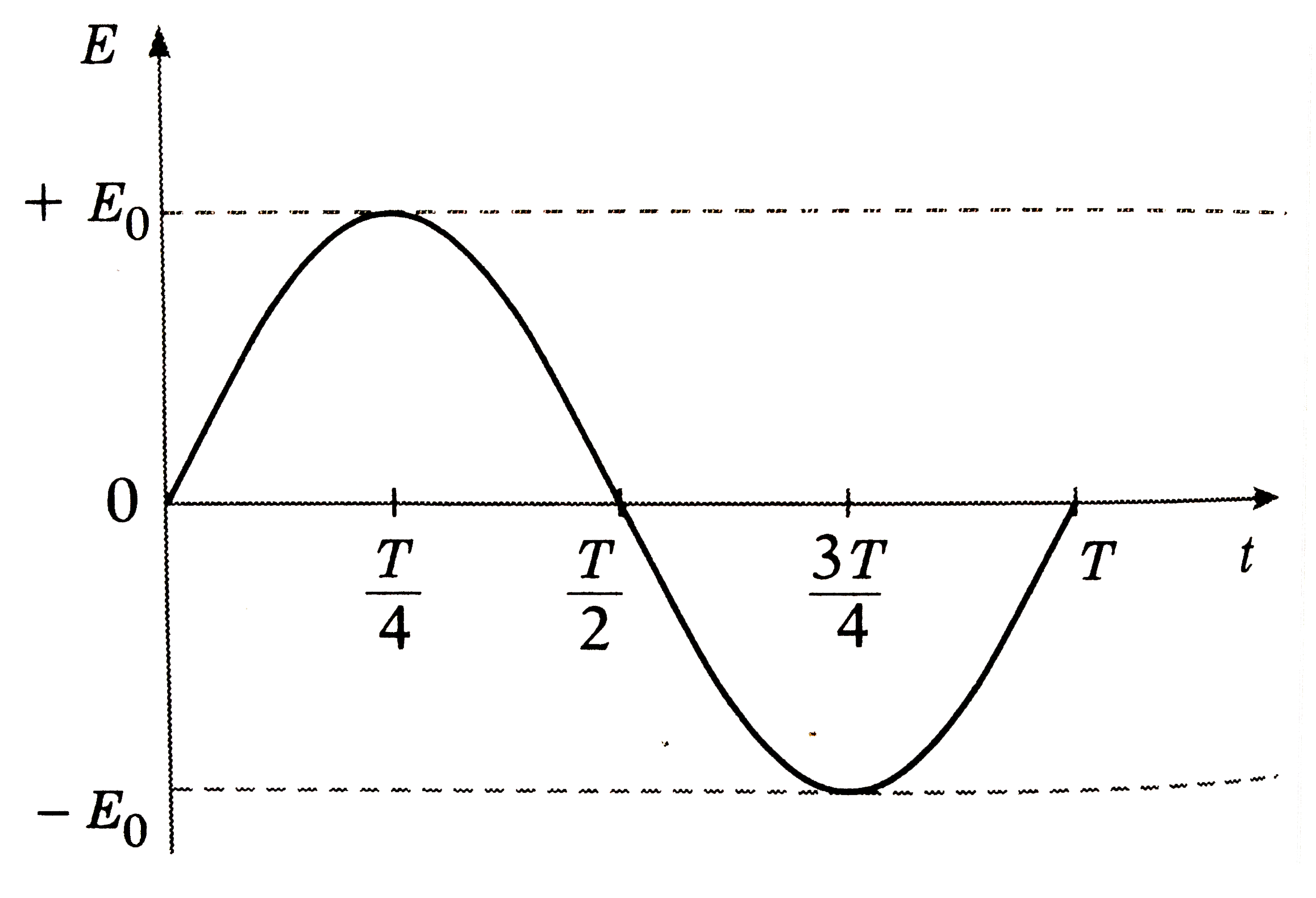
The induced emf varies as `sin omega t` and is, therefore, called sinusoidally alternating emf. In one rotation of the coil, `sin omega t` varies between +1 and -1 and hence the induced emf varies between `+E_(0) and -E_(0)`. The maximum value `E_(0)` of an alternating emf is called the peak value or emplitude of the emf.
The sinusoidal variation of the emf with time over cycle is shown in Fig. 2. `T(=(1)/(f))` is the period of the emf, which is the same as the period of rotation of the coil. The emf changes direction at the end of every half rotation of the coil, i.e. after time `(T)/(2).`
[Note : For the graph of E against `theta`, change the labelling `t to theta, (T)/(4) to pi//2, (T)/(2) to pi, (3T)/(4) to 3pi//2 and T to 2pi` on the x-axis.]
Promotional Banner

Topper's Solved these Questions

  • DERIVATIONS-II

    NAVNEET PUBLICATION - MAHARASHTRA BOARD|Exercise Atoms, Molecules and Nuclei|7 Videos
  • DERIVATIONS-II

    NAVNEET PUBLICATION - MAHARASHTRA BOARD|Exercise Semiconductors|1 Videos
  • DERIVATIONS-II

    NAVNEET PUBLICATION - MAHARASHTRA BOARD|Exercise Magnetism|1 Videos
  • DERIVATIONS-I

    NAVNEET PUBLICATION - MAHARASHTRA BOARD|Exercise Assignments|9 Videos
  • DISTINGUISH BETWEEN

    NAVNEET PUBLICATION - MAHARASHTRA BOARD|Exercise Assingment|3 Videos

Similar Questions

Explore conceptually related problems

An emf induced in a coil rotating in a uniform magnetic field is given by

A particle is moving in a uniform magnetic field, then

What rule do we use to find the direction of induced current in a conductor moving in a magnetic field?

The phase difference between the flux linkage and the induced e.m.f. in a rotating coil in a uniform magnetic field

Consider the following statements: (a)An emf can be induced by moving a conductor in a magnetic field. (b)An emf can be induced by changing the magnetic field.

Read the following two statements. (A) Emf can be induced by changing magnetic field. (B) Emf must be induced when a conductor is moved inside magnetic field.