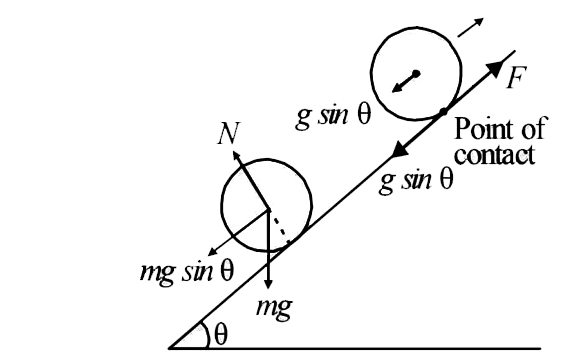
(b) Imagine the cylinder to
be moving on a frictionless surface. In
both the cases the
acceleration of the
centre of mass of the cylinder is g sin `theta`. This
is also the acceleration
of the point of contact
of the cylinder with the inclined surface. Also no torque
(about the centre of cylinder) is acting on the cylinder
since we assumed the surface to be frictionless and
the forces acting on the cylinder is mg and N which
pass through the centre of cylinder. Therefore the net
movement of the point of contact in both the cases is in the downward directoin as shown. Therefore the frictional force will act in the upward direction in both
the cases.