Home
Class 12
PHYSICS
A wire having a uniform linear charge de...

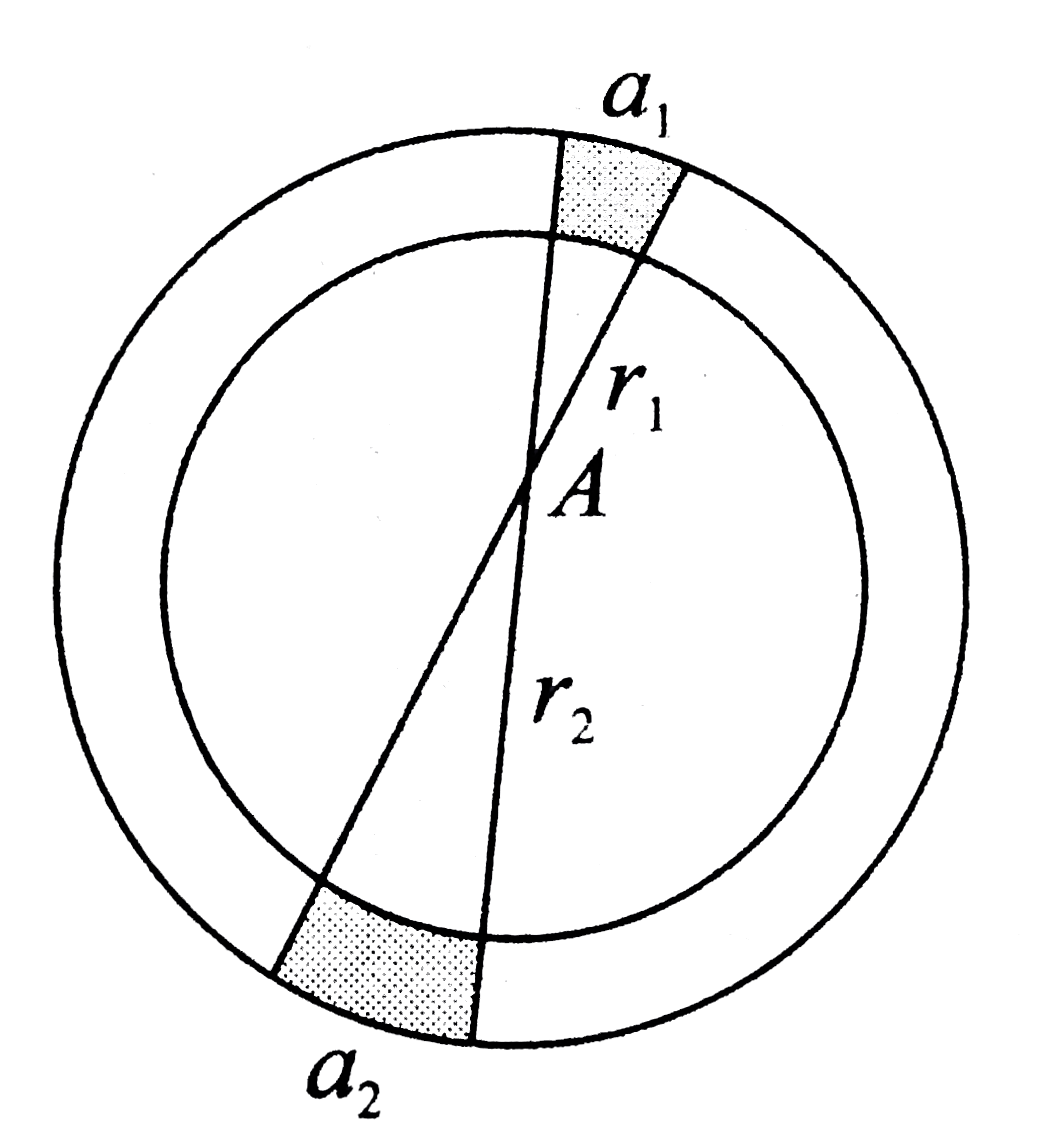
A wire having a uniform linear charge density `lambda` is bent in the form of a ring of radius `R`. Point `A` as shown in (Fig. 3.145) is in the plane of the ring but not at the center. Two elements of the ring of lengths `a_1` and `a_2` subtend very small same angle at point `A`. they are at distances `r_1` and `r_2` from point `A`, respectively `(r_2 gt r_1)`.
.

A

The ratio of charges of element `a_1` to that of element `a_2` is `r_1//r_s`.

B

The element `a_1` produced greater magnitude of electric field at `A` than elements `a_2`.

C

The same elements `a_1 and a_2` produce same potential at `A`

D

The direction of the net electric field produced by the elements only at `A` is toward element `a_2`.

Text Solution

Verified by Experts

The correct Answer is:

a.,b.,c.,d.

Charge on `a_1` is `(r_1 theta) lambda`
Charge on `a_2` is `(r_2 theta) lambda`
ratio of charged is `r_1//r_2`
`E_1 ("field produced by" a_1) = (K [(r_1 theta) lambda])/(r_1^2) = (K theta lambda)/r_(1)`
`E_2 ( "field produced by" a_2) = (K theta lambda)/r_(1)`
As`r_2 gt r_1, E_1 gt E_2` i.e., net field at `A` is toward `a_2`
`V_1 (K(r_1 theta))/r_(1) = K theta lambda`
`V_2 = (K(r_2 theta))/r_(1) = K theta lambda`
`V_1 = V_2`.
Promotional Banner

Topper's Solved these Questions

  • ELECTRIC POTENTIAL

    CENGAGE PHYSICS|Exercise Comprehension|31 Videos
  • ELECTRIC POTENTIAL

    CENGAGE PHYSICS|Exercise Integer|5 Videos
  • ELECTRIC POTENTIAL

    CENGAGE PHYSICS|Exercise Single Correct|56 Videos
  • ELECTRIC FLUX AND GAUSS LAW

    CENGAGE PHYSICS|Exercise MCQ s|38 Videos
  • ELECTRICAL MEASURING INSTRUMENTS

    CENGAGE PHYSICS|Exercise M.C.Q|2 Videos

Similar Questions

Explore conceptually related problems

A half ring of radius r has a linear charge density lambda .The potential at the centre of the half ring is

A charge Q is distributed uniformly on a ring of radius R as shown in the following diagrams. Find the electric potential at the center O of the ring. (a)

A rod with linear charge density lambda is bent in the shap of circular ring. The electric potential at the centre of the circular ring is

A quarter ring of radius R is having uniform charge density lambda . Find the electric field and potential at the centre of the ring.

Potential on the axis of ring of radius 3R and at distance 4R from centre of ring is (charge on the ring is Q )

A point particle of mass m is released from a distance sqrt(3)R along the axis of a fixed ring of mass M and radius R as shown in figure. Find the speed of particle as it passes through the centre of the ring.

The linear charge density on a dielectric ring of radius R vanes with theta as lambda = lambda_0 cos theta//2 , where lambda_0 is constant. Find the potential at the center O of the ring [in volt].

A charge q is placed at the point P as shown in figure on the axis of the ring of elemental thickness 't' and radius R then flux through the ring is :-

A circular ring of radius R and uniform linear charge density +lamdaC//m are kept in x - y plane with its centre at the origin. The electric field at a point (0,0,R/sqrt(2)) is

Knowledge Check

  • A half ring of radius r has a linear charge density lambda .The potential at the centre of the half ring is

    A
    `(lambda)/(4epsioln_(0))`
    B
    `(lambda)/(4pi^(2)epsilon_(0)r)`
    C
    `(lambda)/(4piepsilon_(0)r)`
    D
    `(lambda)/(4piepsilon_(0)r^(2))`
  • A rod with linear charge density lambda is bent in the shap of circular ring. The electric potential at the centre of the circular ring is

    A
    `(lambda)/(epsilon_(0))`
    B
    `(lambda)/(2epsilon_(0))`
    C
    `(lambda)/(epsilon_(0))`
    D
    `(2lambda)/(epsilon_(0))`
  • An infinitely long wire with linear charge density +lambda is bent and the two parts are inclined at angle 30^@ as shown in fig, the electric field at point P is :

    A
    `(lambda)/(4 pi in_0 d) [ (1 + sqrt(3))hati + hatj]`
    B
    `(lambda)/(4 pi in_0 d) [ (1 - sqrt(3))hati + 2hatj]`
    C
    `(lambda)/(4 pi in_0 d) [ (1 + sqrt(3))hati - 2hatj]`
    D
    `(lambda)/(4 pi in_0 d) [ (1 + sqrt(3))hati + 2hatj]`
