Home
Class 12
PHYSICS
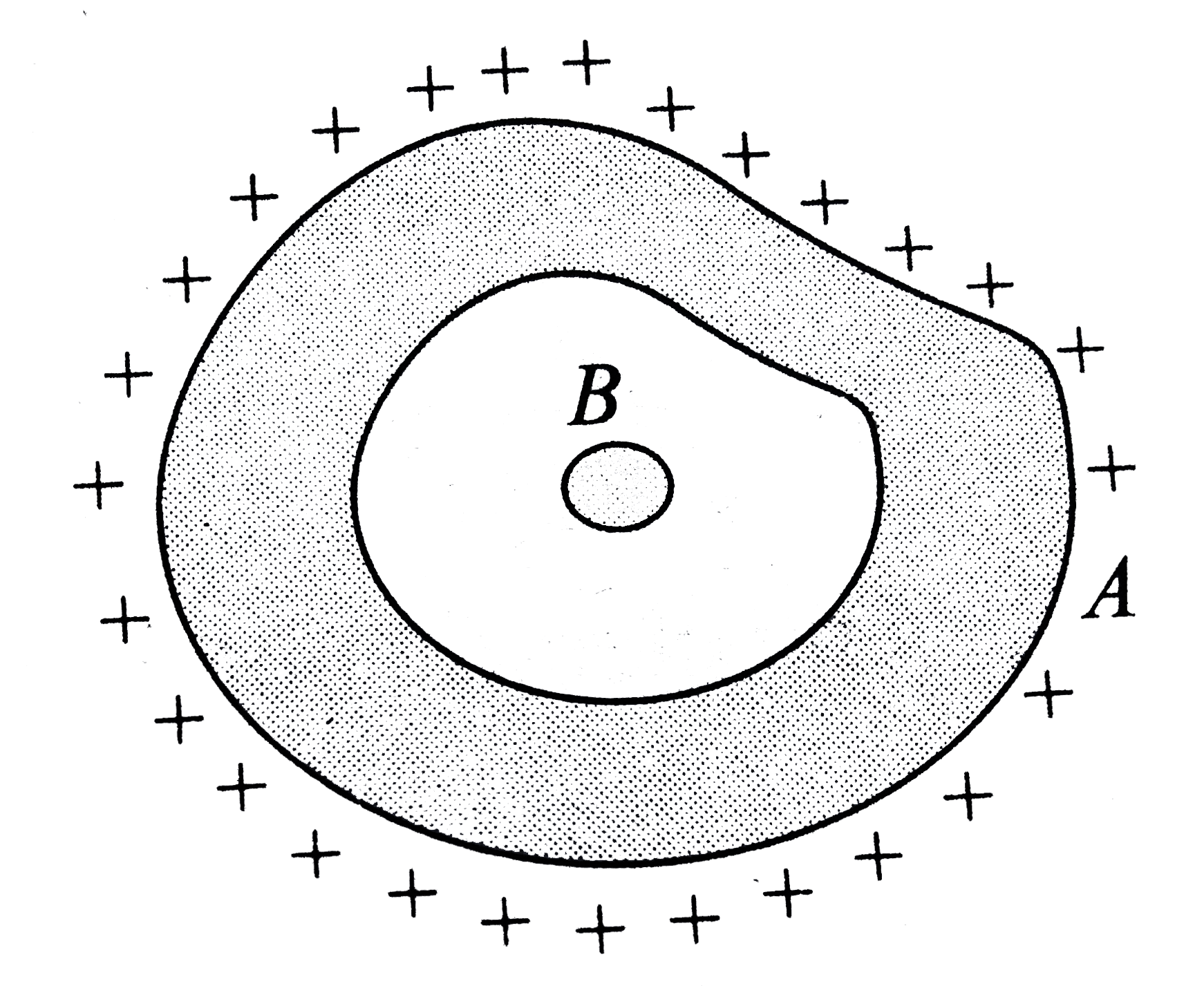
An uncharged conducting ball B lies insi...

An uncharged conducting ball `B` lies inside a charged conductor `A` as shown in (Fig. 3.150). `B` is isolated from `A`.
.

A

When `B` touches the inner surface of `A`, then potential of `B` will change.

B

No net charge is inside the cavity.

C

There is an induced charge on `B`.

D

Potentials of `A and B` are same.

Text Solution

Verified by Experts

The correct Answer is:

b.,d.

potential everywhere inside a charged conductor is same. Even if we touch A and B, nothing will happen because potential is same prior to touching.
Promotional Banner

Topper's Solved these Questions

  • ELECTRIC POTENTIAL

    CENGAGE PHYSICS|Exercise Comprehension|31 Videos
  • ELECTRIC POTENTIAL

    CENGAGE PHYSICS|Exercise Integer|5 Videos
  • ELECTRIC POTENTIAL

    CENGAGE PHYSICS|Exercise Single Correct|56 Videos
  • ELECTRIC FLUX AND GAUSS LAW

    CENGAGE PHYSICS|Exercise MCQ s|38 Videos
  • ELECTRICAL MEASURING INSTRUMENTS

    CENGAGE PHYSICS|Exercise M.C.Q|2 Videos

Similar Questions

Explore conceptually related problems

There are two coils A and B as shown in Fig.

Graphs between electric current and potential difference across two conductors A and B are as shown in (Fig. 3.49). Which of the two conductors has more resistance ? .

We have an isolated conducting spherical shell of radius 10 cm . Some positive charge is given to it so that the resulting electric field has a maximum intensity of 1.8 xx 10^6 NC^-1 . The same amount of negative charge is given to another isolated conducting spherical shell of radius 20 cm . Now, the first shell is placed inside the second so that both are concentric as shown in (Fig. 3.154). . If both the spheres are connected by a conducting wire, then.

An uncharged conductor A is brought near a positively charged conductor B. The size of the conductor A is much greater than the size of conductor B. Then,

A point charge Q is situated (outside) at a distance r from the centre of an uncharged conducting solid sphere of radius R. The potential due to induced charges (on the conductor) at a point B inside the conductor whose distance form the point charge is d is ______

We have an isolated conducting spherical shell of radius 10 cm . Some positive charge is given to it so that the resulting electric field has a maximum intensity of 1.8 xx 10^6 NC^-1 . The same amount of negative charge is given to another isolated conducting spherical shell of radius 20 cm . Now, the first shell is placed inside the second so that both are concentric as shown in (Fig. 3.154). . The electric potential at any point inside the first shell is.

Three concentric conducting shells of radii a, b and c are shown in (Fig. 3.100). Charge on the shell of radius b is Q. If the key K is closed, find the charges on the innermost and outermost shells and the radio of charge densities of the shells. Given that a : b : c = 1 : 2 : 3 .

We have an isolated conducting spherical shell of radius 10 cm . Some positive charge is given to it so that the resulting electric field has a maximum intensity of 1.8 xx 10^6 NC^-1 . The same amount of negative charge is given to another isolated conducting spherical shell of radius 20 cm . Now, the first shell is placed inside the second so that both are concentric as shown in (Fig. 3.154). . The electrostatic energy stored in the system is.

We have an isolated conducting spherical shell of radius 10 cm . Some positive charge is given to it so that the resulting electric field has a maximum intensity of 1.8 xx 10^6 NC^-1 . The same amount of negative charge is given to another isolated conducting spherical shell of radius 20 cm . Now, the first shell is placed inside the second so that both are concentric as shown in (Fig. 3.154). . The electric field intensity just inside the outer sphere.

Inside a charged thin conducting shell of radius R, a point charge +Q is placed as shown in figure potential of shell may be
