Home
Class 12
PHYSICS
The graph between u and v for a convex m...

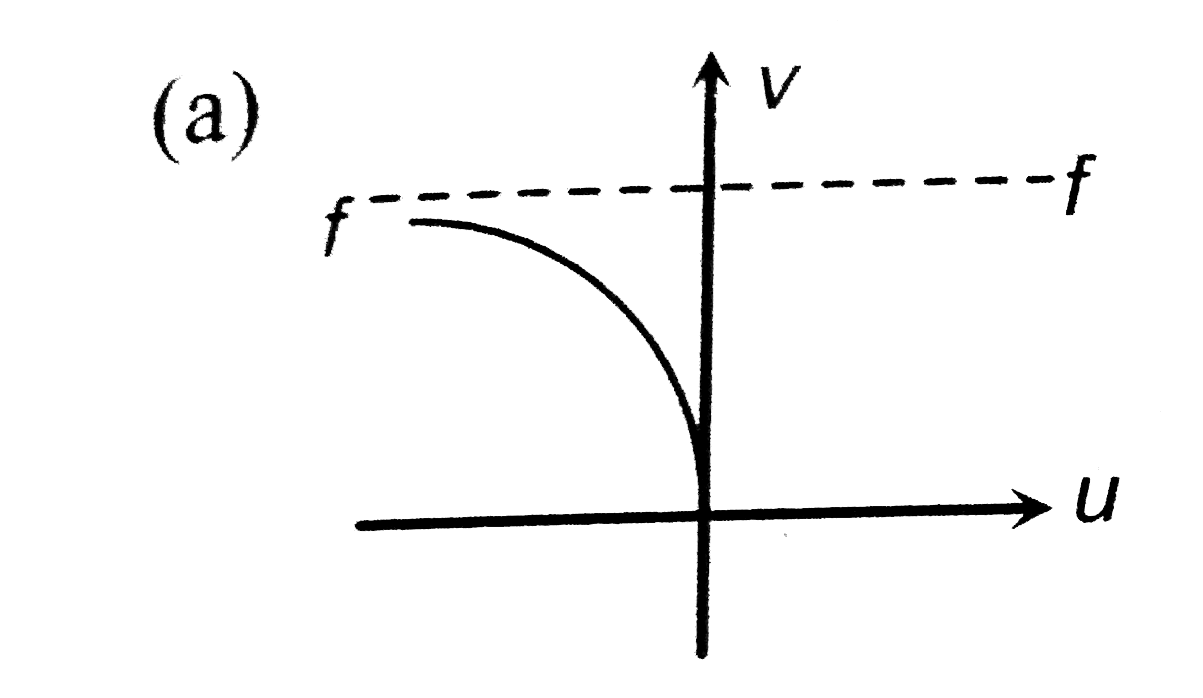
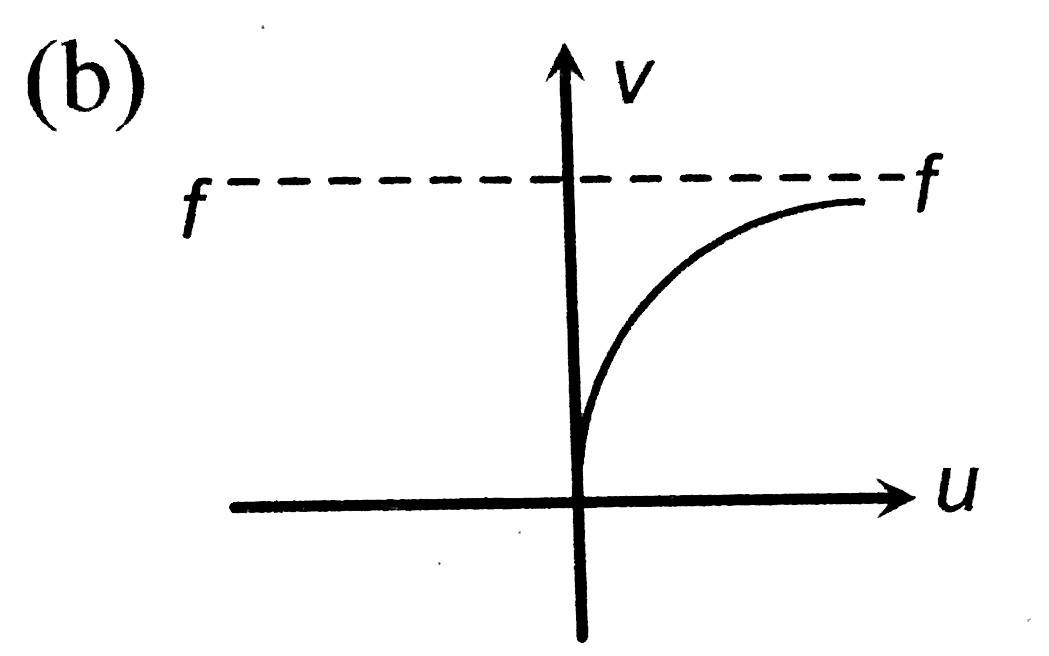
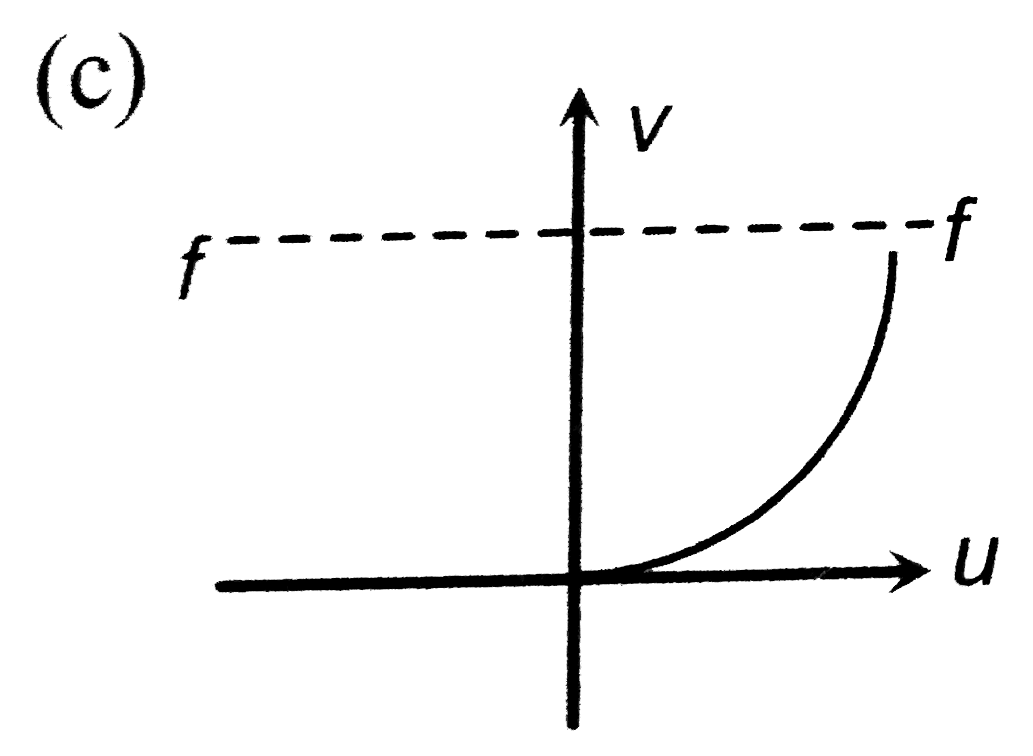
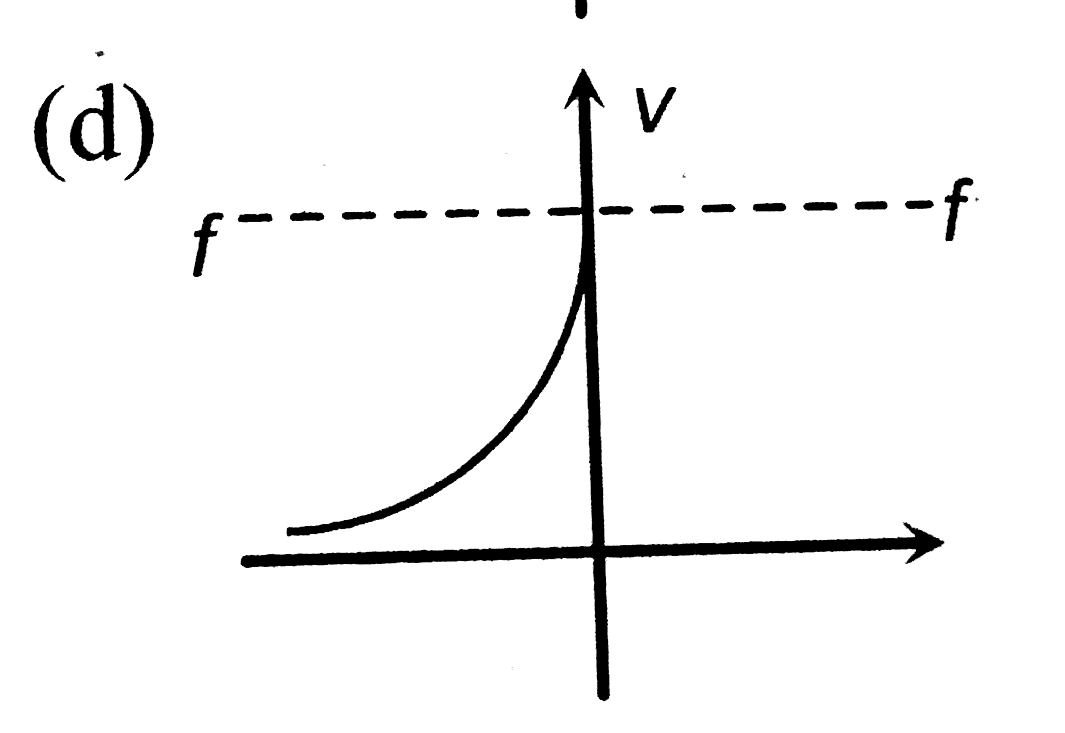
The graph between `u` and `v` for a convex mirrorr is

A

B

C

D

Text Solution

AI Generated Solution

The correct Answer is:

To determine the graph between `u` (object distance) and `v` (image distance) for a convex mirror, we can follow these steps: ### Step-by-Step Solution: 1. **Understanding the Convex Mirror**: - A convex mirror always forms a virtual image. The image is upright and diminished, regardless of the position of the object. 2. **Sign Convention**: - For a convex mirror, the object distance `u` is taken as negative (since the object is on the same side as the incoming light). - The image distance `v` is positive (since the image is formed on the opposite side of the mirror). 3. **Behavior at Infinity**: - When the object is at a very large distance (approaching negative infinity, `u = -∞`), the rays coming from the object are parallel. - These rays appear to diverge from the focus of the convex mirror, which is located behind the mirror. Thus, for `u = -∞`, the image distance `v` approaches the focal point `f` (which is a positive value). 4. **Closer Object Position**: - As the object moves closer to the mirror (i.e., `u` increases towards 0 from negative values), the image distance `v` also increases. - When the object is at the pole of the mirror (i.e., `u = 0`), the image distance `v` also approaches 0. 5. **Plotting the Graph**: - On the graph, the x-axis represents `u` (object distance) and the y-axis represents `v` (image distance). - The graph starts from the point where `u` is at `-∞` and `v` is at `f`, moving towards the point where `u` is 0 and `v` is also 0. - The relationship is such that as `u` increases (becomes less negative), `v` also increases, showing a positive correlation. 6. **Conclusion**: - The graph between `u` and `v` for a convex mirror will be a curve that starts from the point `(−∞, f)` and approaches the origin `(0, 0)`. This indicates that as the object distance increases (becomes less negative), the image distance also increases.

To determine the graph between `u` (object distance) and `v` (image distance) for a convex mirror, we can follow these steps: ### Step-by-Step Solution: 1. **Understanding the Convex Mirror**: - A convex mirror always forms a virtual image. The image is upright and diminished, regardless of the position of the object. 2. **Sign Convention**: ...
Promotional Banner

Topper's Solved these Questions

  • GEOMETRICAL OPTICS

    A2Z|Exercise Refraction At Curved Surface|64 Videos
  • GEOMETRICAL OPTICS

    A2Z|Exercise Prism Theory And Dispersion Of Light|45 Videos
  • ELECTROMAGNETIC WAVES AND COMMUNICATION SYSTEM

    A2Z|Exercise Section D - Chapter End Test|30 Videos
  • MAGNETISM AND MATTER

    A2Z|Exercise Section D - Chapter End Test|30 Videos

Similar Questions

Explore conceptually related problems

The graph between E and v is

The graph between (1)/(v) and (1)/(u) for a concave mirror looks like.

The relation between u, v and f for a mirror given by:

The shape of graph between 1//u and 1//v in case of a convex lens is Fig.

For a convex lens, if real image is formed the graph between (u+v) and u or v is as follows

Graph between p and V at constant temperature is

The relation between U, P and V for an iodeal gas is U=2+3PV. What is the atomicity of the gas.

A2Z-GEOMETRICAL OPTICS-Section D - Chapter End Test
  1. The graph between u and v for a convex mirrorr is

    Text Solution

    |

  2. Wavelength of light used in an optical instrument are lambda(1)=400 Å ...

    Text Solution

    |

  3. A plano convex lens of refractive index 1.5 and radius of curvature 30...

    Text Solution

    |

  4. A light ray is incident perpendicularly to one face of a 90^circ prism...

    Text Solution

    |

  5. A thin glass (refractive index 1.5) lens has optical power of -5D in a...

    Text Solution

    |

  6. Which of the following graphs is the magnification of a real image aga...

    Text Solution

    |

  7. A thin prism P(1) with angle 4degree and made from glass of refractive...

    Text Solution

    |

  8. A converging lens is used to form an image on a screen. When the upper...

    Text Solution

    |

  9. A diminished image of an object is to be obtained on a screen 1.0 m fr...

    Text Solution

    |

  10. An object 15cm high is placed 10cm from the optical center of a thin l...

    Text Solution

    |

  11. A lens forms a virtual, diminished image of an object placed at 2 m fr...

    Text Solution

    |

  12. When the distance between the object and the screen is more than 4 f....

    Text Solution

    |

  13. a convex lens of power +6 diopter is placed in contact with a concave ...

    Text Solution

    |

  14. A concave lens of focal length 20 cm product an image half in size of ...

    Text Solution

    |

  15. A convex lens of focal length 1.0m and a concave lens of focal length ...

    Text Solution

    |

  16. If in a planoconvex lens, the radius of curvature of the convex surfac...

    Text Solution

    |

  17. A convex lens A of focal length 20cm and a concave lens G of focal le...

    Text Solution

    |

  18. The radii of curvature of the two surfaces of a lens are 20cm and 30 c...

    Text Solution

    |

  19. A lens forms a virtual image 4 cm away from it when an object is place...

    Text Solution

    |

  20. A concave lens of focal length (1)/(3)m forms a real, inverted image t...

    Text Solution

    |

  21. An object is placed at a distance of f//2 from a convex lens. The imag...

    Text Solution

    |
