Home
Class 11
PHYSICS
Consider two configurations of a system ...

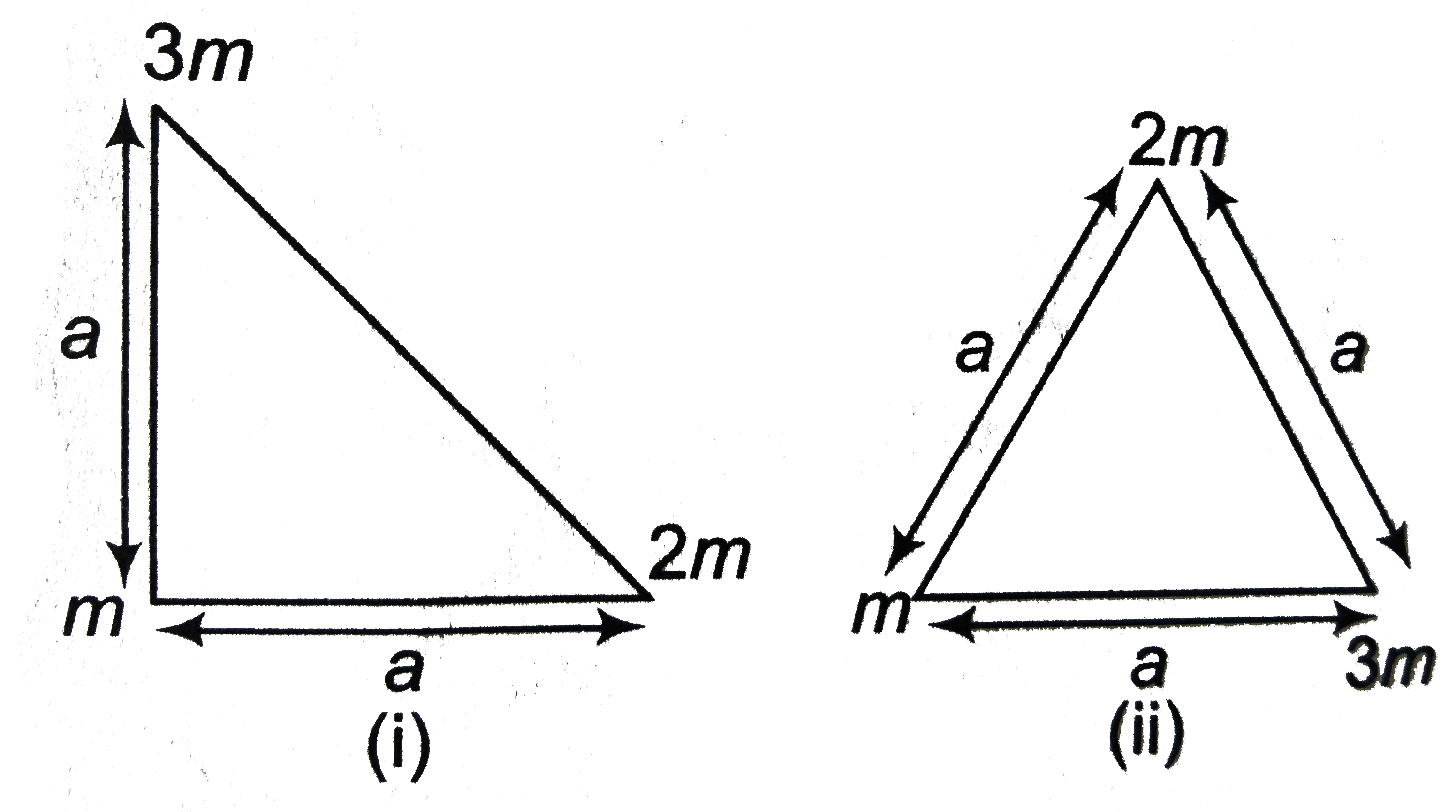
Consider two configurations of a system of three particles of masses `m`, `2m` and `3m`. The work done by gravity in changing the configuration of the system from figure (i) to figure (ii) is

A

zero

B

`-(6Gm^(2))/a(1+1/(sqrt(2)))`

C

`-(6Gm^(2))/a(1-1/(sqrt(2)))`

D

`(6Gm^(2))/(a)(2-1/(sqrt(2)))`

Text Solution

Verified by Experts

The correct Answer is:

C

`GPE=(-Gm_(1)m_(2))/(r), W=GPE_(2)-GPE_(1)`
Promotional Banner

Topper's Solved these Questions

  • GRAVITATION

    NARAYNA|Exercise NCERT BASED QUESTIONS|26 Videos
  • GRAVITATION

    NARAYNA|Exercise LEVEL -I(H.W)|56 Videos
  • GRAVITATION

    NARAYNA|Exercise LEVEL II (C.W.)|38 Videos
  • FRICTION

    NARAYNA|Exercise Passage type of questions I|6 Videos
  • KINETIC THEORY OF GASES

    NARAYNA|Exercise LEVEL-III(C.W)|52 Videos

Similar Questions

Explore conceptually related problems

Consider the configuration of a system of four charges each of value (+q). Find the work done by external agent in changing the configuration of the system from (Fig. 3.44 A) to (Fig. 3.4B). a. ,

Find the mass m in the figure for the system to be at rest

The velocity (in m/s) of centre of mass of the system as shown in the figure is :

Four particles of masses m, m, 2m and 2m are placed at the four corners of square of side a. Find the centre of mass of the system.

Two masses m and M are attached to the strings as shown in the figure. If the system is in equilibrium, then

Two masses m and M are attached to the strings as shown in the figure. If the system is in equilibruim, then

Three particles of masses 1 kg, 2 kg and 3 kg are at distance 1 m, 2 m and 3 m from the axis of rotation. The moment of intertia of the system is

Two point masses m and M are separated bya distance L . The distance of the centre of mass of the system from m is

Three particles, two with mass m and one with mass M, might be arranged in any of Rank the configuration according of the gravitational force on M, least to greatest.

NARAYNA-GRAVITATION-LEVEL III
  1. The gravitational potential of two homogeneous spherical shells A and ...

    Text Solution

    |

  2. A thin uniform disc (see figure) of mass M has outer radius 4R and in...

    Text Solution

    |

  3. The gravitational force in a region is given by, vec(F)=ayhati+axhatj....

    Text Solution

    |

  4. Two identical thin ring each of radius R are co-axially placed at a di...

    Text Solution

    |

  5. The gravitational field in a region due to a certain mass distribution...

    Text Solution

    |

  6. A particle of mass 1kg is placed at a distance of 4m from the centre a...

    Text Solution

    |

  7. Consider two configurations of a system of three particles of masses m...

    Text Solution

    |

  8. A ring having non-uniform distribution of mass M and radius R is being...

    Text Solution

    |

  9. Two concentric spherical shells A and B of radii R and 2R and mases 4M...

    Text Solution

    |

  10. The potential energy of body of mass m given by U=px+qy+rz. The magnit...

    Text Solution

    |

  11. A particle is placed in a field characterized by a value of gravitatio...

    Text Solution

    |

  12. A thin rod of length L is bent to form a semi circle. The mass of the ...

    Text Solution

    |

  13. If the gravitational field intensity at a point is given by g = (GM)/(...

    Text Solution

    |

  14. In a certain region of space, the gravitational field is given by -k//...

    Text Solution

    |

  15. Distance between the centres of two stars is 10a. The masses of these ...

    Text Solution

    |

  16. There is crater of depth R//100 on the surface of the moon (raduis R)....

    Text Solution

    |

  17. Graviational acceleration on the surface of plane fo (sqrt6)/(11)g. wh...

    Text Solution

    |

  18. Two spherical planets P and Q have the same uniform density rho, masse...

    Text Solution

    |

  19. A spherically symmetric gravitational system of particles has a mass d...

    Text Solution

    |

  20. A satellite is moving with a constant speed 'V' in a circular orbit ab...

    Text Solution

    |
