

Home
Class 11
CHEMISTRY
Given the hybridistaiton state of each c...

Given the hybridistaiton state of each carbon in the following compounds :
I. `CH_(2) = C = O` II. `CH_(3) - CH = CH_(2)`
III. `(CH_(3))_(2) CO` IV. `CH_(2) = CH = C -= N`
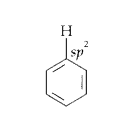
v. `C_(6) H_(6)`

Text Solution

Verified by Experts

(i) `overset(1)CH_(2)=overset(2)C=O`
C–1 is `sp^(2)` hybridised.
C–2 is sp hybridised.
(ii) `overset(1)CH_(3)-overset(2)CH=overset(3)CH_(2)`
C–1 is `sp^(3)` hybridised.
C–2 is `sp^(2)` hybridised.
C–3 is `sp^(2)` hybridised.
(iii) `underset(1)CH_(3)-overset(O)overset(||)underset(2)C-underset(3)CH_(3)`
C–1 and C–3 are `sp^(3)` hybridised.
C–2 is `sp^(2)` hybridised.
(iv) `overset(1)CH_(2)=overset(2)CH-overset(3)CequivN`
C–1 is `sp^(2)` hybridised.
C–2 is `sp^(2)` hybridised.
C–3 is `sp^(2)` hybridised.
(v) `C_(6)H_(6)`
All the 6 carbon atoms in benzene are `sp^(2)` hybridised.
Promotional Banner

Topper's Solved these Questions

  • ORGANIC CHEMISTRY- SOME BASIC PRINCIPLES AND TECHNIQUES

    NCERT|Exercise EXERCISE|40 Videos
  • HYDROGEN

    NCERT|Exercise EXERCISE|36 Videos
  • REDOX REACTIONS

    NCERT|Exercise EXERCISE|30 Videos

Similar Questions

Explore conceptually related problems

Give hybridisation state of each carbon in following compounds : (i) CH_2 = C = O (ii) CH_3 - CH = CH_2 (iii) (CH_3)_2 CO (iv) CH_2 = CH CN (v) CH_3 CH_2CH=CH_2 (vi) CH_2 = CH_2 (vii) CH_3 CH_3

Find the hybridization state of each carbon atoms in following compound? CH_(2)=C=CH-CH_(2)-C=C-CH_(2)-NH_(2)

Give hybridisation state of each carbon atom in the following molecules : (i) CH_3 - CH = CH_2 (ii) CH_2 = C = O (iii) CH_2 = CHCN (iv) HCONH_2

What are the hydridised states of carbon atoms in the following compounds ? (i) CH_(2)=C=O" " (ii) CH_(3)CH=CH_(2)" " (iii) (CH_(3))_(2)C=O (iv) CH=CH_(2) CN" " (v) C_(6)H_(6)

Indicate the sigma- and pi - bonds in the following molecules: I. C_(6) H_(6) II. C_(6) H_(12) III. CH_(2) CI_(2) IV. CH_(2) = C = CH_(2) V. CH_(3) NO_(2) VI. HCOMHCH_(3)

Indicate the type of hybridization of each carbon atom in the following molecules: (i) CH_(3)-C-=CH-CH_(3) (ii) H_(2)C=C=CH_(2) (iii) CH_(3)-CH=CH-CH_(3) (iv) CH_(3)-CH_(2)-CH_(3)

State the nature of hybridisation of each carbon atom in the following compounds ? (a) CH_(3)Cl" "(b) (CH_(3))_(2)C=O" "(c) CH_(3)-C equiv N" "(d) H-overset(O)overset("||")(C)-NH_(2)" "(e) CH_(3)-CH=CH-C equiv N

The length of the carbon-carbon single bond of the compounds (I) CH_(2)=CH-C-=CH (II) CH-=C-C-=CH (III) CH_(3)-CH=CH_(2) (IV) CH_(2)=CH-CH=CH_(2)

Knowledge Check

  • The length of the carbon-carbon single bond of the compounds (I) CH_(2)=CH-C-=CH (II) CH-=C-C-=CH (III) CH_(3)-CH=CH_(2) (IV) CH_(2)=CH-CH=CH_(2)

    A
    `IIIgtIIgtIgtIV`
    B
    `IgtIIIgtIIgtIV`
    C
    `IIIgtIVgtIgtII`
    D
    `IIgtIVgtIgtIII`
  • NCERT-ORGANIC CHEMISTRY- SOME BASIC PRINCIPLES AND TECHNIQUES-EXERCISE
    1. Given the hybridistaiton state of each carbon in the following compoun...

      Text Solution

      |

    2. Indicate the sigma- and pi - bonds in the following molecules: I. C(...

      Text Solution

      |

    3. Write the bond line formula for the following compounds: I. Isopropy...

      Text Solution

      |

    4. Give the IUPAC names of the following compounds :

      Text Solution

      |

    5. Which of the following represents the corrcet IUPAC name for the compo...

      Text Solution

      |

    6. Draw the formulae for the first five numbers of each homologous series...

      Text Solution

      |

    7. Give condensed and bond line structural formulas and identify the func...

      Text Solution

      |

    8. Identify the functional groups in the following compounds

      Text Solution

      |

    9. Which of the two: O(2)NCH(2)CH(2)O^(–) or CH(3)CH(2)O^(–) is expecte...

      Text Solution

      |

    10. Explain why alkyl groups act as electron donors when attacted to a pi-...

      Text Solution

      |

    11. Draw the resonance structures for the following compounds. Show the el...

      Text Solution

      |

    12. What are electrophiles and nucleophiles ? Explain with examples.

      Text Solution

      |

    13. Identify the reagents shown in bold in the following equations as nucl...

      Text Solution

      |

    14. Classify the following reactions in one of the reaction type studied i...

      Text Solution

      |

    15. What is the relationship between the members of the following pairs of...

      Text Solution

      |

    16. For the following bond cleavages, use curved-arrow to show the electro...

      Text Solution

      |

    17. Explain the terms Inductive and Electromeric effects. Which electron d...

      Text Solution

      |

    18. Give a brief description of the principles of the following techniques...

      Text Solution

      |

    19. Describe the method, which can be used to separate two compounds with ...

      Text Solution

      |

    20. What is the difference between distillation, distillation under reduce...

      Text Solution

      |