Home
Class 12
CHEMISTRY
When neopentyl alcohol is heated with an...

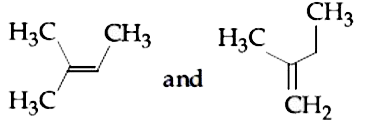
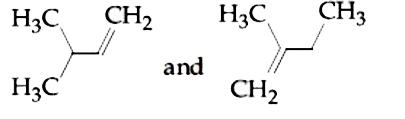
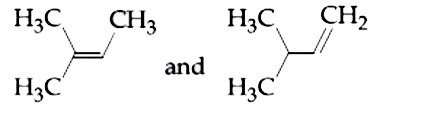
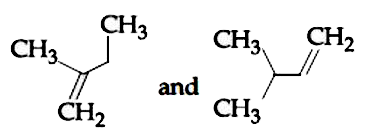
When neopentyl alcohol is heated with an acid , it slowly converted into an 85 : 15 mixture of alkenes A and B , respectively. What are these alkenes ?

A

B

C

D

Text Solution

AI Generated Solution

The correct Answer is:

To determine the alkenes A and B formed from the dehydration of neopentyl alcohol when heated with sulfuric acid, we can follow these steps: ### Step-by-Step Solution: 1. **Identify Neopentyl Alcohol Structure**: Neopentyl alcohol (2,2-dimethylpropan-1-ol) has the structure: \[ \text{(CH}_3\text{)}_4\text{C(OH)CH}_2\text{ (or ) } \text{C(CH}_3\text{)}_4\text{CH}_2\text{OH} \] 2. **Reaction with Sulfuric Acid**: When neopentyl alcohol is heated with sulfuric acid (H₂SO₄), the hydroxyl (-OH) group is protonated, making it a better leaving group. This leads to the formation of a carbocation. 3. **Formation of Carbocation**: The protonation of the -OH group leads to the formation of a good leaving group (water), resulting in a carbocation. The most stable carbocation will form: - The initial carbocation formed is a primary carbocation, but it can rearrange to form a more stable tertiary carbocation. 4. **Carbocation Rearrangement**: The rearrangement occurs as follows: - The methyl group from one of the neighboring carbon atoms can shift to stabilize the carbocation, leading to a tertiary carbocation. 5. **Elimination to Form Alkenes**: From the tertiary carbocation, elimination can occur to form alkenes: - If a hydrogen is removed from the adjacent carbon, two different alkenes can be formed: - Alkene A (major product) - Alkene B (minor product) 6. **Identify the Alkenes**: - Alkene A (major product): 2,2-dimethylpropene (more substituted) - Alkene B (minor product): 2-methylpropene (less substituted) 7. **Determine the Ratio**: The problem states that the products are in an 85:15 ratio, which aligns with the expected stability of the alkenes formed: - Alkene A (85%): 2,2-dimethylpropene - Alkene B (15%): 2-methylpropene ### Final Answer: - Alkene A: 2,2-dimethylpropene - Alkene B: 2-methylpropene
Promotional Banner

Topper's Solved these Questions

  • JEE MAINS 2020

    JEE MAINS PREVIOUS YEAR|Exercise CHEMSITRY|25 Videos
  • JEE MAINS

    JEE MAINS PREVIOUS YEAR|Exercise QUESTION|1 Videos
  • JEE MAINS 2021

    JEE MAINS PREVIOUS YEAR|Exercise Chemistry (Section B )|10 Videos

Similar Questions

Explore conceptually related problems

When 3,3-Dimethyl-2-butanol is heated with acid H_(3)PO_(4) , it is converted into an 80 : 20 mixture of alkene A and B respectively. The structure of A and B are:

When neopentyl alcohol is treted with H_(2)SO_(4) , a mixture of two alkenes (85:15) is formed. Which statement (s) is /are correct about these alkenes ?

Neopentyl bromide is heated with an alcoholic KOH solution. The major alkene formed is

Knowledge Check

  • When 3,3-Dimethyl-2-butanol is heated with acid H_(3)PO_(4) , it is converted into an 80 : 20 mixture of alkene A and B respectively. The structure of A and B are:

    A
    B
    C
    D
  • When neo-pentyl alcohol is treated with H_(2)SO_(4) , a mixture of two alkenes (85 : 15) is formed. Which statements is correct about these alkenes?

    A
    Both give same major product with HBr.
    B
    Both give same products (major) with `HBr//R_(2)O_(2)//"light"`.
    C
    The alkene which is formed in 85% concentration has higher heat of hydrogenation than the other one obtained in 15% concentration.
    D
    Both give same product on ozonolysis.
  • When neopentyl alcohol is treted with H_(2)SO_(4) , a mixture of two alkenes (85:15) is formed. Which statement (s) is /are correct about these alkenes ?

    A
    Both give same major products on treatment with HBr
    B
    Both give different major products on treatment with HBr in presence of peroxide
    C
    The alkene which is formed in `85%` concentration has higher heat of hydrogenation than other alkene
    D
    Both alkene, on ozonolysis give same product
  • JEE MAINS PREVIOUS YEAR-JEE MAINS 2020-CHEMSITRY
    1. When neopentyl alcohol is heated with an acid , it slowly converted in...

      Text Solution

      |

    2. The correct statement with respect to dinitrogen is :

      Text Solution

      |

    3. Consider the following reactions :

      Text Solution

      |

    4. The major product obtained from the following reaction is :

      Text Solution

      |

    5. A solution of two components containing n1 moles of 1^(st) component a...

      Text Solution

      |

    6. The INCORRECT statement is :

      Text Solution

      |

    7. Consider the Assertion and Reason given below. Assertion (A) : Ethe...

      Text Solution

      |

    8. Arrange the following solutions in the decreasing order of pOH : (A...

      Text Solution

      |

    9. Among the sulphates of alkaline earth metals the solubilities of BeSO4...

      Text Solution

      |

    10. The major products of the following reaction are : CH3 -overset(CH...

      Text Solution

      |

    11. The major product of the following reaction is :

      Text Solution

      |

    12. The presence of soluble fluoride ion upto 1 ppm concentration in drink...

      Text Solution

      |

    13. The increasing order of pKb values of the following compounds is :

      Text Solution

      |

    14. Which of the following compounds shows geometrical isomerism ?

      Text Solution

      |

    15. The set that contains atomic numbers of only transition elements , is ...

      Text Solution

      |

    16. The variation of equilibrium constant with temperature is given below ...

      Text Solution

      |

    17. Kraft temperature is the temperature :

      Text Solution

      |

    18. For the reaction Fe2N(s)+(3)/(2)H2(g)=2Fe(s)+NH3(g)

      Text Solution

      |

    19. The species that has a spin -only magnetic moment of 5.9 BM , is : (...

      Text Solution

      |

    20. The lanthanoid that does NOT show +4 oxidation stat is :

      Text Solution

      |

    21. Consider the following reaction A to P1, B to P2 , C to P3 , D to P4...

      Text Solution

      |
