Home
Class 12
PHYSICS
The refractive index of a medium 'x' wit...

The refractive index of a medium 'x' with respect to a medium 'y' is `2/3` and the refractive index of medium 'y' with respect to medium 'z' is `4/3`. Find the refractive index of medium 'z' with respect to medium 'x' . If the speed of light in medium 'x' is `3 xx 10^8 ms^(-1)`, Calculate the speed of light in medium 'y'.

Text Solution

Verified by Experts
Sign Convention.
(1) All the distances are to be measured from the pole of the surface.
(2) The distances measured in the same direction as the incident light are taken as positive.
(3) The distances measured in the direction opposite to the direction of the incident light are taken as negative.

Assumptions. (1) Object is taken as a point object lying on the principal axis.
(2) The aperture of refracting surface is small.
(3) The incident ray from the object strikes the surface at a point very close to point so that angles of incidence and refraction are very small.
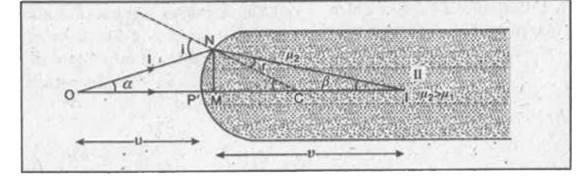
Consider a point object O on the principal axis. A ray ON is incident at N and refracts along NI. Another ray OM goes undeviated to meet the previous ray at I. Thus I is the real image of the object O.
Let `mu_(1) = "Refractive index of medium I"`
 `mu_(2) = "Refractive index of medium II"`,
such that
`mu_(2) gt mu_(1)`
For small apertures (namely `MN lt OM`), the problem can easily be solved.
In `Delta O N C`,
`i = /_NOM + /_NCM`
 In `Delta O N M`,
From Snell.s law, for small i and r, we have
`(sin i)/(sin r)=(i)/(r)=(mu_(2))/(mu_(1))`
or `mu_(1) i=mu_(2) r` ...(1)
In `Delta N O C`,
`i= alpha + beta`
In `Delta N I C`,
`gamma=r + beta` or `r= gamma - beta`
Putting the values of i and r in equation (1), we get
`mu_(1)(alpha + gamma)=mu_(2)(gamma - beta)`
or `mu_(1)alpha+mu_(1)gamma=mu_(2)gamma-mu_(2)beta`
or `mu_(1)alpha+mu_(2)beta=(mu_(2)-mu_(1))gamma` ...(2)
Since `alpha, beta` and `gamma` are small, so they can be replaced by their tangents. So equation (2) becomes
`mu_(1) tan alpha +mu_(2) tan beta=(mu_(2)-mu_(1))tan gamma`
or `mu_(1)(NM)/(MO)+mu_(2)(NM)/(MI)=(mu_(2)-mu_(1))(NM)/(MC)`
or `(mu_(1))/(MO)+(mu_(2))/(MI)=(mu_(2)-mu_(1))/(MC)`
Since M is very close to the pole P, So `MO ~= PO, MI ~= PI` and `MC ~= PC`
`:. (mu_(1))/(PO)+(mu_(2))/(PI)=(mu_(2)-mu_(1))/(PC)`
Using sign conventions, PO= - u, PI = v and PC = R, we get
`-(mu_(1))/(u)+(mu_(2))/(v)=(mu_(2)-mu_(1))/(R)`
or `(mu_(2))/(v)-(mu_(1))/(u)=(mu_(2)-mu_(1))/(R)`
Promotional Banner

Topper's Solved these Questions

  • OPTICS

    MBD -HARYANA BOARD|Exercise OBJECTIVE TYPE QUESTIONS|26 Videos
  • OPTICS

    MBD -HARYANA BOARD|Exercise SHORT ANSWER TYPE QUESTIONS|46 Videos
  • MODEL TEST PAPER - 2

    MBD -HARYANA BOARD|Exercise SET - D ( LONG ANSWER TYPE QUESTIONS)|4 Videos
  • PRINCIPLES OF COMMUNICATION

    MBD -HARYANA BOARD|Exercise Objective Type Questions|19 Videos

Similar Questions

Explore conceptually related problems

The refractive index of a medium with respect to vacuum

If the refractive index of medium 2 with respect to medium 1 is 5 //3 , what is the refractive index of medium 1 with respect to medium 2 ?

The refractive index of a medium (2) with respect to medium (1) is x and refractive index of medium (2) with respect to medium (3) is 'y' then what is the refractive to index of the medium (3) with respect to medium (1).

Refractive index of a medium depends on

MBD -HARYANA BOARD-OPTICS-LONG ANSWER TYPE QUESTIONS
  1. The refractive index of a medium 'x' with respect to a medium 'y' is 2...

    Text Solution

    |

  2. Prove that (-mu1)/(u)+(mu2)/(v) = (mu2 - mu1)/( R) when refraction occ...

    Text Solution

    |

  3. An equiconvex lens of refractive index mu(2) is placed such that the r...

    Text Solution

    |

  4. An equiconvex lens of refractive index mu(2) is placed such that the r...

    Text Solution

    |

  5. Derive lens maker's formula for a thin biconvex lens.

    Text Solution

    |

  6. Draw a ray diagram to show the formation of the image of an object pla...

    Text Solution

    |

  7. State and prove prism formula.

    Text Solution

    |

  8. Discuss the phenomenon of refraction through a prism. Prove that delta...

    Text Solution

    |

  9. Draw the ray diagram for simple microscope. Write expression for its ...

    Text Solution

    |

  10. Draw a labelled diagram of compound microscope. Derive expression for...

    Text Solution

    |

  11. The magnifying power of a compound microscope is

    Text Solution

    |

  12. Draw a labelled ray diagram showing the image formation in an astrono...

    Text Solution

    |

  13. Draw ray diagram for an astronomical telescope. Define magnification ...

    Text Solution

    |

  14. Derive formula for fringe width using Young's double slit method for ...

    Text Solution

    |

  15. Define fringe width in interference and derive its expression.

    Text Solution

    |

  16. The fringe width in Young’s double slit experiment increases when

    Text Solution

    |

  17. Explain two methods of Polarisation.

    Text Solution

    |

  18. MALUS LAW

    Text Solution

    |

