Consider Young's double-slit experimental setup. Two narrow coherent light sources are obtained by wavefront splitting as monochromatic light of wavelength `lambda` emerges out of two closely spaced slits `S_(1) and S_(2)` as shown in the figure. The separation `S_(1)S_(2)=d` is very small. The interference pattern is observed on a screen placed parallel to the plane of `S_(1)S_(2)` and some considerable distance `D(Dgt gt d)` from the slits. OP is the two light waves from `S_(1) and S_(2)` reach Q along the paths `S_(1)Q and S_(2)Q,` respectively.
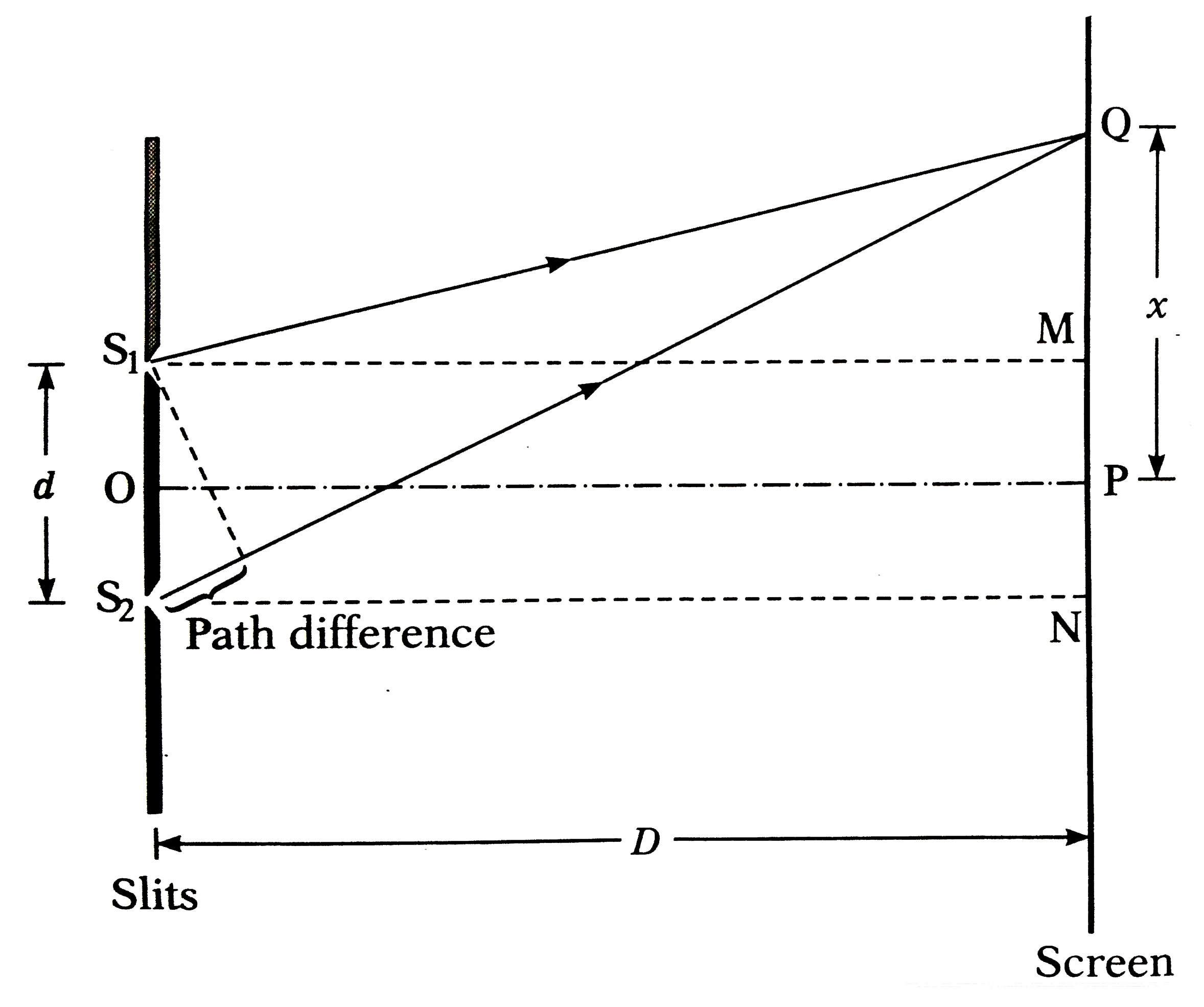
From the figure,
`(S_(2)Q)^(2)=(S_(2)N)^(2)+(QN)^(2)=(S_(2)N)^(2)+(QP+PN)^(2)`
`=D^(2)+(x+(d)/(2))^(2)=D^(2)+x^(2)+xd+(d^(2))/(4)" " `...(1)
`and (S_(1)Q)^(2)=(S_(1)M)^(2)+(QM)^(2)`
`=(S_(1)M)^(2)+(QP-MP)^(2)`
`=D^(2)+(x-(d)/(2))^(2)=D^(2)+x^(2)-xd+(d^(2))/(4)" " ` ...(2)
` therefore (S_(2)Q)^(2)-(S_(1)Q)^(2)=2xd " " ` ...(3)
`therefore (S_(2)Q +S_(1)Q)(S_(2)Q-S_(1)Q)=2xd`
` therefore S_(2)Q-S_(1)Q=(2xd)/(S_(2)Q+S_(1)Q)`
In practice, D gtgt x and D gtgt d, so that `S_(2)Q +S_(1)Q~= 2D`
` therefore` Path difference, `(S_(2)Q-S_(1)Q) ~= (2xd)/(2d)=(xd)/(D) " " ` ...(4)
Point Q will be bright ( maximum intensity), if the path difference, `(xd)/(D)=n lmbda,`
where n = 0, 1, 2, 3, ...... .
Point Q will be dark (minimum intensity ), if `(xd)/(D)=(2m-1)(lambda)/(2),`
where m = 1, 2, 3, .... .
Fpr point P, the path difference `(S_(2)P-S_(1)P)=0.` Hence, point P will be bright, corresponding to the central bright fringe or band. On both sides of point P, the interference pattern consists of alternate bright and dark bands of fringes parrellel to the slit for path difference `n lambda and (m-(1)/(2))lambda,` respectively, as n and m take values 1, 2, 3, ....... .
Let `x _(n) and x_(n+1)` be the distances of the nth and (n + 1)th successive bright fringes from the central bright fringe.
`therefore (x_(n)d)/(D)=n lambda or x_(n) =(n lambda D)/(d)`
` and (x_(n+1)d)/(D)=(n+1)lambda or x_(n+1) =((n+1)lambda D)/(d)`
`therefore` The distance between consecutive bright fringes, i.e., the fringe width,
`X=x_(n+1)-x_(n)=(lambda D)/(d)[(n+1)-n]=(lambda D)/(d)`
For successive dark fringes.
`X=x_(m+1)-x_(m)=(lambda D)/(d)[m+(1)/(2)-(m-(1)/(2))]=(lambda D)/(d),`
which is the same as in the case of bright fringes.


