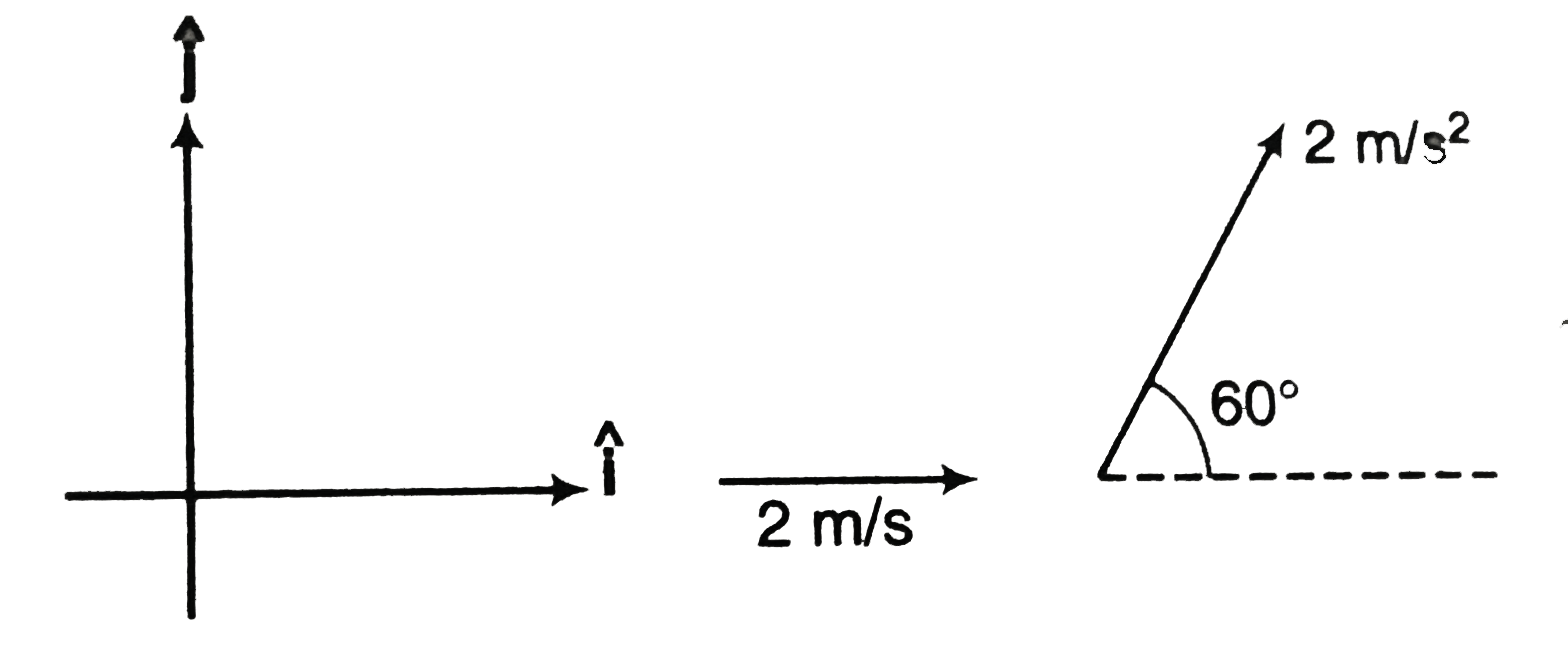
Velocity of a particle at time `t=0 is 2 m//s.` A constant acceleration of `2 m/s^2` acts on the particle for `2 s` at an angle of `60^@` with its initial velocity. Find the magnitude of velocity and displacement of particle at the end of `t=2s.`
DC PANDEY|Exercise (C) Chapter Exercises|45 Videos
KINEMATICS 1
DC PANDEY|Exercise INTEGER_TYPE|15 Videos
Similar Questions
Explore conceptually related problems
Velocity of a particle at time t=0 is 2ms^(-1) . A constant acceleration of 2ms^(-2) acts on the particle for 1 second at an angle of 60^(@) with its initial velocity. Find the magnitude of velocity at the end of 1 second .
A particle of mass 1 kg has a velocity of 2m//s . A constant force of 2N acts on the particle for 1s in a direction perpendicular to its initial velocity. Find the velocity and displacement of the particle at the end of 1 s.
. If the velocity of a particle is (10 + 2 t 2) m/s , then the average acceleration of the particle between 2s and 5s is
Velocity of a particle is given as v = (2t^(2) - 3)m//s . The acceleration of particle at t = 3s will be :
Velocity and acceleration of a particle at time t=0 are u=(2 hati+3 hatj) m//s and a=(4 hati+3 hatj) m//s^2 respectively. Find the velocity and displacement if particle at t=2s.
Velocity of a particle at any time t is v=(2 hati+2t hatj) m//s. Find acceleration and displacement of particle at t=1s. Can we apply v=u+at or not?
Velocity and acceleration of a particle at time t = 0 are u=(2hat(i)+3hat(j))m//s and a=(4hat(i)+2hat(j))m//s^(2) respectively. Find the velocity and displacement of particle at t = 2 s.
A particle starts from rest and moves with an acceleration of a={2+|t-2|}m//s^(2) The velocity of the particle at t=4 sec is
The acceleration of a particle varies with time t as a=t^(2)+t+2 where t is in seconds. The particle starts with an initial velocity v-3m/s at t=0. find the velocity of the particle at the end of 5s.
If the velocity of a particle is (10+2t^(2)m/s ,then the average acceleration of the particle between 2s and 5s is (in m/s^2)