Home
Class 11
PHYSICS
Two particles execute SHM of same amplit...

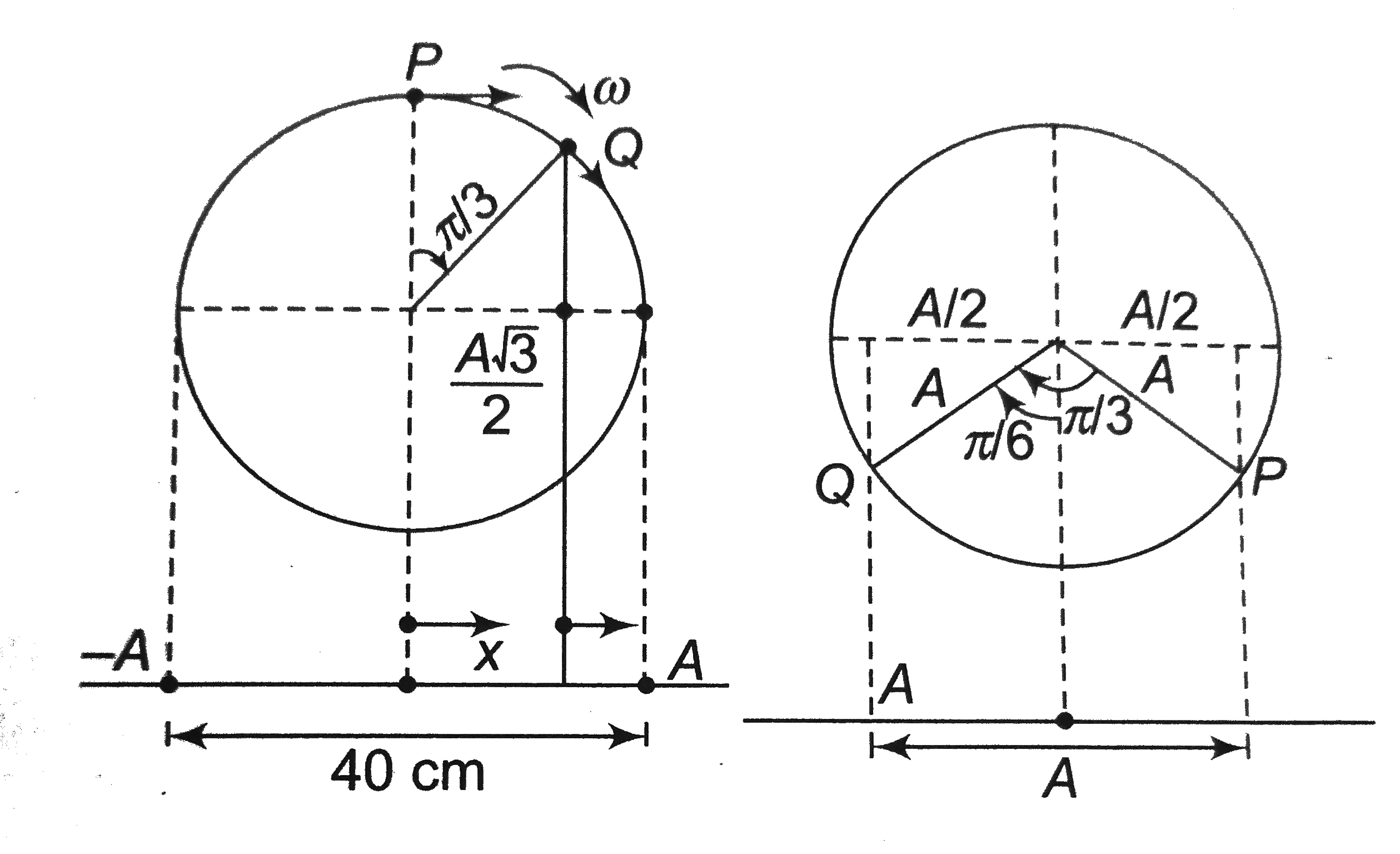
Two particles execute `SHM` of same amplitude of `20 cm` with same period along the same line about the same equilibrium position. If phase difference is `pi//3` then the maximum distance between these two will be

A

`10 cm`

B

`20 cm`

C

`10 sqrt(2)cm`

D

`20 sqrt(2)cm`

Text Solution

Verified by Experts

The correct Answer is:
B

Let as assume that the particle starts from mean position and another start at a distance `x` having `sigma phi = pi//3` . This condition is shown in figure.

Above figure above the situation of maximum distance between them.
So maximum distance `= A = 10 cm`. (as `2A = 20 cm`).
Promotional Banner

Topper's Solved these Questions

  • OSCILLATION AND SIMPLE HARMONIC MOTION

    A2Z|Exercise Velocity , Acceleration And Energy Of Simple Harmonic Motion|40 Videos
  • OSCILLATION AND SIMPLE HARMONIC MOTION

    A2Z|Exercise Spring Particle System|24 Videos
  • NEWTONS LAWS OF MOTION

    A2Z|Exercise Chapter Test|30 Videos
  • PROPERTIES OF MATTER

    A2Z|Exercise Chapter Test|29 Videos

Similar Questions

Explore conceptually related problems

Two particle execute SHM of same amplitude of 20 cm with same period along the same line about the same equilibrium position. The maximum distance between the two is 20 cm . Their phase difference in radians is

Two particle A and B execute SHM along the same line with the same amplitude a, same frequency and same equlibrium position O . If the phase difference between them is phi=2 sin^(-1)(0.9) then find maxium distance between two.

Two particles execute S.H.M. along the same line at the same frequency. They move in opposite direction at the mean position. The phase difference will be :

Two particles execute SHM about a common mean position with equal amplitudes along same line with amplitude of 12cm.If phase difference between the two particles is (2 pi)/(3) ,the maximum separation between the particles is

Two particles P and Q describe S.H.M. of same amplitude a, same frequency f along the same straight line from the same mean position. The maximum distance between the two particles is a sqrt(2) , If the initial phase difference between the particles is (pi)/(N) then find N :

Two particle P and Q describe harmonic , motions of same particle , same amplitude along the same line about the same equilibrium position O when P and Q are an appose sides of O at the same distance from O they have the same speed of 1.2m//s in the same direction when their displacement are the same they have the same speed at 1.6m//s in apposite direction .The maximum velocity in m//s of elther particle is

Two particles execute SHM of the same time period along the same straight lines. They cross each other at the mean position while going in opposite directions. Their phase difference is

Two particles execute SHMs of the same amplitude and frequency along the same straight ling. They cross one another when going in opposite direction. What is th ephase difference between them when their displacements are half of their amplitudes ?

Two particles execute SHM of same amplitude and same time period, about same mean position but with a phase difference between them. At an instant they are found to cross each other at x=+(A)/(3) . The phase difference between them is

Two particles are in SHM with the same amplitude and frequency along the same line and about the same point. If the maximum separation between them is sqrt(3) times their amplitude, the phase difference between them is (2pi)/n . Find value of n

A2Z-OSCILLATION AND SIMPLE HARMONIC MOTION-Chapter Test
  1. Two particles execute SHM of same amplitude of 20 cm with same period ...

    Text Solution

    |

  2. A chimpainzee swinging on a sitting position stands up suddenly the ti...

    Text Solution

    |

  3. A plane oscillation oscillation with time period T suddenly another ap...

    Text Solution

    |

  4. If a spring has time period T, and is cut into (n) equal parts, then t...

    Text Solution

    |

  5. A body executes simple harmonic motion. The potential energy (P.E), th...

    Text Solution

    |

  6. The length of a simple pendulum executing simple harmonic motion is in...

    Text Solution

    |

  7. Two bodies (M) and (N) of equal masses are suspended from two separate...

    Text Solution

    |

  8. A mass (M) is suspended from a spring of negligible mass. The spring i...

    Text Solution

    |

  9. The displacement of a particle varies according to the relation y = 4(...

    Text Solution

    |

  10. The total energy of a particle, executing simple harmonic motion is. ...

    Text Solution

    |

  11. A particle at the end of a spring executes S.H,M with a period t(2) I...

    Text Solution

    |

  12. The bob of a simple pendulum executm simple harmonic motion in water w...

    Text Solution

    |

  13. A particle of mass (m) is attached to a spring (of spring constant k) ...

    Text Solution

    |

  14. Two simple harmonic are represented by the equation y(1)=0.1 sin (100p...

    Text Solution

    |

  15. If a simple harmonic motion is represented by (d^(2)x)/(dt^(2))+ax=0, ...

    Text Solution

    |

  16. The function sin^(2)(omega t) represents:

    Text Solution

    |

  17. A particle executes simple harmonic motion with a frequency. (f). The ...

    Text Solution

    |

  18. The mass and diameter of a planet are twice those of earth. What will ...

    Text Solution

    |

  19. A cylinder piston of mass M sides smoothly inside a long cylinder clos...

    Text Solution

    |

  20. Two bodies P and Q of equal masses are suspended from two separate mas...

    Text Solution

    |

  21. The displacement y of a particle executing periodic motion is given by...

    Text Solution

    |

